Nearly 200,000 people could be killed by tsunami if a massive earthquake occurs in the Japan Trench off Iwate Prefecture, according to an estimate compiled by the National Disaster Management Council on Tuesday.
A quake in the Chishima Trench off Hokkaido could result in 100,000 deaths, the government council predicted.
Early evacuation could help reduce the death toll by 80%, the council said, urging the central and local authorities to take sufficient measures, such as building evacuation towers.
Economic damage from a quake in the Japan Trench was estimated at 31.3 trillion yen.
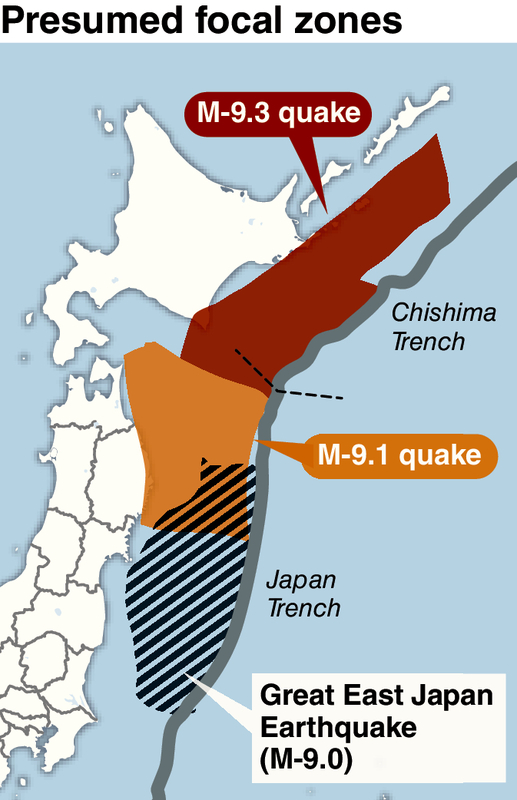
The council envisioned a massive earthquake occurring in the Japan Trench, which stretches between waters off the southeastern coast of Hokkaido and waters off the Boso Peninsula. It also considered the aftermath of a huge quake in the Chishima Trench, which stretches between waters off the southern coast of Russia's Kamchatka and waters off southeastern Hokkaido.
The total length of the two trenches is about 2,800 kilometers, with their deepest point exceeding 9 kilometers.
The council's working group presumed a magnitude-9.1 quake taking place in the northern Japan Trench off the coast of Sanriku and Hokkaido's Hidaka, and a magnitude-9.3 quake in the Chishima Trench off Tokachi and Nemuro in Hokkaido.
The magnitude-9.0 Great East Japan Earthquake occurred along the Japan Trench in 2011. The group envisaged another massive earthquake occurring to the north of that quake's epicenter and estimated the damage at three different times: late at night in winter, during the evening in winter and at noon in summer.
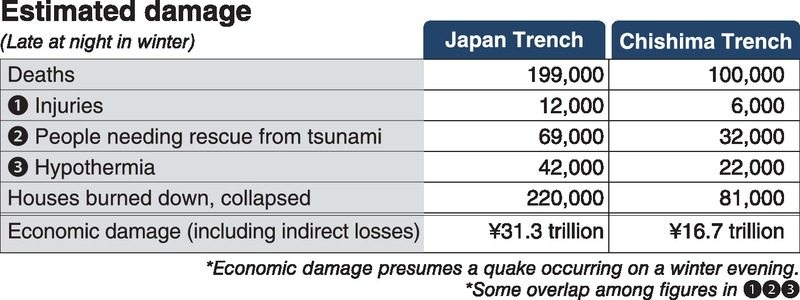
If a quake occurred in the Japan Trench late at night in winter, the death toll was predicted to be 199,000. In a worst-case scenario in which snow and icy roads delayed evacuation, or local governments failed to call for people to flee, 137,000 people would die in Hokkaido and 41,000 in Aomori Prefecture due to a tsunami up to 29.7 meters high in Miyako, Iwate Prefecture.
In this case, 69,000 people in seven prefectures would seek rescue from the second floors of buildings and elsewhere, while 42,000 who got wet as a result of the tsunami would suffer from hypothermia, which increases the risk of death. An estimated 12,000 people would be injured.
By taking adequate measures such as raising the evacuation rate of local residents, and building evacuation towers or utilizing existing buildings, however, the death toll could be reduced by 80% to 30,000, the council said.
The economic damage from a quake in the Japan Trench would be 31.3 trillion yen, with 25.3 trillion yen coming from direct damage such as the destruction of 220,000 buildings, and 6 trillion yen from indirect damage, such as the loss of production and services for a year after the quake.
Surveys of tsunami deposits have found evidence that the most recent major earthquake in these areas occurred in the 17th century. Quakes appear to have occurred every 300-400 years.
Read more from The Japan News at https://japannews.yomiuri.co.jp/