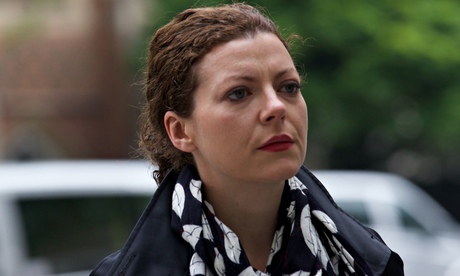
A senior political journalist at the Sun walked free from the Old Bailey on Wednesday after a jury found her not guilty of unlawful payment for leaks from a corrupt tax official, including details of the last budget of the previous Labour government.
Clodagh Hartley was cleared of arranging unlawful payments of £18,000 for stories, including information on the contents of Alistair Darling’s 2010 budget, described in court as one of the government’s most closely guarded secrets.
Hartley was arrested two-and-a-half years ago and has given birth to a second child while waiting to come to trial. The paper’s Whitehall editor is the first reporter from the Sun to be acquitted in relation to Scotland Yard’s Operation Elveden, the investigation into allegations of monies paid by newspapers for leaks from public officials.
She broke down in tears mouthing “thank you, thank you” to the foreman after the not guilty verdict was read out, before leaving the dock. Her husband, John Higginson, looked on ashen-faced from the public gallery. Outside court on Wednesday afternoon, clearly delighted, Hartley said she would now be able to get on with her life.
Hartley, 40, was prosecuted after police were handed emails, texts and payment records containing evidence that Jonathan Hall had fed Hartley tips about stories between 2008 and 2011. She had been charged with conspiracy to commit misconduct in a public office.
Hall, 53, chief of the HMRC’s law enforcement desk, had already pleaded guilty to misconduct in a public office after receiving £17,475 from the Sun, it can be reported for the first time.
A paper trail showed he was paid £750 for details of Labour’s final budget in March 2010. He will be sentenced in February and faces a custodial sentence.
But Hartley argued the leak was in the public interest. She had met Hall the night before the budget in Starbucks and was shown a sheaf of salmon-coloured documents outlining the “lines” the press office were to take on the following day’s budget.
She said readers had a right to analyse the budget before it was subjected to “spin” handed down from the Treasury.
Hall was a “whistleblower” trying to expose government waste and maladministration, she argued.
Other stories under scrutiny during the trial included revelations about a £1.3m campaign starring Kelly Brook to promote a government department and the £24m cost of moving a schools authority from London to Coventry.
There was also an article headlined “Monster Revenue Loony party” about the department throwing a huge party despite a disastrous year.
The prosecution accused Hall of being “motivated by greed” and Hartley of being motivated by the desire to beat her rivals. “It was easy money for lazy journalism,” the prosecutor said.
But detectives from Operation Elveden failed to demonstrate that the payments amounted to a criminal conspiracy rather than legitimate public interest investigations.
Hartley said she was “just doing her job” and making contacts with sources who helped her expose the double standards in Whitehall, where the culture of spin made it difficult to get to the truth.
She said “leaks” were rarely what they seemed in Whitehall and were usually authorised by someone trying to gain political advantage.
Professor of journalism and Guardian media commentator Roy Greenslade robustly defended Hartley’s behaviour, appearing as an expert witness during the trial. “There would not be political journalism without leaks,” Greenslade told the court. “They are its lifeblood.”
After the verdict he wrote: “Clodagh Hartley is innocent. I have been aching to write those four words for many months since I first met her and listened to her story.” He had told the jury that whistleblowers had many motives - but without them the reader was the loser.
“No sources. No leaks. No stories. And who is the loser? Most often, especially in the political sphere, it is the public, the readers, who fail to know what is being done to them or in their name,” he wrote.
Greenslade, a former editor of the Mirror and executive on the Sun, wrote on Wednesday that all the leaks had public interest relevance and Hartley had told jurors she had made no secret in the office about the payments, and that budget leaks had happened every year at every budget since he started his career 50 years ago.
Hartley told jurors she had no idea her conduct could be questioned by police and hit out at the decision of the Sun’s then-publisher, News International, to hand over swaths of data to the Met. “I thought that sources would be protected,” she said.
Hall’s girlfriend, Marta Bukarewicz, a Polish administration assistant whose bank account was used for more than £13,000 of the payments – was also found not guilty by the jury of a conspiracy to cause misconduct in public office.
The reporter, who had stints as the Sun’s Los Angeles correspondent as well as the paper’s consumer affairs editor, had said in court that she did not plan to return to newsroom journalism.
Alexandra Healy QC, for Hartley, said the stories associated with Hall had not involved a “scintilla” of information potentially affecting national security or invading the privacy of individuals.
The barrister maintained prosecutors could only back up their argument that Hartley had used confidential information in respect of “three articles and two stories … that were never published”.
Jurors also learned that Hall’s bosses appeared unperturbed by the leaks.
Richard Lester, HMRC’s head of security, admitted his department did not even look into the supposedly damaging leaks at the time they were published.
Zoe Johnson QC, prosecuting, asked Lester if the Treasury had investigated any of the stories, or how Hartley got hold of the information. “No, they did not,” he replied.