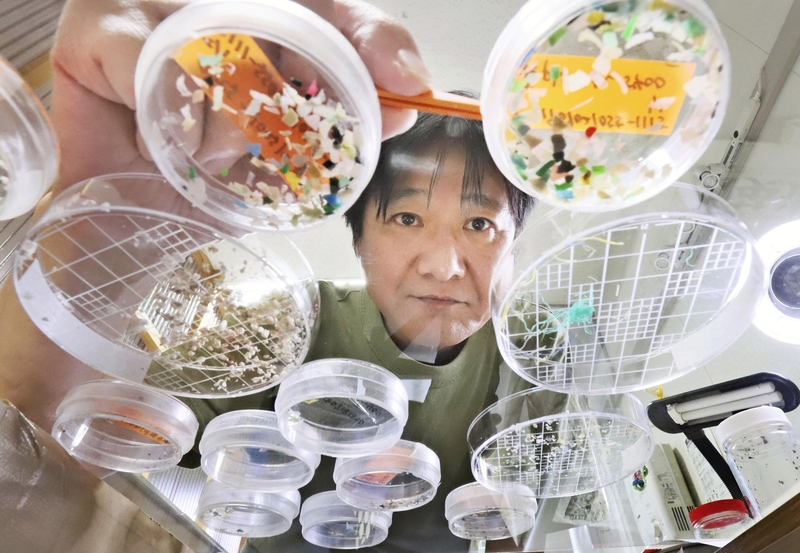
Most people are aware that plastics, which have permeated every facet of our lives, do not decompose in nature. Plastic waste from plastic bags, bottles and other items break up into fine pieces in the ocean before drifting around the globe. Plastics with a diameter of 5 mm or less, called microplastics, have also been found inside fish. What can we do to reduce plastic waste? Kyushu University Prof. Atsuhiko Isobe, an expert on the movement of marine plastic waste, gave his views in an interview with Yomiuri Shimbun Staff Writer Shinsuke Yasuda. The following are excerpts.
-- Many unknowns
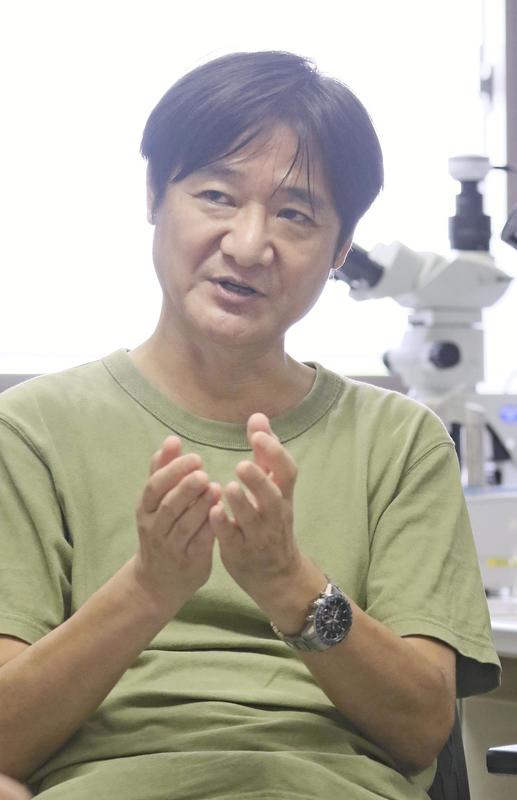
As I began to understand the process by which plastic waste breaks up into microplastics, it made me think, "Nature sure is nasty."
Imagine, for example, a plastic bag or bottle that is discarded on the road and then carried away by river to the sea. How many days do you think it will remain on the beach?
There was a researcher who wrote numbers on pieces of plastic garbage littered on a beach, and traced them for 3-1/2 years. Based on his research, the answer to the previous question is about half a year. Even if waste goes into the ocean, waves send it back onto the beach.
It is said that the tensile strength of plastic reduces by half over a half year. Over that time, plastic waste is damaged by being exposed to ultraviolet rays, washed by waves and undergoing temperature changes. That results in rapid deterioration, and the waste breaks down into smaller pieces.
It is not exactly known how much time it takes to ultimately produce a microplastic. But as they get smaller, they lose their buoyancy and sink, then drift to deeper parts of the sea. It is as if nature itself was growing toxic plastic waste. Don't you think that's nasty?
Around the world, several million tons of plastic waste are discharged into the sea every year, but nobody knows where most of it goes. This is the so-called "missing plastic." It's our job to track it down.
What effect does plastic waste have on living things?
One property of plastic is that it absorbs toxic substances such as polychlorinated biphenyl (PCB). It has been noted that medaka (killifish) continuously fed microplastics that had absorbed toxic substances have shown indications of liver damage. Even without the absorption of toxic substances, it is presumed if the level of microplastics reaches about 1 gram per 1 ton of seawater, it could have an effect on living things. As the laboratory and the open sea are different, it is impossible to say for sure, but it is likely that a sea with a huge amount of microplastics adrift will emerge in the 2060s.
There has yet to be research showing that microplastics are harmful to human body. Humans can live amid such conditions as house dust, so there are those who say we should not be too skittish about microplastics.
Research in this field is brimming with unknowns. In the first place, it is difficult to measure and analyze microplastics that are not at least several dozen micrometers (1 micrometer equals 1/1000 mm). Smaller than that and they cannot even be detected. Therefore, the worst-case scenario could be that the sea surface is already filled with ultrafine microplastics. Conversely, there is a possibility that microplastics have sunk to the sea floor and are absorbed by the Earth, and won't rise to the surface again.
-- Start of research
My original field of expertise was ocean currents. I became interested in plastic around 2007 during a trip to the Goto Islands of Nagasaki Prefecture.
At that time, the question was, "Where did the garbage washed ashore come from?" That's when I started creating a system to find out through a computer simulation.
Heading to a beach to begin my research, I found it filled with plastic waste such as bottles and fishing nets. A large amount of small plastic particles were littered under my feet.
I chartered a fishing boat and tried trawling the sea. At first glance, a beautiful blue sea spread out around me. But about 10 minutes, pieces of what looked like a shopping bag, hard plastic debris continuously and other junk found its way into the net. "This is a real mess," I thought.
I decided to check other areas. Compared with the Seto Inland Sea, there was 10 times more plastic waste along coasts of the Pacific Ocean and the Sea of Japan, which have sea currents.
Plastic floats in the sea and breaks into pieces, but never decomposes, making it the first substance of its kind in the history of the Earth. Plastic has sustained civilization for more than 100 years and is used in every facet of our lives.
But the fact remains that plastic is drifting in the world's oceans and posing a hazard to the ecological system. How does the seas dispose of the debris? Can it be done? Where does it accumulate? It may sound strange, but I am excited to be able to uncover one step at a time how it all works.
-- Difficult to completely eliminate
Plastic waste in the oceans must be reduced. But I realize it is virtually impossible to remove it all at once.
What makes it difficult is that plastic is not a luxury item of the wealthy. If you go to Thailand or other Southeast Asian countries, you will see plastic used in a variety of containers, including those for meals and drinks served at open-air stalls. This is because plastic is a material that can cheaply ensure safety in terms of hygiene. If advanced countries start saying "stop using it," I feel it will be seen as an act of bullying by forcing an unsanitary and unpleasant life on developing countries.
Japan produces 9 million tons of plastic waste annually. Even with separation from other types of waste and disposal at incineration facilities, 140,000 tons (1.6%) somehow falls through the cracks. It is difficult to get it all.
Starting in July, it became mandatory for supermarkets and others to charge for plastic bags. Eco-friendly plastics that decompose in water and plant-derived biomass plastics are drawing attention. However, there are many things still not known, including the process for decomposition and how long it takes.
In the end, I think the only option is to place limits on the amount of plastic that is disposed of. For example, the Japanese government can decide on something like "a reduction in the amount disposed of by half to 5 million tons." To achieve that goal, businesses and consumers will offer ideas. As an advanced country, I want the government to serve as a role model for the world by demonstrating that it is "possible to lead a prosperous life like this without relying on plastic."
Another way to look at it is that for the industrial world, this could be an opportunity. If a company can come up with a substitute material for plastic, it will have huge market potential. Such an alternative material could be sturdy and soft like plastic and, in addition to being inexpensive, it would dissolve when coming into contact with seawater. It's quite a dream. I would like Japan to take the lead by developing such technology.
-- Comparable to global warming
In these times of recurring natural disasters and the coronavirus pandemic, I'm sure that even in Japan, many people feel gratitude toward plastic.
If you order delivery during self-quarantine at home, the food comes in clean plastic containers. In evacuation centers at times of disaster, water and food are also provided in plastic containers. But it still needs to be reduced. I am hoping that this will serve as an opportunity to think about the value and risks of plastic as well as alternative means.
It is also essential that the younger generation be informed of the current situation of plastic waste.
In lectures I give at junior and senior high schools, I repeatedly say, "Everyone produces plastic waste." Some students have offered that "debris on the beach come from overseas" or "it's thrown away by people having barbeques on the beach." These are misunderstandings. Almost all of the garbage on the Pacific Ocean and Seto Inland Sea coasts comes from Japan. Even if a hundred people properly dispose of waste, if just one doesn't, that debris will make its way into the sea.
To me, the discussion on plastic resembles that for global warming. We scientists make forecasts based on scientific evidence, such as what lies in the future if plastic waste is not reduced by a certain amount by a certain year. Just like the "Paris Agreement" was a global response to the threat of climate change, governments need to formulate policies and make pledges to deal with plastic waste based on the research of experts around the world.
-- Atsuhiko Isobe, 56
Professor of Kyushu University
Born in Shiga Prefecture, he graduated from Ehime University in 1986. After working in the private sector, he became an assistant professor at Kyushu University's Interdisciplinary Graduate School of Engineering Sciences in 1994. In 2008, he became a professor of the Center for Marine Environmental Studies at Ehime University. He has been in his current post as professor at Kyushu University since 2014. His latest book on the current situation and problems of marine plastic waste and the facts and future of microplastics is a Dojin selection published by Kagaku Dojin.
Read more from The Japan News at https://japannews.yomiuri.co.jp/