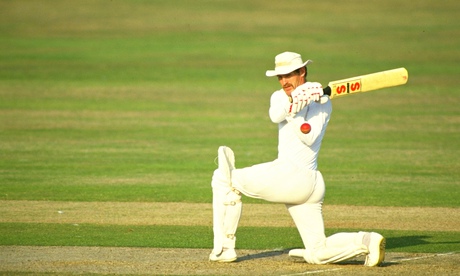
Clive Rice, who has died aged 66 of complications from a brain tumour, was one of the world’s best all-round cricketers during the 1970s and 80s. He also made his mark as a hard-headed leader, taking Nottinghamshire to two County Championship titles and becoming South Africa’s first post-apartheid international cricket captain.
Like many South African cricketers of his generation, Rice was unable to make his mark on the world stage due to the ban on his country taking part in international matches. He was eventually able to make his debut as South Africa’s captain at the age of 42 in 1991, when the team marked their return to international cricket with a three-game one-day series in India, which they lost. To his consternation Rice was then told he was too old to be a part of the team’s long-term future. His international career therefore amounted to just three one-day games, a poor return for a player who possessed the sort of exceptional ability exhibited by other fine all-rounders of the time – Ian Botham, Kapil Dev and Imran Khan.
What Rice missed out on in the Test arena, he made up for in English county cricket, where he transformed the fortunes of Nottinghamshire as their captain from 1979 to 1987. The county had not won anything since 1929, but under Rice’s combative direction they finished third in 1980 and then won the title in 1981, when he was named a Wisden Cricketer of the Year. They narrowly missed out on first place again three years later, finishing second to a strong Essex side as the title went down to the wire, and won again in 1987, Rice’s final year as a player with the county. That season Nottinghamshire also took the 60-over Nat West Trophy – their first one-day honour – with Rice contributing a crucial 63 in the Lord’s final against Northamptonshire.
His success as captain at Nottinghamshire owed much to his 10-year opening bowling partnership with the great New Zealand all-rounder Richard Hadlee, who arrived at Trent Bridge in 1979. Making full use of hard, grassy “green top” wickets helpfully prepared by the Trent Bridge groundsman, Rice and Hadlee frequently ripped through early batting orders, forming one of the most penetrative opening attacks in county cricket since Nottinghamshire’s own Harold Larwood and Bill Voce 50 years before.
Although Rice was hardly fully formed as a tactician when he first took on the captaincy, he was wise enough to listen to his senior players and had the advantage of being able to lead from the front, not only with his threatening fast-medium seam bowling but with his exuberant middle-order batting.
A fierce competitor, he also created a fresh spirit in the dressing room, remoulding the side in his own image with aggression and a will to win. Though a gentle man outside the game, on the field, with his bristling moustache to the fore, he looked anything but. His success as a captain in England was replicated during the English winters at Transvaal: under his leadership they won the Currie Cup, now the Castle Cup, five times.
Clive was born in Johannesburg to Angela (nee Bower) and Patrick Rice. His English grandfather, Philip Bower, had played a handful of first-class games for Oxford University after the first world war. Clive was educated in Johannesburg at St John’s college and then took a BCom at the University of Natal. He worked for a time for a street-lighting company, but showed great promise as a cricketer at his club side, Bedfordview, and in 1969 made his first-class debut for Transvaal. In his early days he was more naturally a bowler, but he worked hard to improve his batting, to the point where he became one of the world’s most complete cricketers.
He was called up to play for South Africa on their planned 1971-72 tour of Australia, but the trip was cancelled due to the worldwide anti-apartheid sporting boycott, and he had to content himself with domestic cricket thereafter. In 1973 he came to England as a professional for the Lancashire League side Ramsbottom, and two years later Nottinghamshire signed him as an all-rounder replacement for Garfield Sobers.
Having quickly become the county’s key player – Wisden characterised Nottinghamshire’s 1977 season as “Rice with everything” – in the winter of 1978 he was appointed captain. But he then announced that he had agreed to play some matches in 1979 for a World XI in Kerry Packer’s controversial World Series competition in Australia, which had set itself up as an all-singing, all-dancing rival to established Test cricket. The Nottinghamshire authorities took a dim view of Rice’s involvement, and he was sacked not just from the captaincy but from the playing staff too. Backed by Packer’s money, Rice challenged the decision in the high court, and before the case could proceed Nottinghamshire backtracked, eventually restoring him to the captaincy.
During the 1980s Rice also played occasionally during the winter for South Africa in unofficial “Tests” – often as captain – against rebel touring sides of top international cricketers. Although those matches, in the eyes of some critics, aligned him squarely with the apartheid regime, he was still chosen to lead the reinstated South Africa in their first one-day international against India in 1991, and told the BBC commentator Jonathan Agnew: “Now I know how Neil Armstrong felt when he walked on the moon.”
He continued to play first-class cricket in South Africa until 1994, by which time he had switched from Transvaal to Natal. Over his career he scored 26,331 first class runs at an average of 40.95 and took 930 wickets at 22.49 apiece – ample evidence of his credentials as a world class all-rounder.
Later, Rice ran South Africa’s National Cricket Academy and became a selector for the national side, as well as setting up a sports tour and bush safari company run by his wife, Susan. In 1999 he returned to Nottinghamshire as cricket manager for four years, during which time he brought Kevin Pietersen to the county. In recent years he ran a telecommunications business.
He is survived by Susan and by a son and daughter.
• Clive Edward Butler Rice, cricketer, born 23 July 1949; died 28 July 2015
• This article was amended on 30 July 2015. South Africa lost rather than won the 1991 one-day series with India.