WASHINGTON _ She responded this way when challenged about potential conflicts of interest involving her family's foundation, and again when questioned about her use of private email to conduct government business.
And now, when asked about her health Sunday, Hillary Clinton has fallen back on the same strategy she has used for decades: silence.
Her secrecy seems to create as much controversy _ if not more _ than the initial issue itself, perpetuating a belief held by most voters since the start of the presidential campaign that she is not honest.
In other words, Clinton's careful attempts to avoid political trouble only seem to get her into more political trouble.
"Antibiotics can take care of pneumonia," tweeted David Axelrod, a top strategist for President Barack Obama's campaigns. "What's the cure for an unhealthy penchant for privacy that repeatedly creates unnecessary problems?"
Clinton has a history of staying quiet as controversy mounts, stemming to her days as first lady, when she and her husband, then-President Bill Clinton, found themselves involved in multiple investigations from Whitewater to Travelgate.
The Clintons were criticized for failing to release their tax returns during his first run for president and billing records from her tenure at the Rose Law Firm in Little Rock, Ark.
They were lambasted for meeting behind closed doors on health care.
And they successfully pushed to keep documents relating to the failed Whitewater Arkansas real estate deal hidden, which may have led to the appointment of a special prosecutor and the subsequent impeachment of Bill Clinton on charges of lying about his affair with Monica Lewinsky.
Now, one of her biggest challenges is her use of a private email system while secretary of state, a system that critics think she used to keep private communications secret from Congress or the news media.
Since the system was revealed, even Clinton's strongest supporters have called on her to say more about her growing email scandal, which eventually led to an FBI investigation. "The silence is going to hurt her," Sen. Dianne Feinstein, D-Calif., said at the time.
Elie Attie, a speechwriter in Bill Clinton's White House, explained the campaign's close-to-the-vest attitude as a combination of factors: Both the former secretary of state and former president are lawyers, and they put a "premium on withholding information. You only release as much as you have to at the moment."
But Attie also said the couple "has also been targeted and demonized for 25 years. It'd have been great if they had been a little bit more forthcoming about this. But if I had had Donald Trump and (Trump adviser) Roger Stone and an actual right-wing conspiracy making up crazy conspiracies, I'd lie about a hangnail."
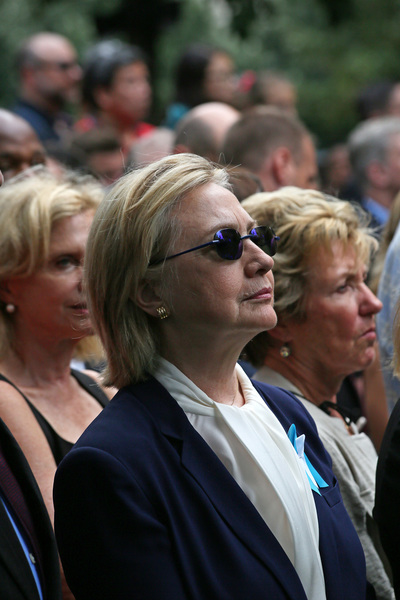
On Sunday, after Clinton fell ill and abruptly departed a 9/11 ceremony in New York, she ditched her press corps and waited 90 minutes to offer a first explanation of what happened. It wasn't until hours later that Clinton's campaign announced she had been diagnosed with pneumonia two days earlier and released a statement from her doctor.
Rather than controlling a story, silence allows critics to frame the debate. Republicans quickly seize on the lack of information, arguing Clinton must be hiding something, sometimes forcing Democrats to push her to release more details.
"It raises questions about _ again _ Clinton truthfulness, honesty and trust issues," said Republican pollster Neil Newhouse. "It puts those issues once again front and center. It goes beyond the issue of her health and more to 'What else aren't they telling us?'"
Newhouse said the trouble for Clinton lay in the fact that polls revealed a solid percentage of voters who were "tippable": They don't like either White House hopeful, but could be persuaded by events to fall in with one. Circumstances like Sunday _ not the fact that Clinton got sick but that her campaign was slow to reveal it _ "could very well snatch defeat from the jaws of victory," he said.
"When you have a crisis developing ... I come from the school where you need to deal with it immediately," said Steve Schale, a Democratic strategist in Florida who worked for Obama in 2008. "The quicker you can move on from things like this the better."
But Schale praised Clinton for quickly saying she regretted dismissing half of Trump's supporters as a "basket of deplorables" or racist, sexist, homophobic or xenophobic while at a fundraiser Friday. "The 'deplorable' comment was an unfortunate error," he said. "But she came out pretty quickly and owned it."
Clinton is trusted slightly more than her Republican rival, Donald Trump, but it's nothing for her campaign to cheer about: Only 35 percent of those surveyed in an ABC/Washington Post poll released Sunday found her honest and trustworthy, compared with just 31 percent for him.
Clinton's campaign said Monday that it regretted the slow response and planned to release additional informational about her health in the coming days.
Clinton has released more details than Trump has by far, including a two-page letter from her doctor in 2015 and decades of tax returns. Trump has not released his tax returns and has released only a letter from his doctor that has been mocked. "If elected, Mr. Trump, I can state unequivocally, will be the healthiest individual elected to the presidency," gastroenterologist Harold Bornstein wrote.
Paul Begala, a Democratic strategist and longtime Clinton family ally who is working for a political action committee supporting her, said: "The rules are different. Everything she does we're going to process through a lens of, 'Oh, she's dishonest.'"
Scott Surovell, a Democratic state senator from Virginia, said there was a double standard when it came to Clinton, that she was treated differently than Trump or other candidates. "She's the most scrutinized woman in the world," he said.