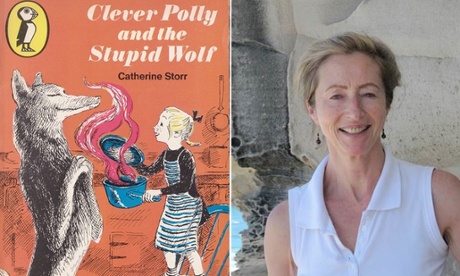
Polly Storr is part of a very exclusive club. Like Christopher Robin Milne, immortalised by his father AA Milne in the Winnie-the-Pooh stories; Sophie Dahl, whose name her grandfather Roald Dahl swiped for the heroine of The Big Friendly Giant; and Lucy Barfield, goddaughter of CS Lewis and dedicatee of The Lion, the Witch and the Wardrobe, she has given her name to a classic character in children’s fiction.
Storr was around five or six when she visited Whipsnade zoo, and saw the wild wolves in their tree-filled enclosure. She was terrified. Her mother, Catherine Storr, attempted to comfort her with a story about Clever Polly, who outwits the Stupid Wolf with ease. The tale went on to form the basis of Clever Polly and the Stupid Wolf, first published in 1955. The book consists of a genuinely funny, charmingly illustrated series of attempts by the Wolf to eat Polly, drawing on fairy tales.
I adored it as a child (my sister was frightened of wolves too), and we’re reading it with our four-year-old at the moment. At times I have been laughing harder than her, particularly at the Wolf’s version of the “Monday’s child is fair of face” rhyme. Annoyed at Polly’s “namby-pamby” version of the ditty – “It doesn’t bring tears to your eyes and make you feel you understand life for the first time, like proper poetry” – he recites his own poem. “Monday’s child is fairly tough, Tuesday’s child is tender enough, Wednesday’s child is good to fry, Thursday’s child is best in pie.”

The whole book is like that, droll and silly and clever and sweet, and it’s about to enjoy a new lease of life after being picked by Waterstones as the bookseller’s children’s book of the month for July. It is the first time a backlist title has been chosen for the key slot; Clever Polly has also been picked by Puffin as one of its 20 best titles for the A Puffin Book list, alongside classics such as The Wolves of Willoughby Chase and Ballet Shoes.
“My mother loved to tell stories,” says Polly Storr, speaking from her home in California. “She wasn’t really a published author when she told the Clever Polly one – she had written one children’s book before the war, which died a complete death. But we’d go for a walk, and she’d invent stories for us, little adventures picking up on whatever we children [Storr is one of three sisters] were upset about or dying to do.”
Wolves, she says, “both intrigued and frightened me, and when I saw them at Whipsnade, I got even more frightened, with a small child’s irrational fear … I think she wrote Clever Polly to empower me.”
The tale was picked up by publisher Faber; Catherine Storr had intended to use a different name in the published version, rather than her daughter’s, but Faber persuaded her to go with Clever Polly. Polly and her continuing adventures were illustrated by neighbour and friend of the family Marjorie-Ann Watts, with Polly modelling for her drawings. Catherine would go on to write a whole series of stories about Polly and the Wolf, which have long been a staple in primary schools.
Unlike Christopher Robin Milne, who hated the fame his father’s books brought him – “he had filched from me my good name and had left me with nothing but the empty fame of being his son,” he once said – Polly is happy with her literary immortality.
“I was old enough to be happy I was in a book. That was fun, but nobody I went to school with knew about me being Clever Polly, because by the time the books came out they were always too young for my age, so none of my contemporaries were reading them,” she says. “I wasn’t like poor old Christopher Robin, who got hounded by everyone and couldn’t have a normal kind of life.”
Clever Polly might be less well known than Milne, Dahl and Lewis’s titles, but the fact it has never been out of print since publication is “pretty amazing”, says Polly. She thinks its appeal lies in its “timeless” nature, and its humour.
“Children love it because it’s funny, and because the wolf makes silly mistakes of the kind they might make themselves,” she says. “So they can sympathise with him, and feel superior to him, at the same time.”
And as for the character of Clever Polly herself? “I don’t think I’m nearly as clever as her. I think I’d be much more frightened if I met a wolf,” she says, adding in a letter to Waterstones thanking them for choosing her mother’s book as their title of the month, that she “can make absolutely no claim to have been clever myself, the credit is all due to my mother …
However, I do bask in the undeserved glory of being the Polly who gave rise to Clever Polly. (So much nicer than being frightened Polly.)”