With five years to go until the 2025 Osaka-Kansai Expo, expectations are high among business circles for the estimated 2 trillion yen economic ripple effect it will bring. However, such issues have emerged as an increase in construction costs and a lack of clear direction of how to stage an Expo suitable for the new era.
From '20 Olympics to '25 Expo
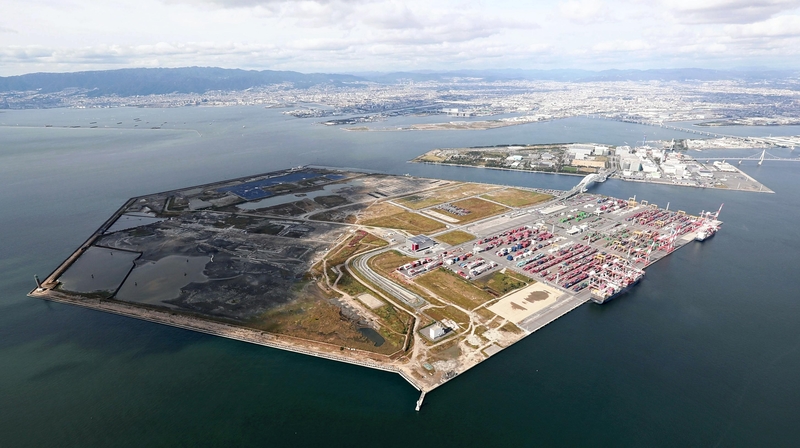
The Osaka-Kansai Expo will be held mainly on the artificial island of Yumeshima in Osaka Bay over six months from April 13, 2025. The government submitted registration documents to the Bureau International des Expositions (BIE) in Paris at the end of 2019. If approved at the BIE general meeting in June, it will be possible to start inviting countries to participate.
In 2014, then Osaka mayor Toru Hashimoto and then Osaka Gov. Ichiro Matsui -- who is currently Osaka mayor -- proposed the Expo plan as a catalyst for the revival of the region.
The 1970 Osaka Expo, which led to the development of such urban infrastructure projects as Senri New Town and Shin-Midosuji avenue, was used as a reference. The decision was in line with the central government's intention to seek ways to reinvigorate the economy after the Tokyo Olympics.
The business community is hoping the economy will get a welcome boost from the "Olympics to Expo" relay handover, which led to rapid economic growth when it last occurred between the 1964 Tokyo Games and the '70 Osaka Expo.
"If the Kansai economy improves, the Japanese economy will improve," said Masayoshi Matsumoto, chairman of the Kansai Economic Federation. "I want the Expo to demonstrate that Japan has the technical and economic capacity to solve international challenges."
Different times
At the 1970 Osaka Expo, a piece of lunar rock brought to Earth in the U.S. Apollo program was among the most popular items. A total of 64 million spectators visited the Expo, a record high at that time.
However, Hiroyuki Ishige, secretary general of the Japan Association for the 2025 World Exposition, the organizer of the Osaka-Kansai Expo, has repeatedly stated that "The environment surrounding the Expo is different now compared to in 1970."
The first world exposition took place in Britain in the 19th century. Since then, it has grown into a trade fair showcasing industrial technology.
The Convention relating to International Exhibitions agreed upon in the 20th century states that the principal purpose of the event is education of the public, through such means as demonstrating cutting-edge technology that showcases prospects for the future.
The United States and the former Soviet Union took part in the Expo 1970, which was held during the Cold War era. Both showed off space technology to boost national pride.
But in an era in which major technology firms have emerged, with technology trade fairs held all over the world, the level of demand for the Expo has been very high, according to Ishige.
In recent years, while problem-solving has emerged as a common theme at world expositions, the direction of each event has differed, with such issues as the environment being tackled. Furthermore, with the exception of the Shanghai Expo in 2010, the number of visitors has also been declining.
"A laboratory for a future society" has been chosen as the concept for the Osaka-Kansai Expo. However, it is possible that the near future envisaged now will be outdated in five years.
Promote fresh talent
Human resources are the key to presenting a new image of the Expo. Artist Tadanori Yokoo and designer Junko Koshino, two young creatives thrust into the limelight at the Osaka Expo 1970, created avant-garde pavilions and costumes that are still highly regarded.
"We should learn from the active promotion of young people [at the last Expo]," many members of the association have said.
The association hopes to select someone by autumn who will be responsible for drawing up the overall concept and the content of the exhibition. In November last year, the government established a panel of experts to promote the concept of a "People's Living Lab." The association also has been trying to encourage companies to participate and to solicit ideas for exhibits.
The many challenges that lie ahead include a rise in construction costs, which is currently estimated at 125 billion yen.
Matsui had said: "We have made a strict estimate. There's no problem." However, he mentioned the possibility of cost increases for the first time at the end of last year, saying, "Given the rise in labor and material costs, we can't determine the cost of building the venue now."
It has been decided that the central government, the Osaka prefectural and city governments, and business circles will each pay one-third of the construction costs, but it is not yet clear how much costs will rise. It may become necessary for relevant parties to make adjustments.
Read more from The Japan News at https://japannews.yomiuri.co.jp/