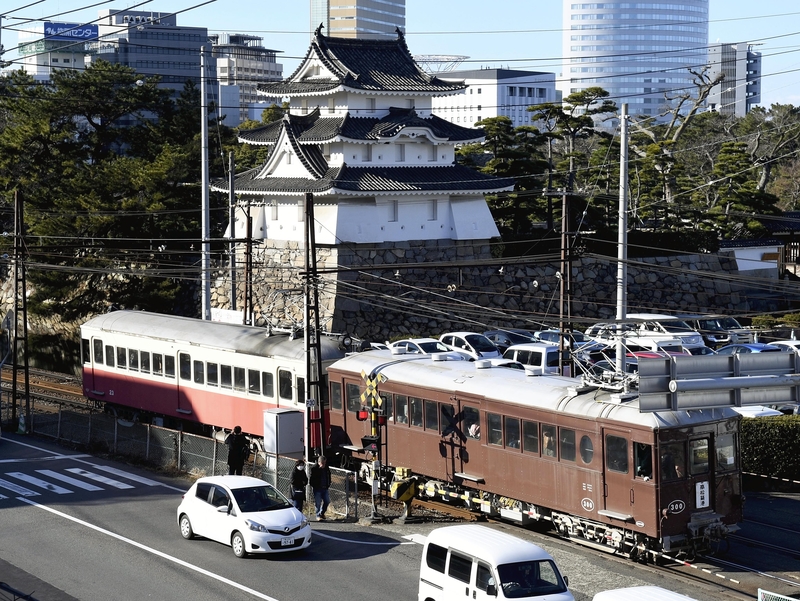
TAKAMATSU -- Old-fashioned boxy train cars run through the Sanuki Plain, where the peaceful scenery of farm land spreads. The retro, electric train cars belong to the Takamatsu-Kotohira Electric Railroad Co., based in Takamatsu.
Some of the train cars are more than 90 years old, but they are still in service. Thus, the routes of the train system, dubbed "Kotoden" by local residents, are attracting railway fans as a "moving train museum."
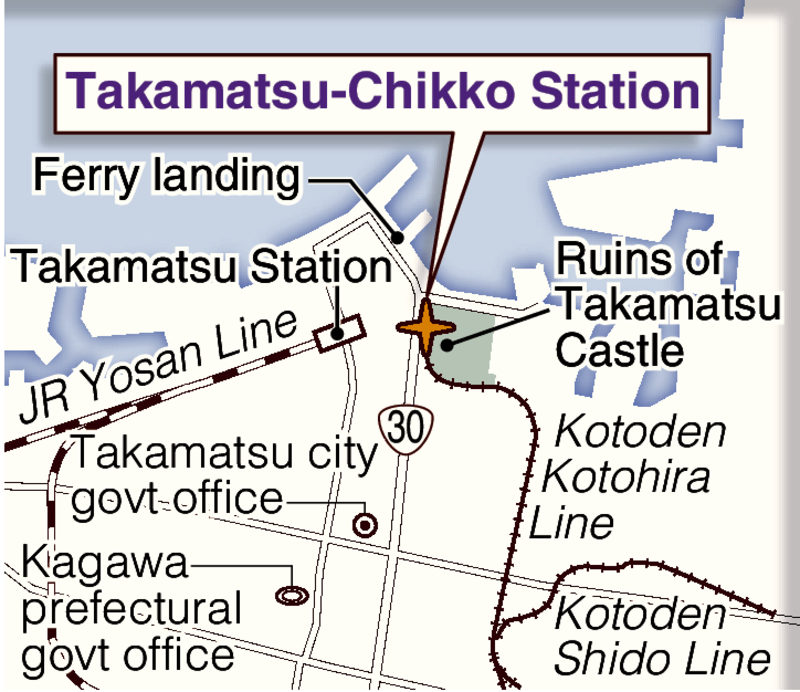
In mid-January, about 60 railway fans gathered on a platform of the line's Takamatsu-Chikko Station, which is adjacent to the ruins of Takamatsu Castle. They directed their cameras toward a two-car train -- one car two-toned and the other dark brown -- and enthusiastically took photos of them.
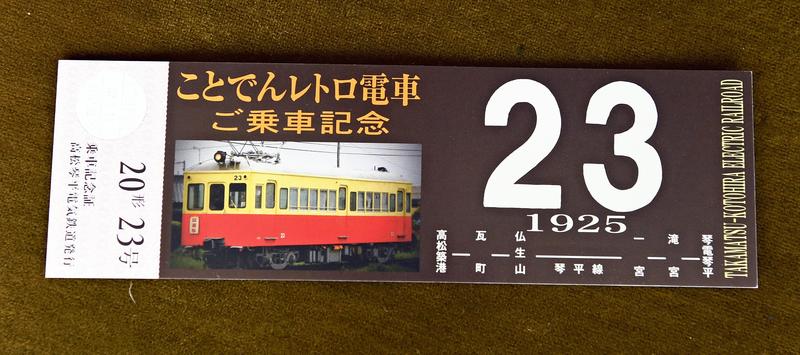
The two-toned car is the No. 23 of the model 20 series, which was manufactured in 1925, while the dark brown one is the No. 300 of the model 3000 series, which was manufactured in 1926.
The two train cars are among four retro cars owned by the railroad company and run as a special service operation once a month.
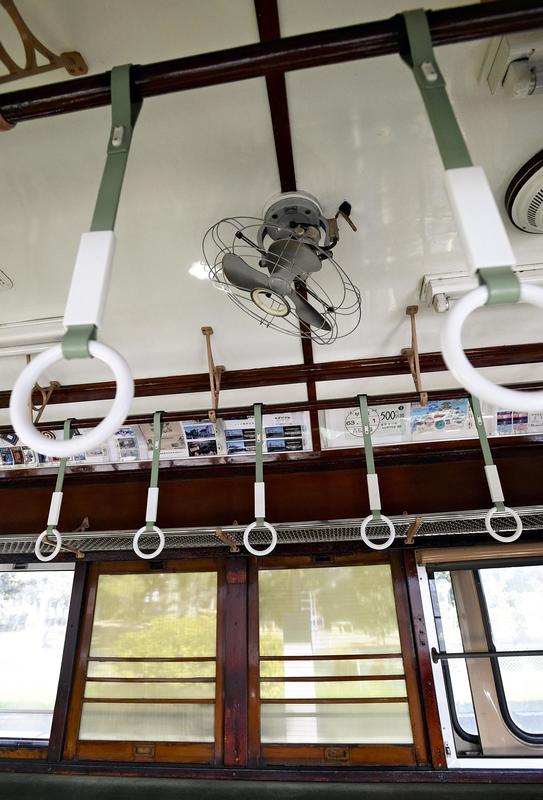
Within one of the cars, the small wooden window frames lined with light-green seats evoke a sense of nostalgia.
As the train was about to depart, strong vibrations were felt under the floor together with thunderous sounds.
The noise and vibrations are peculiar to an old drive system known as "tsurikake-shiki" (nose suspension drive), in which motors and axles are integrally structured.
Bodies of the cars swing vertically and largely, and so the ride is turbulent. But for railway fans, this seems to just add to the precious attractiveness.
The ride is about 33 kilometers to the terminal at Kotoden-Kotohira Station in Kotohira, Kagawa Prefecture. Through the train's windows, railway fans were seen taking photos at many places.
Sojin Kitaguchi, 41, from Miyake, Nara Prefecture, who rode the retro train for the first time, said in an excited tone: "It's unbelievable that such old trains actually run. I feel as if I slipped back in time."
The Kotoden was opened by its predecessor railway company in 1911. The company merged with other local railway companies in 1943. In the 1950s, current railroad routes were completed.
Among the company's four retro cars, three -- including the No. 300 of the 3000 series -- have been in service since 1926 to 1928. In 2009, they were designated as the Economy, Trade and Industry Ministry's Heritage of Industrial Modernization.
The other car, the No. 23 of the model 20 series, was handed over from Osaka-based Kintetsu Railway Co. in 1961. It is the oldest car still in service in the nation.
The existence of the four retro cars is not the only reason Kotoden is dubbed as a moving train museum. Another 80 cars owned by Kotoden are those that were once retired after service on various railways, including lines of Keikyu Corp. based in Tokyo.
Many of the cars were manufactured in the 1960s and '70s. Their bodies are wrapped with advertisements, but their interiors are almost the same as in former days.
The old trains are still available for service because of a management situation at the company, which has had difficulties introducing newer models.
When a Kotoden subsidiary that operated a department store went bankrupt in 2001, it negatively impacted Kotoden, which had to apply for court protection under the Civil Rehabilitation Law. Thus, the company's management was all replaced.
In the process of the management reconstruction, the company made efforts to improve convenience for passengers, such as the introduction of IC cards as tickets. Also, it began appealing the retro trains to the rest of the nation.
The special operation service of the retro trains started in 2012. The company also began selling goods related to the retro trains.
Since the retro trains can be chartered, the company said it receives about 30 applications a year for this service.
Not only railway fans but also ordinary tourists in family groups later came to ride on the retro trains. The Kotoden carried 14.37 million passengers in fiscal 2017 -- up from a low of 12 million a year -- the same level as before the company's application for bankruptcy protection.
A Kotoden official said, "The retro trains are irreplaceable assets for us."
Spare parts scarcity
The retro trains can continue to be in service because the company has maintenance engineers for the purpose. What it doesn't have is spare parts.
When breakdowns occur or equipment fails, the engineers often fashion replacement parts by welding pieces together. And because the parts do not contain sensors for detecting abnormalities, the engineers depend on their five senses to confirm whether parts are overheated or give off burn odors while they do their maintenance work.
Masahiro Funakoshi, 39, who has done this work for 20 years, said, "There is no work manual, and so I acquired my skills by watching and copying my senior colleagues."
Koji Masuhara, 34, worked for a manufacturer of Shinkansen bullet train cars for 10 years, and moved to the Kotoden in 2015.
"My work is a dialogue with the train cars, rather than maintenance. I feel as if all of the parts were living creatures," Masuhara said.
Being supported by railway fans and engineers, the retro trains should continue to run in service even after the Heisei era ends.
-- Access
The Kotoden has three lines: Kotohira Line (32.9 kilometers long), Nagao Line (14.6 kilometers long) and Shido Line (12.5 kilometers long). Takamatsu-Chikko Station, the starting station of the Kotohira and Nagao lines, is about a five-minute walk from JR Takamatsu Station. No reservations are needed for the special service of the retro trains. For more information, call the company at (087) 863-7300.
Read more from The Japan News at https://japannews.yomiuri.co.jp/