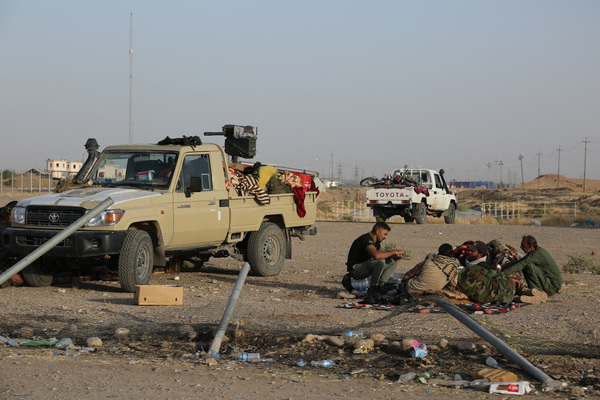
BEIRUT _ Gunfire and explosions rang out Monday as Iraqi forces moved to take control of a Kurdish-held military base and oil fields outside the disputed city of Kirkuk, raising the specter of a showdown between two U.S.-armed allies in the fight against the Islamic State.
The government forces, which include members of the army, counterterrorism commandos and federal police, said they were under orders to avoid violence. And state television reported that the forces did not meet resistance as they advanced overnight into areas seized by a Kurdish militia after government troops fled an Islamic State assault in 2014.
But residents said they heard exchanges of fire in the early morning hours. Terrified families piled into cars and fled, clogging the highway to the city of Sulaimaniyah in Iraq's semiautonomous Kurdish region.
Others grabbed weapons and descended into the streets to help defend Kirkuk against what the Kurdish Region Security Council described as "a major, multi-pronged operation" intended to enter the city and take over a key airbase and oil fields.
The ethnically and religiously diverse city has long been a flashpoint between the central government in Baghdad and the northern Kurdish region. Tensions ramped up after Kurdish leaders held a referendum on independence last month, over the objections of the federal government, the United States, Iran and Turkey.
Prime Minister Haider al-Abadi demanded that the vote, which was overwhelmingly in favor of secession, be annulled and imposed an international flight ban on the Kurdish region.
Iran and Turkey, concerned that the vote could inflame their own Kurdish minorities, have also threatened punitive measures. Late Sunday, Iraq's foreign ministry said Iran had closed its border with the landlocked Kurdish region at Baghdad's request.
As both sides massed troops and armor on the southern approaches to Kirkuk in recent days, U.S. military officials and diplomats pressed them to avoid a conflict they fear could become a trigger for another war in the Middle East and divert attention from the fight against Islamic State extremists.
In a statement read on state television early Monday, al-Abadi took a placatory but firm stance, saying it was his constitutional duty to protect the unity of a country that was in danger of being divided while Iraq was fighting "an existential war against terror."
"We reassure our people in Kurdistan and Kirkuk specifically that we care for their safety and interests," al-Abadi said.
He called on "all citizens to cooperate with the armed forces" who had been tasked with "protecting civilians in the first degree and imposing security and order and protecting the facilities and institutions of the state."
Al-Abadi also sought that the Kurdish peshmerga forces "fulfill their duty under the federal command as part of the Iraqi armed forces."
Among the facilities captured Monday were the provincial airport, a key military base known as K1, the North Gas Co. and a power plant, government officials said. Federal forces also assumed control of a number of roads and bridges, as well as headquarters and warehouses.
The U.S.-led coalition said in a statement that it had been monitoring the federal troop advances and believed they were "coordinated movements, not attacks" on the peshmerga.
The coalition confirmed an exchange of fire south of Kirkuk, but attributed it to a misunderstanding as two units attempted to link up in the predawn hours.
The exchanges took place around the town of Tuz Khurmatu, where there have been periodic clashes between Kurdish forces, who are mostly Sunni Muslims, and Turkmen residents, who are mainly Shiites. Casualty figures were not immediately available.
Ali Hilla, a member of a government-sanctioned Shiite militia stationed in Tuz Khurmatu, said federal forces had assumed complete control of the town.
"We didn't have orders to engage. Our commanders said, 'We don't want to escalate the situation with them,'" he said in a phone interview. "But then they attacked us some time after 2 a.m. So then we got the order to attack anyone who fires on us."
The presence of the Shiite militias, some of which are armed and funded by Iran, is a particularly sensitive issue for the Kurdish forces. Al-Abadi's office said the militias would remain on the outskirts of Kirkuk rather than enter the city.