For the purists, today's big race at Haydock is the Lancashire Chase. You may never have heard of such a race title, but it exists - it is the official title given to the Betfair Chase as a kind of insurance against the day when the sponsor might withdraw.
Personally, I hope that day never comes, but there are certainly people in racing who feel no goodwill whatever towards the leading betting exchange and would not despair if it somehow disappeared into a black hole in cyberspace. The company has been accused of providing a route for cheats to turn a profit and of allowing unlicensed layers to leech off unsuspecting punters.
Whatever your feeling on these subjects, there is no denying that the existence of Betfair makes betting on horses so much more interesting than it was. I think it's fair to say there was a certain staleness about the old system, under which you took a price from a bookmaker and then, after a decent interval, threw your betting slip away. Suddenly, through Betfair, you could bet against a particular horse, back a horse and then trade out for a guaranteed profit (or a loss, if the market had moved against you) and continue to bet during the race.
The rapid ebb and flow of prices was absorbing, but not so absorbing as the Betfair forum, which offered an astonishing collision of wit, mindlessness, priceless information, worthless drivel, ribaldry, bragging and furious invective. Solitary punters who knew no one else interested in racing unexpectedly found themselves swapping views with professional gamblers and stable lads.
Above all, the advent of Betfair created a new kind of story, as people won and lost at odds that had never previously been heard of, in circumstances that had never previously existed. Here's my countdown of the five biggest Betfair stories so far, the ones that I reckon will live longest in betting lore.
5) Noland stuffs Straw Bear on the line
Already a Grade One winner, Noland had obvious claims for the Supreme Novice Hurdle that opened the 2006 Cheltenham Festival and he was sent off as the 6-1 second-favourite. But he'd lost his position at the top of the hill and Ruby Walsh was hard at work after Noland flattened the third-last.
As the field swung round the final turn, he disappeared off the edge of the TV picture in about 10th place. Horses of the calibre of Straw Bear, Sweet Wake, Buena Vista and Sublimity were in front of him and going better. Surely he had no chance.
It was presumably at this point that a punter in Pontypridd, having asked for a £10 bet at 7-1, found his bet had been matched at 999-1, thanks to Betfair's system of giving backers the best odds available at the split second their bet is made.
Whoever layed that bet would have been filled with instant misgiving. When the camera angle widened again to include Noland, Walsh's mount was clearly charging. He had a lot of work to do but the leaders tired as soon as they hit the hill. Straw Bear plugged on gamely but the momentum was all with the challenger and Noland went past in the final stride.
To many of us, the idea that someone might risk £9,990 to win a tenner seems incomprehensible but bets are struck at those odds on the exchange every day. If you bet like that, you have to get it right 999 times out of 1,000 just to break even, which doesn't make much appeal to me, but there's at least one punter out there who is very grateful that it happens at all.
4) Jim Bolger takes a nap
Having won the Dewhurst at the end of his two-year-old season, Teofilo was the winter favourite for the Derby and the Guineas of 2007 until one Monday in mid-April when it seemed something may have gone wrong with him. On Betfair, the Guineas market was becalmed as Teofilo drifted out to 10-1. Everyone waited for clarification from his trainer, Jim Bolger, but none came.
Bolger later explained that he had had four hours' sleep the previous night. On returning to his office that Monday afternoon, he had received messages from various journalists. "I thought I'd deal with them in a few minutes. I fell asleep and didn't wake up until half 10, and it was too late to ring anybody at that stage.
"When I saw the Racing Post the next day, that was the first inkling I had that some people seemed to be having a big problem. I was human and I succumbed to sleep, nothing more and nothing less."
Bolger explained that Teofilo had suffered a minor setback, but the horse appeared fine one week later when he was paraded in front of visiting hacks at Bolger's yard. He could, it seemed, still turn out to be the first Triple Crown winner since Nijinsky. Alas, he never got to first base. Two days before the Guineas, Teofilo did a final piece of work over five furlongs, after which he was found to have heat and pain in a knee. Bolger appeared to have learned a lesson in communication - having found the problem at 9am, he had a statement issued within an hour, confirming the horse would miss the Guineas. Teofilo never ran again.
3) Jim Bolger changes his mind
Having won the Dewhurst at the end of his two-year-old campaign, New Approach was the winter favourite for the 2008 Derby (is this sounding familiar?) but, when pressmen turned up at Bolger's yard in late April, they were stunned to be told that the Epsom race was not a target. "We'll take it step by step," the trainer said, "but [the owners] have left the horse's programme to me and, after he runs at Newmarket [in the 2,000 Guineas], I have to say at this stage that I would be more keen to go for the Irish Guineas and then the Irish Derby."
New Approach was then beaten by Henrythenavigator in both the English and Irish 2,000 Guineas. At the end of May, it was noticed that the chestnut had been left in at the latest entry stage for the Derby. When asked why, Bolger said: "It was a mistake and that is all I have to say on the matter".
On the Sunday before the Derby, New Approach briefly traded at 209-1 in the ante-post market for the Epsom race, the highest price he had ever been. By the end of the day, he was 119-1, odds that held overnight. But, from 8.15am, the price started to crash. In the space of five minutes, his odds halved to 64-1.
Two hours later, New Approach was 26-1. By 11am, he had got all the way down to 13-1. Somebody knew something, but it was not until 11.11am that the news became available to the betting public, when Bolger announced that he would run the horse, as long as the going was suitable.
"I live in a changing world and I feel sorry for people who can't cope withminor changes in life," the trainer said. "Circumstances change and my prediction was wrong. I was convinced that Epsom would come too soon after running at the Curragh, but he lost no weight at the Curragh and it appears he did not have a hard race."
Those who had layed the horse at big prices may have thought they were going to get away with it as he pulled hard through the early part of the Derby. After all, he had never raced beyond a mile and would surely never last for a mile and a half if he didn't settle down. It was a false hope. New Approach carved his way through the field in the last two furlongs and won in the style of a good horse. His SP was 5-1 but some people were on at a lot bigger than that.
2) Layers take a Kicking
Kicking King had been an impressive winner of the King George but this was the era of Best Mate and Beef Or Salmon. At the beginning of March, he was still only the 6-1 third-favourite for the Gold Cup when the news broke that he wasn't going to make it to Cheltenham. The horse had worked badly and then scoped poorly, his owner said.
"He has an infection," Conor Clarkson told the press, "and, as a result, must undergo a course of antibiotics for a week. With Cheltenham just around the corner, there is no way he's going to make it. It's nothing life-threatening, just an infection, simple as that, but it's like a bombshell, absolutely devastating news and a real kick in the teeth.
"To rush him there would not be right but, on the plus side, we have a seven-year-old with a bright future. It would have been a lot worse had it been a leg problem."
As had become normal, Betfair did not remove Kicking King from their ante-post market for the Gold Cup. He was, after all, still entered. His odds went straight out into three figures after the bad news and it seemed unlikely that there would be any takers.
But there were. Over the next week, several punters had a few quid on at the maximum odds of 999-1, at which a total of £94 was traded. Then, on 8th March, Kicking King's odds kept shortening until they reached about 14-1. Eventually, someone got Tom Taaffe, the trainer, on the phone. Wasn't Kicking King still a non-runner? "We can confirm that the horse's condition has improved since last week," said Taaffe, who promised a statement in a couple of days. "The wheels are back on the wagon. That's all I'm prepared to say for now."
When Taaffe's statement eventually came, he confirmed the horse would run in the Gold Cup, which, by then, was just a week away. He had not, after all, been put on antibiotics, but had been allowed to recover from an unidentified bug in his own time. On the same day, Best Mate was ruled out of the Gold Cup after bursting a blood vessel on the gallops. For the 999-1 layers, there must have been a sense of impending doom. Eventually sent off as the 4-1 favourite, Kicking King did not look like a horse who had been sick a fortnight before, cruising round to win easily. But the leg injury that Clarkson had seemed to foretell came to pass within a year. Kicking King injured a tendon at Sandown while winning a second King George, effectively ending his career as a top-class chaser.
1) The first ever 999-1 winner
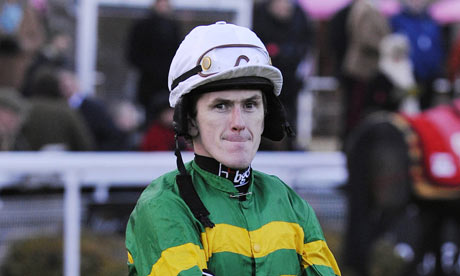
The Feast of St Raymond Novice Chase at Southwell in January 2002 was not pretty to watch. Indeed, jump racing probably wouldn't last very long if many races looked like this . Seven runners set off and they were reduced to five after a couple of fallers at the first three fences. Backers of the 8-11 shot Family Business, the mount of Tony McCoy, would have been pleased to see the opposition being reduced so quickly but any satisfaction was short-lived, as the Martin Pipe-trained chestnut unseated at the 10th. As invariably happens when a horse falls or unseats, Family Business was immediately laid out to the maximum odds on Betfair, 999-1.
But, with the favourite out, the race descended into a festival of incompetence. Just two fences later, Joe Luke unseated and Eaux Les Coeurs fell. What A Wonder was left in the lead, a position he enjoyed for just a matter of seconds until he unseated at the very next fence.
Gamely, the 7lb claimer Howie Ephgrave remounted, while the 66-1 shot Red Radish plodded along behind. What A Wonder was in front and surely going to win when he lurched to the right at the fourth-last, jumped awkwardly and tipped Ephgrave out of the saddle for the second and final time. Red Radish reached the fence shortly afterwards and refused, exhausted. As he lay on the take-off side, the remounted Eaux Les Coeurs approached the fourth-last and also refused, dumping Rupert Wakley onto the landing side.
In-running punters may have assumed they were watching that rare thing, a race that would be declared void because no horses finished. But, as it began to look as if nothing would get round, McCoy got back on Family Business and the pair set off from the point where they had parted company.
The chestnut threw in some distinctly dodgy leaps but they stayed together and eventually crossed the line some 10 minutes after the race had started. It was a horrifying outcome for the man who had layed a total of £4 at 999-1. He told the Racing Post that he had not been trying to strike a bet by offering those odds, but was acting in a community spirit, trying to let fellow Betfair users know that the horse had fallen and they should not back it. "Under Betfair rules, I am happy for it to be honoured," he told the Racing Post, "but you can be sure I will not be alerting other users about fallers in the future, and Tony McCoy's off my Christmas card list as well!"
Incredibly, the same punter was among those who later had to pay out on Kicking King, having layed £15 at 999-1. The Southwell race was the first time in Betfair history that someone had struck a winning bet at the maximum odds. Previously, the record had been 599-1, the odds at which someone backed Bolivia to beat Brazil in a World Cup qualifier after they had gone a goal down.
Family Business only ever won one more race, a hunter chase at Chepstow five years later. But this would not be the last time that McCoy pulled victory from deep in the jaws of defeat. His mount was again matched at the maximum odds in the Devon National of 2004, in which Mini Sensation looked a most unlikely winner with a circuit to go before eventually being driven to the front.
Just two months ago, McCoy turned the trick for at least the third time when getting a potent late turn of foot from Shadow Dancer in a novice hurdle at Market Rasen. Fifth and apparently held over the final flight, the pair collared Kilcrea Asla close home to win by a length. But McCoy will never again be able to win a race as he did on Family Business, at least in Britain, because remounting has recently been banned. If the Southwell race happened now, it really would be void, which would have spared that community-spirited punter a lot of pain.