
ANDREWS AIR FORCE BASE, Md. _ A Pentagon shuttle left for Guantanamo Bay, Cuba, Sunday morning without three civilian lawyers who quit the USS Cole case, setting the stage for a showdown Monday with the military judge who ordered them to the remote U.S. Navy base in Cuba.
Veteran death-penalty defense attorney Rick Kammen and colleagues Rosa Eliades and Mary Spears resigned from the defense team Oct. 11 over a classified ethical conflict. The judge said, under his reading of the rules, they cannot leave the case without his permission.
"The military judge has ordered U.S. citizens to go to what the government claims is a foreign country to provide unethical legal services to keep the facade of justice that is the military commissions running," Kammen said Sunday morning. "This order is illegal and neither I nor the other civilians are going to Guantanamo.
The Pentagon charter specifically shuttled attorneys and other war court staff for a scheduled three-week pretrial hearing in the capital case against Abd al Rahim al Nashiri. The Saudi is accused of orchestrating al-Qaida's Oct. 12, 2000, suicide bombing of Cole, in which 17 U.S. sailors were killed and dozens of others were wounded.
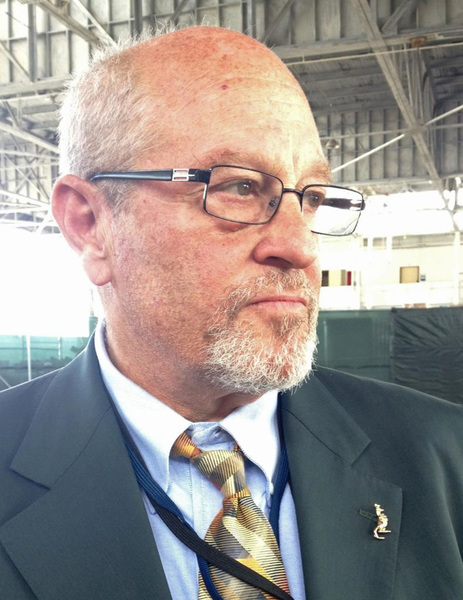
Kammen has represented Nashiri for a decade; the two women came to the case later. Only a Navy lieutenant with no capital experience remains on the case.
Those aboard Sunday's flight included the judge, Air Force Col. Vance Spath, and Marine Brig. Gen. John Baker, the chief defense counsel for military commissions, and his counterpart, Army Brig. Gen. Mark Martins. Baker authorized the resignations of Kammen, Eliades and Spears after they briefed him on a covert breach of attorney-client privilege involving something so secretive at the prison, neither Nashiri nor the public can know the details.
In an Oct. 24 filing, Baker advised Spath that he released the three after "a thorough review of the relevant facts, both classified and unclassified, and the legal parameters of my supervisory authority," that considered advice from "a prominent legal ethicist, professor Ellen Yaroshefsky."
Baker wrote that, as chief defense counsel, he has "unilateral, unreviewable authority to excuse counsel for good cause." "Nowhere do the Rules make provision for the review or reversal of that determination," he wrote.
On Oct. 16, Spath ordered them to appear in court, saying that while the general "purported to find good cause" to approve their leaving the case, Spath, as judge, has not. "Accordingly, Mr. Kammen, Ms. Eliades, and Ms. Spears remain counsel of record in this case, and are ordered to appear at the next scheduled hearing."
Their absence is likely the first order of business Monday because, under the rules of court, a hearing requires a lawyer specializing in the death penalty to proceed.
When a subpoenaed witness did not show up to testify by video feed to the base last year, the judge sent U.S. marshals to the man's Massachusetts home, had him held in a Virginia jail overnight and taken to a Pentagon-run video-conference room. Before that happened, the lead USS Cole case prosecutor, Mark Miller, said, "I think we all agree that we cannot force somebody to come to the island."
The tug-of-war over authority to excuse the attorneys is based upon different rule books governing the war court created by President George W. Bush after the Sept. 11, 2001, attacks and reformed by President Barack Obama to expand the rights of the accused. The war court judge's bench book, called the Trial Judiciary Rules of Court, says that once a civilian lawyer has appeared in court, "excusal must be approved by the military judge." But the Manual for Military Commissions, from which the rules are drawn, says the authority who appointed the lawyer gets to excuse the lawyer for good cause.
In response to a question about Spath's authority to enforce his appearance order, a Pentagon spokesman noted that the judge has forced a witness to testify and can find someone in contempt of court. The contempt option involves a multi-step process, including an opportunity to appeal and have a Pentagon official review the finding, and may be punishable by 30 days in a brig or jail and a $1,000 fine.