Canberra already boasts an unusually high ratio of statues to people, but a new one has appeared, calling Civic its home.
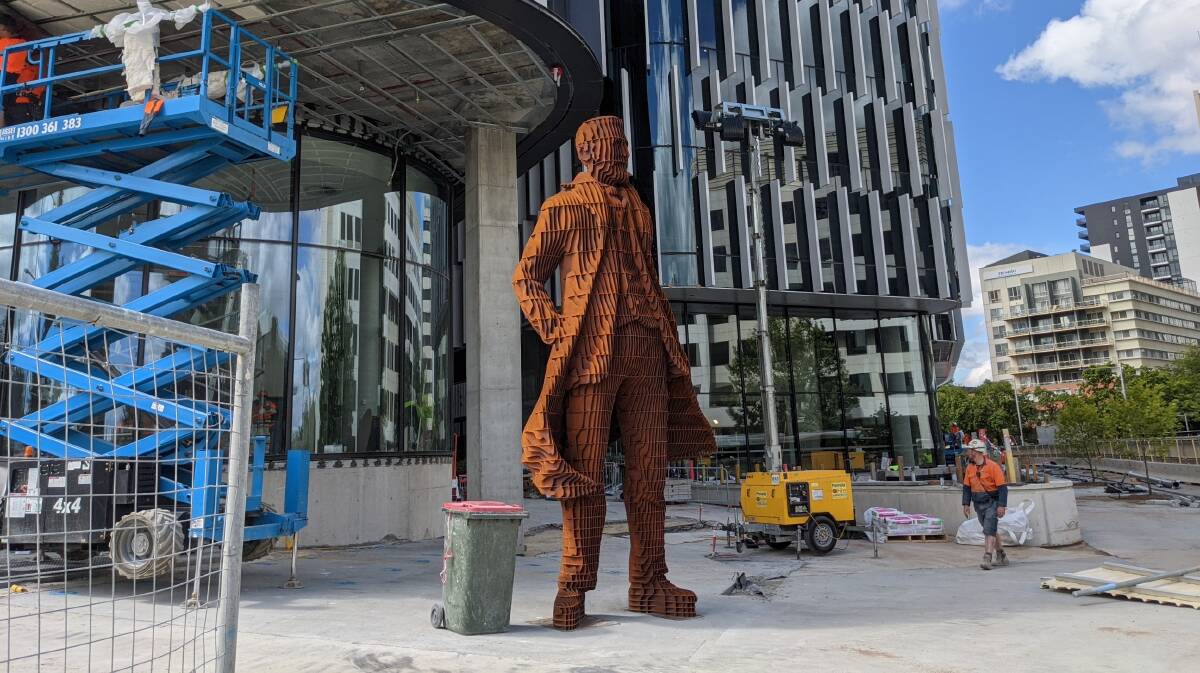
Locals wandering the streets around London Circuit and Constitution Avenue might have noticed a new statue made of weathered steel overlooking the intersection.
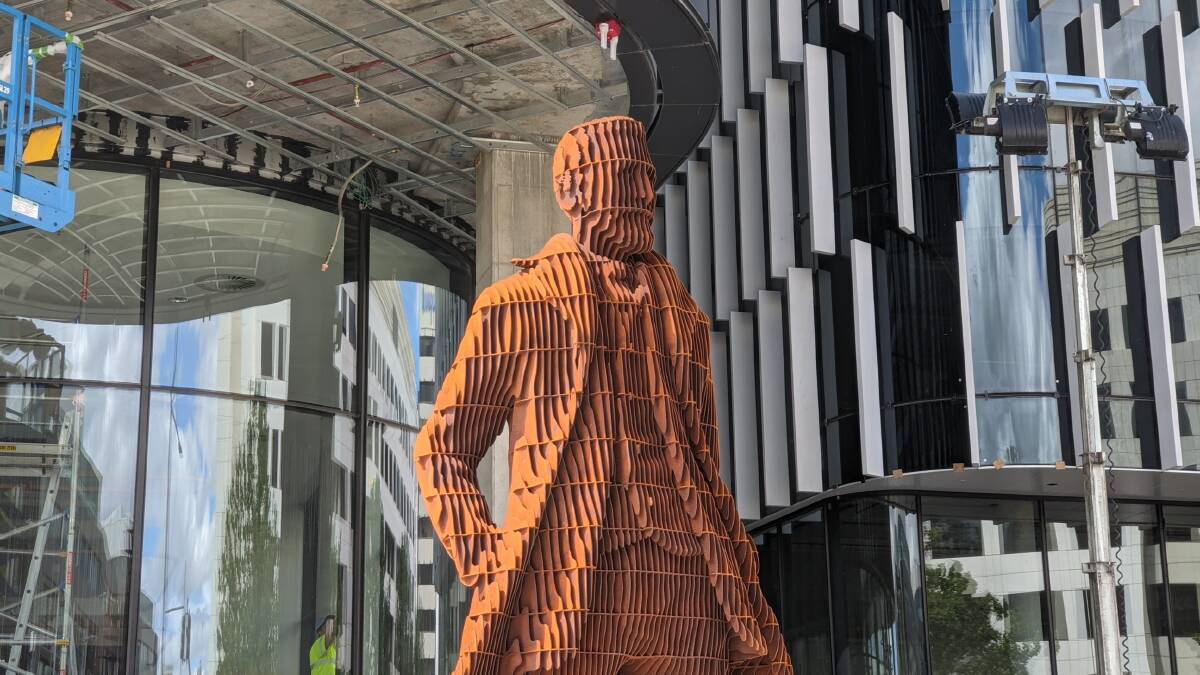
The statue, standing at 4.8 metres or about five wheelie bins high, is of Andrew Inglis Clark - a barrister best known for co-authoring the Australian constitution.
The statue's commissioner, Capital Airport Group, said having an artwork of Clark was a requirement by the National Capital Authority on the government building site expected to open in the coming months.
It was built by Perth-based sculptor April Pine, and is titled Windswept.
"Throughout his life, Clark was a progressive," Ms Pine said of the artwork.
"He championed the rights of workers to organise through trades unions, universal suffrage - including women's suffrage - and the rights to a fair trial - all issues which today we take for granted, but were so radical in the 1880s."
While Clark is known for being a founding father of the constitution, his impact locally is significant too.
He pioneered the Hare-Clark electoral voting system, used in Tasmania for more than a century and in the Australian Capital Territory since the '90s.
But while Clark could be regarded as one of the more admirable white males of Australian history by modern standards, some still questioned whether the capital city was in need of another statue commemorating one of them.
Queensland Labor MP Anika Wells noted on Twitter the statue was another addition to the city's male-dominated line-up.
Well that ain’t a woman, ping @clareawrighthttps://t.co/6nBfkjXp4S
— Anika Wells MP (@AnikaWells) December 14, 2020
Professor Kim Rubenstein, a legal history expert at the University of Canberra, said it was important notable Indigenous Australians and women-identifying figures were recognised among the nation's monuments as well.
"While Andrew Inglis Clark clearly was an important figure in the move to Federation, we do also need monuments to women and Indigenous Australians to ensure we mark their valuable contributions - and have an equality of representation in our public consciousness," Professor Rubenstein told The Canberra Times.
"We need to do this not just in the statues but also in the naming of electorates and in all public representations of our citizenry."
Professor Rubenstein suggested Catherine Helen Spence, Australia's first female political candidate in the 1890s, or Susan Ryan, one of the first female cabinet members, would be suitable candidates for sculptures.
The site will also host two other sculptures, by American sculptor Gary Lee Price and New Zealand artist Phil Price.