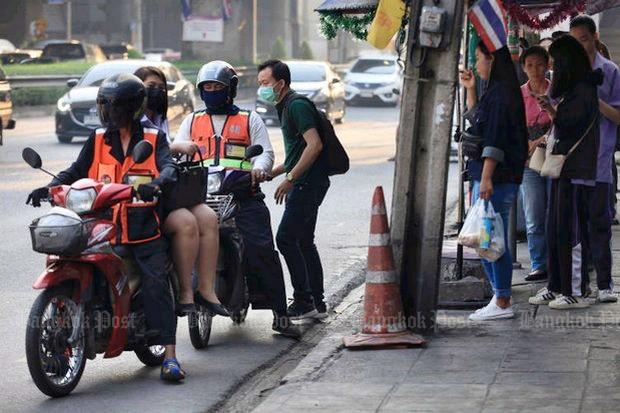
Despite the initial high costs and often dangerous roads, for many motorcycle taxi riders, commonly referred to as motorsai, work is still an appealing job that many opt to do in Bangkok to earn more money to help them pay the bills.
Motorcycle taxis are a popular method of commuting for Bangkokians, especially during rush hour. Their fees range from 15 to 40 baht or more depending on the distance.
According to recent research by the University of the Thai Chamber of Commerce (UTCC) into 1,243 motorcycle taxi riders, orange vest riders make around 975 baht a day, or 24,500 per month. They usually work 25 days a month, make 41 trips a day and clock in at least 9 hours every day on average.
Their monthly expenses include fuel, rent for their allotted spot and payment instalments for their motorcycles, and work out to about 11,600 baht, which leaves them with nearly 13,000 baht per month on average.
"We make as much money as recent graduates whereas we only got to 6th grade," said Kasem Punrat, a 51-year-old motorcycle taxi rider whose pillion has been in service for almost 24 years.
"I usually make around 800-900 baht a day. I always save 500 baht every day, no matter how much money I make. The rest goes towards my daily expenses such as food and fuel."
"I only take Sundays off, which means I ride 27 days a month, so I have around 13,500 baht at the end of each month. When you think about it, it's really not bad at all."
However, Mr Kasem said that being a successful motorcycle taxi rider depends on how hard he is prepared to work and what a rider's family situation is like.
"My kids have all married off, and my motorcycles are all paid for. So all I have to pay for are food and fuel expenses. But some young riders still have kids to raise, so they have to make much more money than me."
Like 39-year-old Puwadol Sinkaew, who has two children to take care of and works two jobs simultaneously. "My main job is as a courier rider but I also ride a motorcycle taxi in the evening after I clock out of my day job," he said.
"My salary as a courier is 15,000 baht, which I put towards my kids' education and my motorcycle instalments. The 500-600 baht I make from riding a motorcycle taxi pays for my daily expenses, like fuel, food and cigarettes. Any that is left, I try to save.
"Most of the young riders work as couriers as a main or side job. Working only as a motorcycle taxi would not be enough to raise kids. But when they've all graduated, I plan to give up the courier work," he said.
"Riding a motorcycle taxi is not bad. You're free to work when you please. You make your own schedule and you're your own boss. The only downside I see with this occupation is that there are still many riders who work using white licence plates. They don't do everything according to the law."
According to the UTCC, more than 30.4% of motorcycle taxi riders have not registered for the yellow licence plates which permit them to carry passengers legally.
"If you want the yellow plate, you have to obtain a public vehicle driver's licence. And in order to do that, you must not have a criminal record," said one rider who asked not to be named, referring to Section 46 of the Road Traffic Act drafted by the military government.
"I can tell you that ex-convicts make up 20-30% of orange-shirt riders. Motorcycle taxi stands are a last chance for many of us. The job doesn't require a high level of education, you just have to know how to ride a motorcycle. But with all these rules, the junta cut off many people's chance to start over," he said.
"I know they're trying to make the system better, but they don't really see the problems grassroots people face every day. They just drafted the rule without even considering what it's like to live a day in our shoes.
"We don't want to be illegal, but sometimes in life you have to do what you have to do," he said.