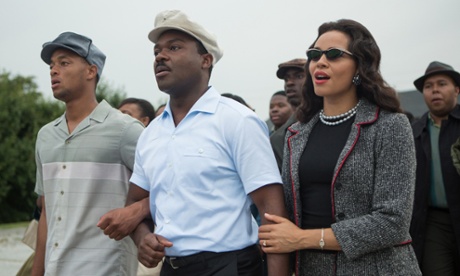
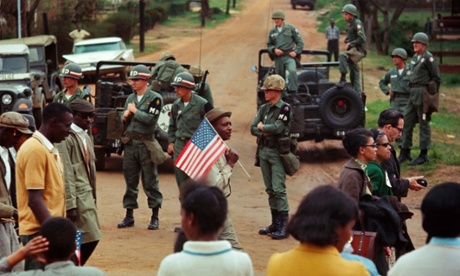
To watch the film Selma on Friday, Joe Evans will drive the 54 miles from his home in Montgomery, Alabama, to Selma, a distance he knows all too well. It is the same path he marched on 7 March 1965, where he was teargassed and watched others being beaten by state troopers and local police.
“It was a frightening scene, terrifying. People are burning, horses are running after you, you lose where you are, it was a dramatic experience, probably the worst disaster I’d ever been in in my life,” says Evans, 66. “But thank God we made it.”
Selma, an Oscar-tipped docudrama, tells the story of that march. Led by Martin Luther King Jr, the march is credited with prompting the passage of the Voting Rights Act of 1965, one of the pioneering victories of the civil rights movement. Paramount Pictures, the studio releasing the film, announced last week that it would premiere the film for free in downtown Selma, but the screenings, scheduled for Friday through Sunday, are temporary: Selma has struggled to maintain a first-run cinema, which has forced moviegoers to travel more than 40 miles to sit beneath the silver screen.
Selma’s mayor, George Evans, wants to change that. Evans, who is black and grew up in Selma, remembers being forced as a child in the late 1950s to watch movies in the balcony of the Walton Theatre, which was not yet racially integrated. Built in 1914, the Walton served as a vaudeville theatre and movie house. It closed in the 1970s and lay dormant for over a decade until it was restored and transformed into a local performing arts venue.
While the Walton thrived as a community playhouse, it stopped showing movies, which created a kind of cultural segregation for the city: for two decades, to see a first-run blockbuster, Selma residents were forced to drive nearly 40 miles to Prattville, a Montgomery suburb that, unlike Selma, was majority white and affluent. For many, the drive was not just costly and time-consuming, but often dangerous: returning home meant navigating dark country roads.
When Evans took office in 2008, he wanted the movies back in Selma. With the Walton now under city ownership, he pushed the city to spend over $100,000 to install the theatre with a digital projection system and hired David and Sharon Jackson, both retirees who relocated from Long Beach, California, to Selma in 2010 to serve as managers.
“It was an investment in our city,” says Evans, 70. “A way to right an old wrong.”
The Jacksons had little background in running a movie theatre, but within months had the Walton up and running. To successfully operate a 270-seat, single-screen theatre in the age of Netflix and Redbox meant getting creative. They established a relationship with the major studios, learned how to choose films that Selma residents wanted and hustled to fill every role necessary, from popping popcorn to working the projection booth to marketing upcoming releases.
For Mayor Evans, being at the Walton as an adult was an entirely new experience compared with when he was a child in the Old South. “We had no problems, black or white. All of the community came out and we had diversity at all of the movies,” he says. “For me, that sent a powerful message.”
The Jacksons lasted two years in the job and the Walton closed in December 2013 and has not reopened. Mayor Evans says he hopes to get a new operator in the spring.
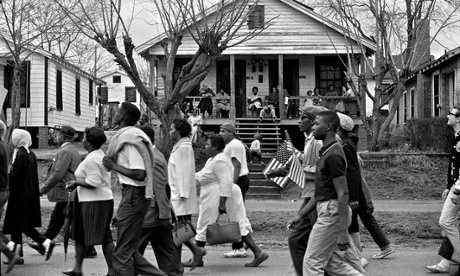
Selma the film opens in a significant year for the town. Not only is it the 50th anniversary of the historic marches, but April marks the 150th anniversary of the end of the civil war. Evans says Selma will be celebrating both.
“I want people to come to see Selma now and see that even though those things happened then, things change,” he says. “We should never forget, but we should never try to get even.”
Evans was in college in Kansas during the Selma marches, but he got updates from his younger brother Joe. Now 66, Joe Evans says he is grateful he played a role in history, but is worried that apathy among black voters has sunk in, which he says has worsened due to the continuing stalemate in Congress during the Obama years.
“The most critical thing about the movie is that there were so many people that gave up so much to give our people the opportunity to have freedom to choose,” he says. “And now that we have it, it seems like, in some cases, we have taken it for granted. We made progress but sometimes you cannot sit down on your game. The momentum has to keep going forward.”