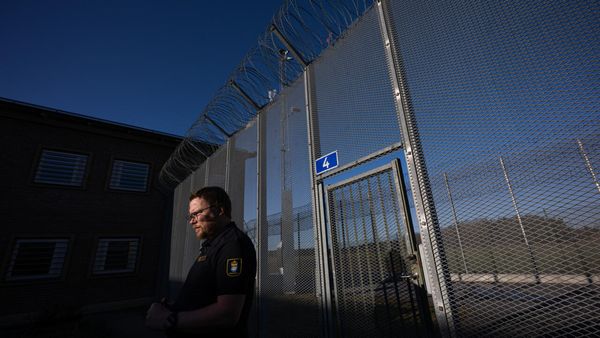
WASHINGTON _ The 17-year-old Guatemalan boy has been in a California detention center for migrant children for more than 400 days.
He's one of the longest-held of the roughly 1,800 minors in the U.S. immigration detention system _ the largest in the world, and one now riddled with the novel coronavirus.
Federal detention of immigrants is civil, not criminal, and migrant children have special protections under a decades-old legal settlement known as the Flores agreement, which requires the government to hold them in "safe and sanitary" conditions and make "prompt and continuous" efforts to release them and reunify families. Two federal judges in recent weeks have ruled that the administration has violated the terms of that agreement in its handling of migrant children.
The Guatemalan teen _ detained at the center in Fairfield, in Solano County _ has been held by the Trump administration for 20 times the 20-day maximum allowed under Flores.
It's not for lack of someone wanting to take him. When Bryce Tache and James Donaldson read on social media about the teenager, whom they call Mariano to protect his identity, the Minneapolis couple quickly applied to sponsor him, which would allow him to be released.
That was six months ago.
Now they fear the administration is using the pandemic to try to keep the boy until he turns 18, when officials can more easily deport him.
Officials at the Department of Health and Human Services, which oversees the detention of unaccompanied minors, denied making any policy changes amid the pandemic to prioritize enforcement actions against migrant children and parents.
"HHS is a child welfare agency, not a law enforcement agency," spokesman Mark Weber said Friday. "If there is a delay in unification, it is for public health reasons."
Across the country, however, lawyers who represent migrant kids say the administration is refusing to release children to ready sponsors. Court documents and lawmakers back them up.
Trump administration attorneys have argued in court that children are safer from COVID-19 in custody _ even as the government quietly ramps up efforts to deport them. In recent weeks, officials have pulled scores of children and parents from detention in secretive operations to remove them from the U.S., according to lawyers, migrants' affidavits and the receiving countries. Some were sick. A number were challenging administration policies in court.
Since March, when President Donald Trump declared a national emergency over the coronavirus, the administration has cut the population of detained kids and families by about 2,400, according to data from the Office of Refugee Resettlement, or ORR, the agency in the HHS department that Congress charged with the care and placement of unaccompanied migrant minors, and Immigration and Customs Enforcement, which detains migrant kids with their parents.
But releases of kids to sponsors, already slowed under Trump, have nearly stalled during the same time period, recent litigation shows.
After the administration essentially sealed the U.S. border in March as part of its coronavirus response, few new children and families have entered the system: The number of unaccompanied migrant children turned over to the refugee resettlement office has dropped roughly 97%.
At the same time, ORR has released far fewer kids to sponsors than in previous months, and those left behind are being held longer.
Since March, the agency lists about 50 children as having been removed from the U.S. and roughly 180 more as having been transferred to ICE custody. ICE wouldn't say how many minors it had deported.
The U.S. data appear to conflict with numbers from the countries receiving U.S. deportees. From March through May, Guatemala's immigration officials, for example, report that the U.S. has deported 417 minors to that country alone.
"We don't get notice from the government when families get dragged from their rooms in the middle of the night," said Shay Fluharty, director of the Dilley Pro Bono Project, a legal clinic at an ICE detention center in Dilley, Texas, that holds kids with their parents.
Laura Pena, a former ICE attorney, now works as pro-bono counsel with the American Bar Assn.'s Pro Bono Asylum Representation Project, which helped represent an unaccompanied 16-year-old recently deported to Honduras.
"It's outrageous, trying to deport this child and deny them rights during a pandemic," Pena said, a few hours before the girl was removed from the U.S. "Why?"
The Los Angeles Times reviewed extensive court records and spoke with more than 20 officials, lawyers, potential sponsors and immigrants for this story. Many spoke on condition of anonymity for fear the administration would retaliate against children and families in custody.
In one case, officials in the ORR blocked a detained teen from speaking to a reporter, despite the permission of the teen, her parent and her legal representatives. The "individual risk posed to the minor seems to far outweigh the benefit" of an interview, the agency said.
ICE provided data on families and COVID-19 cases in custody but did not respond to questions about its policies.
Lawyers across the country said that under the cover of the coronavirus, the ORR is coordinating with ICE to target kids in custody for removal.
"Just as all of this craziness happened with the coronavirus," said A'Kiesha Soliman, a lawyer with the unaccompanied minors program at Diocesan Migrant and Refugee Services in El Paso, Texas, "it seems like they're ramping up deportations of children who we'd normally have more time to find relief for."
Soliman warns young clients that despite legal rules designed to protect them, "they can be removed at any time."
In Mariano's case, the ORR has refused to consider the Minneapolis couple's application because they aren't legal guardians or immediate relatives and didn't have a prior relationship with the teenager, according to Ricardo de Anda, the boy's attorney.
Mariano's parents gave permission in an affidavit for him to be released to the Minnesota family. Grinding poverty in the Guatemalan highlands led them to abandon Mariano when he was a boy, de Anda said. They gave him to another man who tried to pass him off as his biological child while entering the United States last spring, court documents say.
Federal rules require additional checks for victims of trafficking as well as for potential sponsors who didn't know a minor before he or she arrived in the U.S. _ but neither disqualifies a child from being placed with a family.
De Anda helped Mariano sue, arguing that the government was violating his rights by denying him sponsorship and protections.
"You have good-hearted Americans who take this child under their wings," de Anda said. "But it's like pulling teeth."
Tache and Donaldson and their two teenage sons have moved into a larger home so that Mariano would have his own room. The couple hopes to win guardianship of Mariano by attesting that as a trafficking victim, he is eligible for a Special Immigrant Juvenile visa.
With the government restricting transportation of migrant children amid the crisis, they said they are prepared to drop everything and drive to California to pick Mariano up.
For now, they talk with him at least once a week by phone. The teen describes some detention staff as wearing masks but not practicing social distancing. He's increasingly depressed.
"What if he gets sick tomorrow or the next day?" Tache said.
"I personally believe the government's end goal is to send everyone back to their country of origin," he said. "The right thing and safe thing for him right now is to be with a family who can help him."