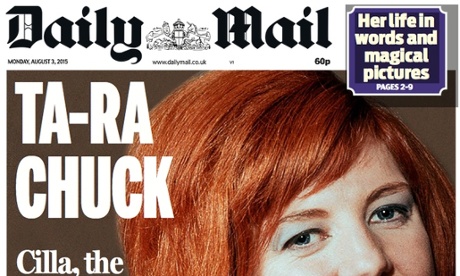
Cilla Black dominated Monday’s front pages. The death of the great grand-daughter of Irish immigrants pushed the Calais migrants’ crisis into second place.
It is highly likely that people younger than, say, 21 had never heard of the woman who became one of Britain’s most famous TV personalities and, in the process, a national treasure.
But the newspapers, with pages and pages of coverage, reflected the peculiar affection that Black held for the baby boom generation. She symbolised the social class changes that occurred after the second world war, first through her music and then through her pioneering of populist television shows.
The tributes, in noting her rise to fame courtesy of the Beatles, illustrated the importance of her Liverpudlian background along with the city’s accent, which she never lost and never tried to lose.
It was celebrated in several headlines: “Lorra, lorra tears” (Sun); “Ta-ra chuck” (Daily Mail and Metro); “Cilla dies aged 72 after a lorra laughs” (Times); “Our Cilla: the singer who gave us a lorra, lorra laughs” (Independent) and “A lorra lorra tears for Cilla” (Daily Star).
Two others simply registered her hold on public affection: “Our national treasure” (Daily Mirror) and “She captured all our hearts” (Daily Express).
She was, said the Daily Telegraph’s headline, the “star who always felt like a friend in your living room.” And the Guardian, on the front page, echoed that view: “Two starry careers - but always ‘Our Cilla’” (Guardian).
Popular paper leader writers tried to sum up what the woman born Priscilla White in 1943 meant to the British people.
“We loved her because of her voice, her humour and her humanity,” said the Mirror in considering “her amazing Cinderella story.” It continued:
“In the golden age of television she was television gold. Yet during all her years at the top she never stopped being Our Cilla: the girl next door with the smile, those teeth and that infectious laugh.
She could sing, dance, act and present. But above all she entertained... There was in all of them a common theme: the recognition of her genuine warmth and kindness. She touched our hearts because if anyone had a heart, she did.”
The Sun said: “It’s easy to think of Cilla as ‘just’ a TV presenter or ‘just’ a singer. But Cilla was never ‘just’ anything.” She was “a truly British star.” It went on:
“In her first career, she was the ordinary Liverpool girl with the extraordinary voice.
And then in the 1980s and 1990s she was the person we welcomed into our front rooms on a Saturday night. She felt like one of us. Even if she also happened to be a superstar.”
And the Express believed she “brought happiness, joy and the occasional tear to our Saturday nights with Blind Date and Surprise Surprise. Cilla was a natural entertainer because all she had to do to make the nation smile was be herself. And she did that brilliantly.”
Mark Lawson, in the Guardian, wrote of her as portraying a wholesomeness that made her “an unlikely entertainment megastar”:
“Female performers were often required to fit a template of sexiness imposed by male executives. Cilla challenged these stereotypes in both her recording and broadcasting careers.
Though attractive and perky, she never pretended, as a singer, to be anything other than the good Liverpudlian Catholic girl she was, giving the impression, unusually for the 60s music scene, that she was more likely after a gig to opt for cocoa with her mum than a beer with a Beatle.
As for television, she liked to claim, in autobiographies and interviews, that her career had been revived through being, as she described herself, ‘sexless.’”
Christopher Stevens, in his Mail article charting her career, reminded readers of the way in which her personality - “glamorous, effervescent and overflowing with fun” - informed all she did and was the reason for popularity.
In the obituaries, there were also remarks and quotes that highlighted Black’s unselfconscious, down-to-earth appeal:
The Times said she “shrugged off... sneers” about her working classness. It said: “If her achievements in popular culture were not particularly profound or thought-provoking, she was always ‘real’ and was widely and genuinely loved for it.”
The Telegraph quoted her as once observing: “I didn’t want to be Doris Day, but I wanted what went with it. She’d talk about her backyard and it was three acres of lawn; our backyard was where we kept the coal. I wanted her backyard, the fame and fortune.”
The Independent argued that Black “embodied the Sixties spirit of working-class people with talent suddenly having the opportunity to prove it. In the words of Twiggy, it was “a time when ordinary people could do extraordinary things.”
And the Guardian’s obituarist, Dave Laing, contended that her Liverpool accent “acted as a guarantor to viewers of her down-to-earth decency and sincerity.”