Get all your news in one place.
100’s of premium titles.
One app.
Start reading
The Guardian - UK
The Guardian - UK
Lifestyle
Graeme Robertson

Cider making: From the orchard to the bottle

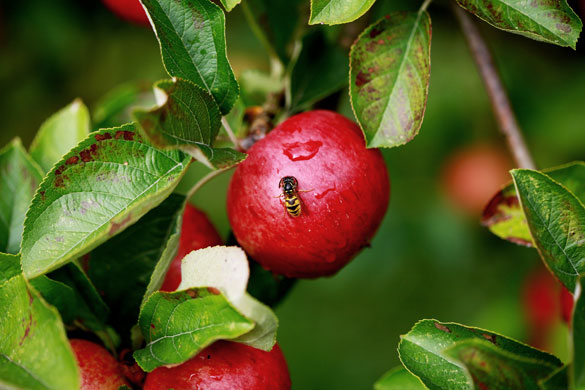
cider apple harvest: A wasp on a red apple during the apple harvest in Somerset
The 38-acre orchard was planted in 1972, before Gaymers existed. Now it is the company’s 'greenest' orchard – spare land is given to native trees and shrubs to encourage wildlife and birdhouses attract blue tits who feed on pests like aphids Photograph: Graeme Robertson
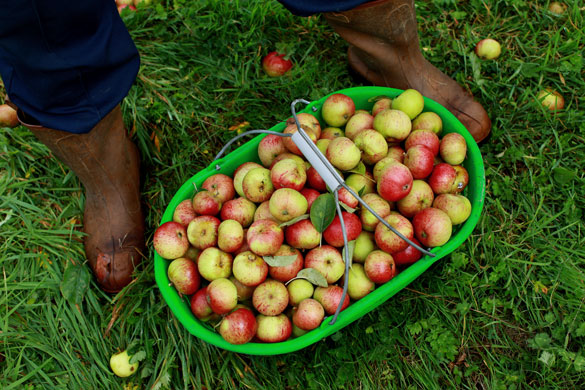
cider apple harvest: A basket of apples during the apple harvest in Somerset
Stewley is planted with 12 varieties of cider apple. 'Eight varieties too many,' the firm’s fruit orcharding manager, Bob Chaplin, says. The large number of different apples makes it harder to harvest as they each peak at a different time Photograph: Graeme Robertson
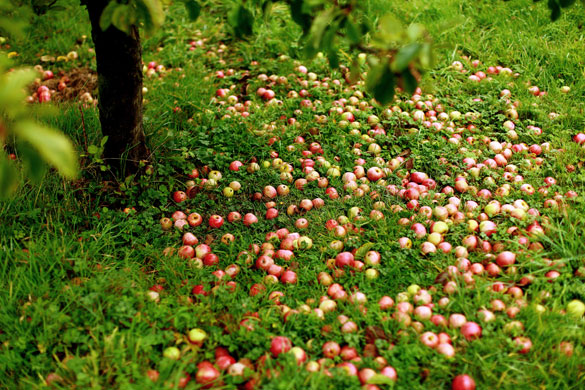
cider apple harvest:  Apples lying under a tree during the apple harvest in Somerset
The orchard has other problems too – there is clay underfoot, which stunts the apples growth, and it is pretty hilly. 'It’s a nightmare harvesting here,' Martin Riddle says, who looks after the orchard with his colleague Martyn Knight. Between them they prune the trees in winter and spring, look after them over the summer and gather the fruit in autumn Photograph: Graeme Robertson
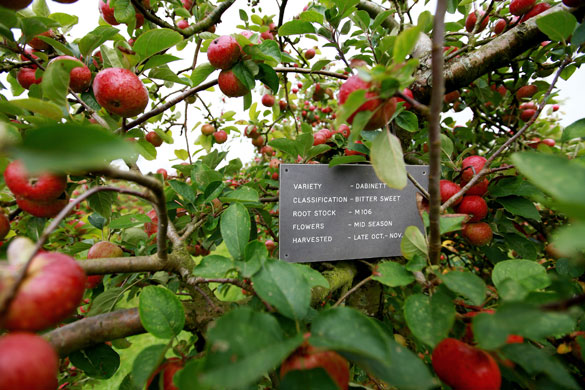
cider apple harvest: Dabinett appleson tree branches during the apple harvest in Somerset
Chaplin says a modern orchard would be primarily made up of Dabinett and Michelins – two mainstays of the West Country cider industry. The Dabinett is his favourite variety. 'With my cider grower’s hat on they crop well and they’re heavy; with my fruit processor’s hat on they press very well; and with my cider maker’s hat on they have lots of sugar and tannins,' he says.
He’s not so keen on Michelins – a greeny-yellow apple that is more acidic than the Dabinett or the Chisel Jerseys, another variety in the orchard. This one is prone to scab – a disease that keeps the fruit small and leads to brown patches and welts on the skin. Apples with scab are no good to cider makers
Photograph: Graeme Robertson
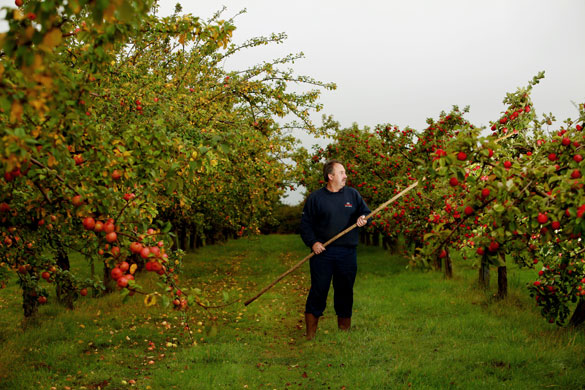
cider apple harvest:  A man knocks apples off tree branches during the apple harvest in Somerset
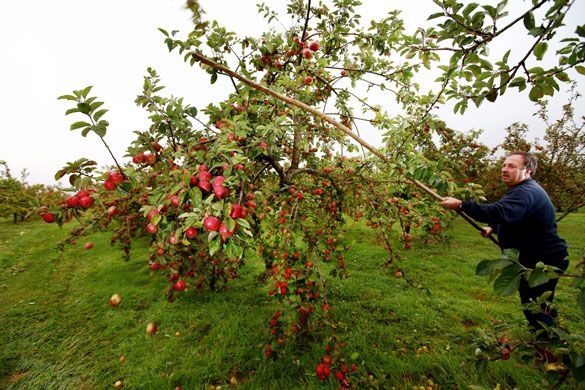
Between now and the end of November Martyn Knight (pictured) and Martin Riddle will gather 600 tonnes of fruit a week. One ton of apples creates around 750 litres of cider, so they will have a hand in the creation of almost 800,000 pints Photograph: Graeme Robertson
cider apple harvest: A man knocks apples off tree branches during the apple harvest in Somerset
Harvesting starts once the fruit is ready. To assess this you have to hit a tree with a stick. If the fruit falls easily it is ready to come off. 'This year the apples are tending to stay on the trees longer,' Chaplin says. The branches are banged with sticks to release the fruit because using a mechanical shaker would cause long-term damage to the trees Photograph: Graeme Robertson

cider apple harvest: Gaymer Cider Company's Stanley orchard
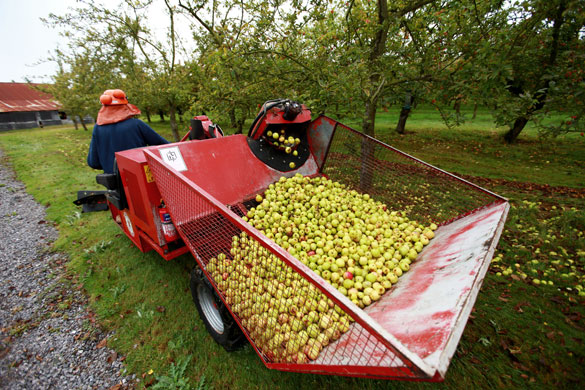
Once the fruit is on the ground it’s time to rev-up the collecting machine. Originally designed to pick up golf balls, this sweeps apples off the floor and sends them whooshing up a pipe before throwing them in a trailer. It can collect up to 15 tonnes a day Photograph: Graeme Robertson
cider apple harvest: The apple harvest in Somerset
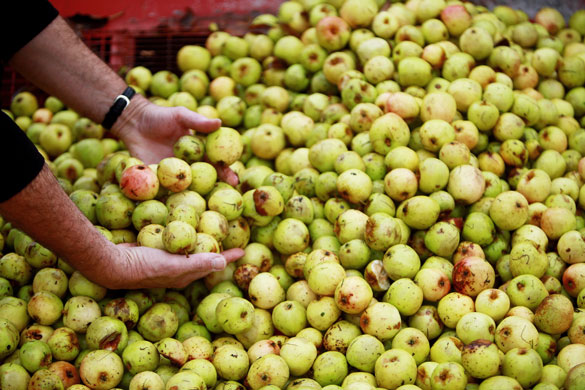
Cider apples get a hard time as they are gathered – not like the fruit we buy for eating, where looks are everything. As long as they are ripe and not rotten they can be used. All of the varieties are collected together. This is a common practice as most ciders are made with a blend of different apples Photograph: Graeme Robertson

cider apple harvest: A trailer load of apples is unloaded during the apple harvest in Somerset
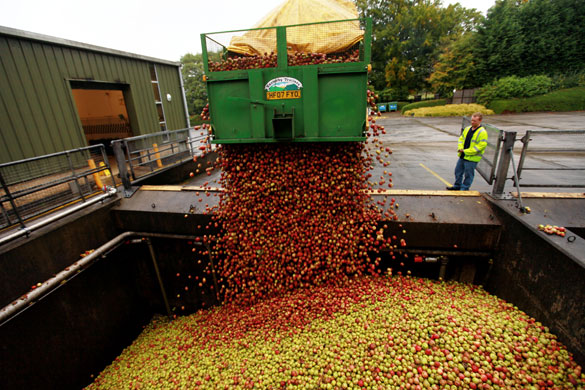
The fruit is then taken 33 miles to Gaymer’s plant at Shepton Mallet. They arrive alongside fruit from more than 65 growers around the county and are tipped into pits. There are six pits each holding 75 tonnes. Each lorry delivers between eight and 29 tonnes. The apples are all thrown in together – except those that go into single county and single orchard varieties. The late crops from Stewley are kept separate to create Stewley Orchard Reserve Photograph: Graeme Robertson
cider apple harvest: The apple harvest in Somerset
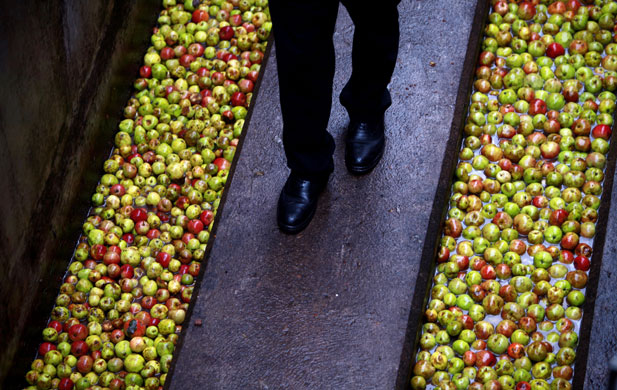
The apples are carried into the plant in a flume of water. 'This gives the apple a good wash, it treats it quite gently and the rotten apples sink and we can stop them going further,' Bob Cork, the general manager of the cider mill, says. Thousands of apples fly down a muddy stream. Inside they are spewed on to rollers which send them tumbling down into more water. They are then whizzed up to the choppers. From here the diced apples are moved to the presses where the juice is extracted Photograph: Graeme Robertson
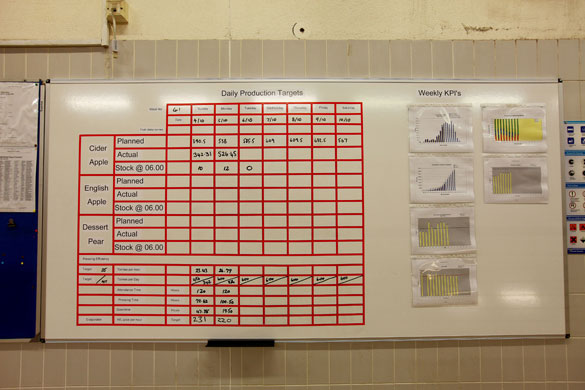
cider apple harvest: Production targets and key Performance indicators at Gaymers cider
Some of the juice is stored so the firm can make cider year round; some is used straight away. It is blended according to which kind of cider is being produced. Yeast is added and then it is left for eight to 14 days to ferment Photograph: Graeme Robertson
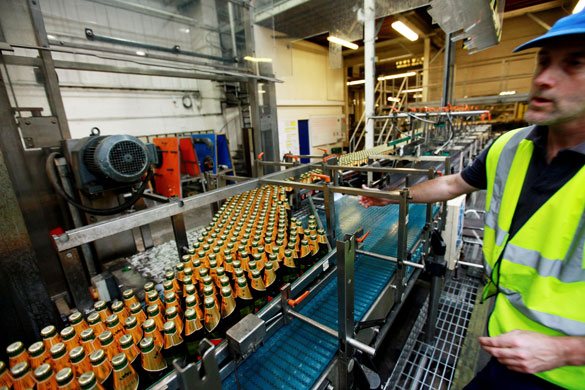
cider apple harvest: Bottles of Gaymers cider on the production line
After fermentation, dead yeast is removed and the cider is moved to a storage tank. From here it can be bottled Photograph: Graeme Robertson

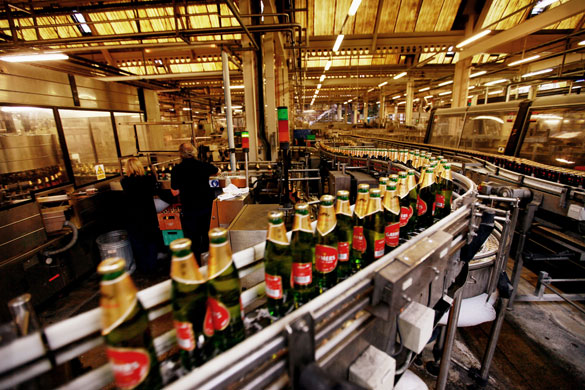
cider apple harvest: Bottles of Gaymers cider on the production line
'Three things go into a good consistent cider: one is the raw materials – you need good apples, and we have them with Somerset apples; two is the type of yeast you use – we have our own secret yeast; three is the temperature at which you ferment,' Cork says. The temperature can only vary by 0.5C Photograph: Graeme Robertson

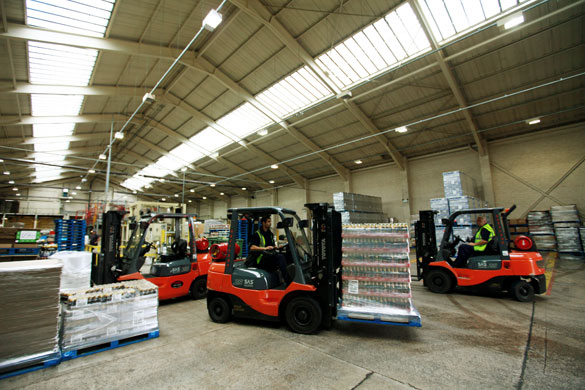
cider apple harvest: Bottles of Gaymers cider are transported by forklift truck
It will be at least three months before the apples picked this week have left the factory and arrived in your local pub or off-licence Photograph: Graeme Robertson

Sign up to read this article
Read news from 100’s of titles, curated specifically for you.
Already a member? Sign in here
Related Stories
Top stories on inkl right now
One subscription that gives you access to news from hundreds of sites
Already a member? Sign in here
Our Picks
Fourteen days free
Download the app
One app. One membership.
100+ trusted global sources.