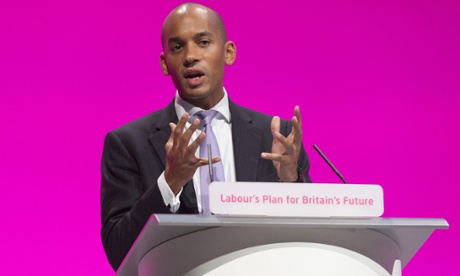
In the runup to the general election on May 7, we’re running a series of interviews with representatives from the main political parties. Chuka Umunna is shadow secretary of state for business, innovation and skills. We spoke to him about Labour’s promises to small businesses:
Business rates
The Labour party manifesto proposes to cut and freeze business rates for 1.5 million small business properties , instead of cutting corporation tax for large firms. The UK already has the lowest corporation tax in Europe .
The coalition has committed to a business rates review in 2017, after the 2015 review was postponed. Labour agrees that the current business rates system needs an overhaul, but hasn’t explicitly said it will follow the coalition’s review plan.
Asked whether small business owners can expect the same commitment from Labour, Umunna said: “The business rates review is ongoing and we will carry on with that review.” He added that this would be in addition to their cutting and freezing approach for small business properties. “That will see small businesses saving an average of £400. Those in properties with a rateable value of up to £50,000 will benefit.”
Zero-hours contracts
In recent speeches Ed Miliband has emphasised that Labour would crack down on zero-hours contracts. While this is seen to target large employers, it could affect small firms who experience seasonal peaks or can’t yet cope with the expense of permanent staff.
It costs a small firm £35,000 on average to take on their first employee, according to research from the Centre of Economics and Business Research and the Federation of Small Businesses (FSB).
Umunna said this issue has come up during his discussions with small business leaders. “I’ve just been visiting an incubator in Northampton and one business owner there spoke to me about zero-hours contracts,” he said. “But we want to target them where they are discriminatory, for example, where someone comes in for a shift and finds it cancelled or who doesn’t know how many hours they’ll be working from one week to the next”. However, under Miliband’s most recent announcement, employees working regular hours would be entitled by law to request a regular contract after 12 weeks of work.
Fee for industrial tribunals
In its manifesto, Labour proposes dropping the fee for a member of staff to bring an industrial tribunal against their employers, which at the moment costs £1,200.
This has the potential to have the biggest impact on the smallest firms that can’t afford lawyers’ fees and, with limited resource, could be bogged down by the paperwork of legal proceedings.
Umunna insisted that rather than undermining employers, removing this fee was designed to protect workers. “The fee system under the current government has seen an 80% drop in sex discrimination claims and that’s not something we want to see in 2015,” he said. “Business organisations [...] want to distance themselves from the changes [around industrial tribunals] that were made under the current government. It’s the good employers that lose out at the moment.”
European trade
In a recent small business network poll of our readers’ biggest election concerns, membership of the European Union came out on top. The EU is the UK’s largest trading partner, and the possibility that exporting rights could be removed could be a worrying uncertainty for small businesses. Some of the main parties, including the Conservatives, are proposing a referendum on our membership. What can Labour offer to reassure SMES? “We have a commitment to making sure that the UK remains a member of the European Union,” says Umunna. “We need to expand that [export] network to other markets, China and beyond. That’s fundamental.”
‘Northern powerhouse’
The term “northern powerhouse” was a recurring point of discussion during the recent FSB annual conference. It refers widely to growing the economy outside of London and the south-east through devolving powers, improving transport links and encouraging the creation of groupings of northern authorities to compete with London and other world cities.
In his recent budget, George Osborne announced that devolved business rates, where local authorities can keep 100% of business rates growth, rather than sending them back to central government , will continue for Greater Manchester, Leeds and Cambridge.
Umunna says this approach is working well. “The example of devolved powers, in somewhere like Leeds where there are combined local authorities, encourages growth and creates a local enterprise partnership,” he said. He added that Labour supported the continued work on transport links, such as the work on HS2.
Local initiatives
As shadow business minister Umunna was involved in bringing US initiative Small Business Saturday to the UK. The annual event, which encourages consumers to shop in smaller companies for the day, has enjoyed growing success year-on-year.
Umunna, who has been MP for Streatham since 2010, said that small businesses are fundamental to his constituency. Another topic discussed widely at the FSB conference was the potential for a small business minister to represent the leaders of small firms. While Umunna wouldn’t commit on this, he said a Labour government would be considering this addition if they came into power.
Sign up to become a member of the Guardian Small Business Network here for more advice, insight and best practice direct to your inbox.