There was Black Friday, when people fought for cut-price TVs, followed by Cyber Monday, forecast to be the year’s busiest online shopping day. But this weekend will see shoppers’ focus shift when millions of people descend on superstores, florists and street markets to spend more than £1bn buying an estimated 6.5m Christmas trees.
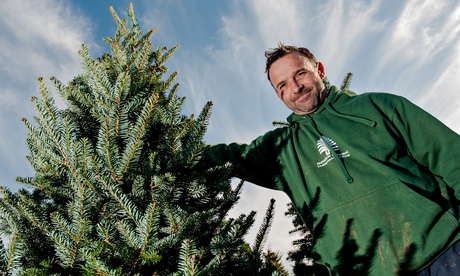
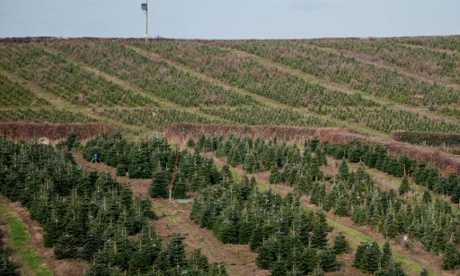
Rob Morgan and family at Poundffald farm on the Gower, near Swansea, who grow about 350,000 trees on 120 hectares (300 acres) – including one destined for 10 Downing Street – have been waiting for this moment for months. Last weekend they had a sense of what was coming when half-mile traffic jams built up in their village of Three Crosses as people queued to get to their farm.
The three young Father Christmases sitting in their grottos in an old barn were overwhelmed and the 23 reindeer, which Morgan’s family have bred, looked tired between posing for selfies with a robotic polar bear and eating handfuls of imported Swedish lichen.
This weekend will be the most intense of the year, Morgan says. “People are buying trees earlier than ever. I don’t know how we’ll cope. It’s warfare out there, I tell you. The kids love seeing where the trees are grown but the parents quarrel like anything over which one they should buy. I’ll have to have solicitors here next year.
“A woman can spend two hours choosing a tree, but they always go back to the first one. The men get up to all kind of tricks. I’ve seen people swap labels on the trees to get a better one. I think I’ve created a monster,” he says.
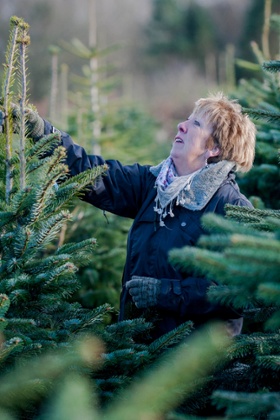
Morgan, a relatively small grower, expects to sell nearly 10,000 trees over the Christmas period, ranging from £25 metre-high blue spruces to three-metre Nordman firs on sale for £90. Most families will want well-shaped 5ft to 6ft (1.5-1.8-metre) trees , he says, but the price they will pay depends on postcodes. Expect to pay more than £100 for such a tree in central London, £60 for the same tree in the suburbs, and £40-£50 for it elsewhere.
But the finest tree on Poundffald farm this year will be given away. A tall, slow-growing Nordman planted nearly 10 years ago will be cut down on Sunday and delivered to 10 Downing Street on Monday morning.
It will be erected in the Pillared Room where Tony Blair entertained the England rugby union team after they won the World Cup in 2003 and where John Logie Baird gave Ramsay MacDonald a demonstration of his invention, the television, in 1927.
Morgan, whose rugby-player father Dai bred the 1987 Grand National winner Maori Venture on the farm, was asked to provide No 10 with a tree after he beat 300 other Christmas tree growers in a competition in October. “Eleven foot six. That’s the height that Downing Street wants.
“It’s the first time a Welsh tree has been chosen to go to Downing Street so it’s like winning the Royal Welsh show.”
Morgan, like many other family farmers, got out of animals and crops and into Christmas trees after foot and mouth disease and then depressed milk and food prices in the 1990s. But he has found the tree trade just as fiercely competitive, with crooks and sharks at every turn. A field of 1,000 premium trees inspected in October may be delivered to the retailer in second-class condition. A single tree may be sold several times between dealers before the public sees it. Trees bought from supermarkets are likely to have been cut months earlier.
Morgan says the way to tell a fresh tree is by its weight. “The heavier it is, the later it will have been cut. Some of trees imported from Lithuania, Ireland or Denmark will be light as feathers. You have to have an instinct who to deal with,” he says.
The trade is changing, says Harry Brightwell, secretary of the British Christmas Tree Growers’ Association. “There’s all kind of people growing them now. Some are farmers diversifying into trees but there are estates with over 1m trees in Scotland. It’s an industrial crop now. But we still can’t get enough good trees and we have to keep importing them from Denmark and Ireland.”
“The difficulty is you have to wait eight years before you get a return. You can get an attack by insects and lose the lot. But it’s different from selling other crops. People are generally in a good mood when they buy them.”
Except, says Morgan, two weekends before Christmas.
Christmas trees: the first, the best and the oldest
• Approximately six million Christmas trees are sold each year in Britain, with more than 90% of families decorating a tree.
• The Forestry Commission rates the Noble Fir as the best tree for holding its needles. It takes 10 years to grow to a sufficient height.
• The Trafalgar Square Christmas tree has been donated to London by the people of Norway since 1947, as a thankyou for British support during the second world war. The tree is selected from forests surrounding Oslo and is between 50 and 60 years old.
• The Christmas tree tradition was brought to the UK by Prince Albert in 1841 to remind him of Christmas as a child in Germany. A drawing of Queen Victoria, the prince and their children with the family tree was published in the Illustrated London News in 1848, prompting families all over Britain to follow the trend. Trees were decorated with candles, fruit and homemade ornaments.
• A 100ft tree in Wrest Park, Bedfordshire, may be the oldest Christmas tree in the UK. It was planted in the park in 1856 by Thomas, 2nd Earl de Grey, then transported to the mansion each year to be decorated before being replanted after Christmas, until it became too big to carry and was left where it was. Still going strong, the tree has been decorated this year for the first time in a century.
Ashley Chalmers