The playwright Christina Reid, who has died of pancreatic cancer aged 73, was one of a prominent group of Belfast playwrights whose work in the 1980s gave an often flintier and more directly working-class take on the Troubles than the more critically lionised, poetic theatre in Dublin. Along with Anne Devlin, Martyn Lynch, Graham Reid (no relation) and, later, Gary Mitchell, Reid provided a ground-level guide to the tensions and fissures in Northern Ireland during recent times. It was ironic that the first play of hers seen in London, Joyriders (1986), was a deliberate response, and maybe a riposte, to Seán O’Casey’s The Shadow of a Gunman (1923), set in the Irish war of independence.
Joyriders was written after Reid visited the notorious (and now demolished) Divis Flats in west Belfast, an IRA stronghold and a battleground of social deprivation, with glue-sniffing teenagers “joyriding” through military checkpoints and brick walls. Reid’s four youngsters in the play are joining a scheme run by a middle-class woman trying to encourage them in developing domestic skills such as hairdressing, cookery and knitting.
From an early age, Reid wrote about other people’s lives, and those of her immediate family, because she thought her own was of no great interest. She even fictionalised her own diary. But it was years before she started to submit short stories to the BBC in Belfast. In her mid-30s, having raised a family of three girls, she embarked on an English literature degree at Queen’s University, Belfast, which she promptly abandoned when the Lyric theatre in the city produced her first play, Tea in a China Cup (1983).
She was the daughter of James Orchin, a Belfast docker, and his wife, Christina, who worked in the linen mills and also as a waitress. The family – she had two younger brothers – lived in the Ardoyne area of Belfast and Christina was educated at Everton primary and Belfast Model School for Girls. She left school aged 15 and worked in a variety of clerical and secretarial jobs before marrying Michael Reid, a civil engineer, in 1963.
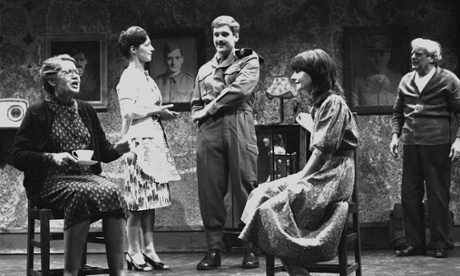
Tea in a China Cup was a memory play, covering the period from 1939 to 1972 in the company of three generations of Protestant women (Reid’s family) during the 12 July Orange Order parades and celebrations. The Irish Times noted that “through a succession of small, revelatory incidents, a tapestry of humour, prejudice, affection, courage and pretence is woven over a ground of sympathy”.
Her name was made, and she followed up with Joyriders, for the touring company Paines Plough. This tough, funny and pungent play, with lots of songs, was a hit with the critics when it played at the Tricycle theatre in Kilburn, north London, and her next work, The Belle of Belfast City (1989) – five women in a corner shop unravel themes of sectarian racism and sexism during the week of an anti Anglo-Irish agreement rally – won the Royal Court’s George Devine award, though it was not seen in London until an impressive revival at the Orange Tree, Richmond upon Thames, in 1993.
By this time Reid had divorced and remarried, to the actor Richard Howard. In 1987 they moved to Twickenham in south London. She adapted one of her many radio plays, My Name, Shall I Tell You My Name? (1987) for the Dublin theatre festival of 1989, again using a series of flashbacks to detail the antagonism between an unforgiving Protestant first world war veteran and his granddaughter in Derry, weaned on his stories.
Reid experimented more obviously with form in a riff on Romeo and Juliet in Did You Hear the One About the Irishman? (1993) at the King’s Head in Islington; different religions in a marriage led directly to fatal consequences for young lovers, the proceedings punctuated with deliberately off-colour racist jokes, as implied in the title.
And when the peace process got under way, Reid responded by tracing the stories of her teenagers in Joyriders eight years on: Clowns (1996) at the Orange Tree was full of ghosts, including that of the girl killed by an army bullet, but two of the gang had made careers, in restaurants and stand-up comedy. The sequel did not attract as much attention as the original, though the critic Lyn Gardner admired the delicacy of the writing and the clear-eyed realism demonstrating all too clearly “that living through a war may be hard but making the peace can be even more painful”.
She continued to write short, vivid, arresting plays for radio and young people’s schemes such as the NT Connections at the National Theatre, always writing in longhand and typing at night when the house was quiet. She served as patron of the charity Youth Action Northern Ireland, and was a dedicated Halloween party-thrower and keen gardener.
She is survived by Richard; her brothers, John and James; three daughters, Heidi, Tara and Siubhan, from her first marriage; and seven grandchildren.
• Christina Jean Reid, playwright, born 12 March 1942; died 31 May 2015