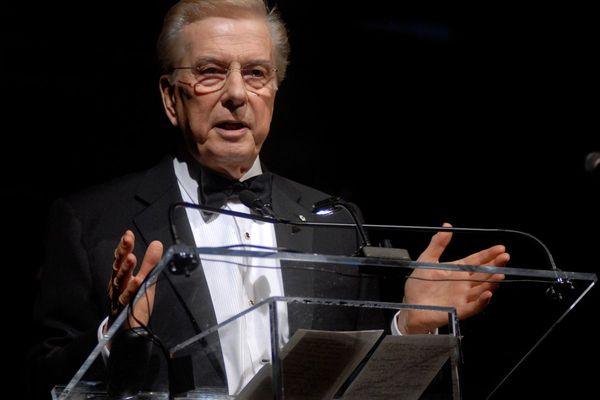
Christian apologist Frank Turek has told students in Tennessee that the discovery of aliens would not topple Christianity, arguing that any intelligent life found elsewhere in the universe would still fall under the authority of the same creator worshipped on Earth.
For context, Turek's comments come amid a renewed cultural obsession with aliens and UFOs, fed by congressional hearings on unidentified aerial phenomena, viral clips of strange lights in the sky, and a whole new wave of Hollywood speculation about life beyond Earth. Within US Christian circles, that curiosity has come with an anxious twist: are aliens real, and if they are, do they threaten the core of the Christian story?
Turek, speaking at an event at the University of Tennessee, was asked directly how Christians should respond to all the noise about aliens and unidentified flying objects, and how to 'talk people off the ledge' when friends or family spiral into fear or fringe theories. The question reflects something quite real among churchgoers, especially in the US, where talk of disclosure, cover-ups and demonic deception is now standard fodder in some pulpits and podcasts.
His answer was notably calm, almost disarmingly so. Unidentified flying objects, he said, were just that: things we cannot yet explain. 'Unidentified flying objects in my view are unidentified flying objects,' he replied. He followed with a blunt admission that would make many conspiracy channels grind their teeth: 'I don't know if there are aliens or not. Is there intelligent life out there?'
From there, Turek drew a very clear line. 'If there is intelligent life out there, it doesn't affect Christianity,' he insisted. 'God would still be the creator of that intelligent life.' The logic is straightforward enough. In his view, Christianity rests on claims about God, creation and the person of Jesus, not on human beings being the only conscious species in existence. A larger universe, in this telling, is simply a larger canvas.
Aliens, Demons And A Universe Full Of Questions
The discussion did not stop at benign extraterrestrials. Among some conservative Christians, one of the fastest-growing ideas is that aliens and UFOs are not visitors from other planets at all, but demonic beings in disguise. On that, Turek was more cautious and much less dogmatic.
He was asked whether he believed UFOs and extraterrestrials might, in fact, be demonic. His answer was short. 'I don't know.' Later he added that he was 'not sure where all this is going on,' but acknowledged 'some very strange happenings.' Even so, his bottom line stayed the same. 'No matter what it is, it's not going to defeat Christianity because aliens, if they exist at all, are inside the universe and had to be created just like us.'
That framing matters. Many Christians are not only wondering whether aliens are real, but whether their existence would blow up long-held doctrine about human uniqueness, the incarnation of Christ and salvation. Turek's position effectively shrinks that threat. If aliens are creatures, then they are not gods, and they sit under whatever rules the creator has set. That is the argument, at least.
Not everyone in religious life is willing to leave it so open-ended. In a video interview released last month, US Catholic priest and exorcist Monsignor Stephen Rossetti said he personally believed that 'probably many, if not most, of these UFO sightings are, in fact, demons; and they can do things that we can't do, such [as] the speed and all sorts of things that human beings can't do.' He made a point of stressing that he was not speaking on behalf of the Catholic Church.
The fallout was swift. Cardinal Robert McElroy of the Roman Catholic Archdiocese of Washington later announced that he had cut ties with Rossetti, saying the priest's comments and his organisation, the St Michael Center for Spiritual Renewal, 'gravely undermine the Church's very precise teaching on the devil, demons and exorcism.' In other words, even within one denomination, suggesting that aliens are basically devils in drag can cause institutional blowback.
Spielberg, Politicians And The Theology Of Aliens
While theologians and priests argue over demons and doctrine, Hollywood is, predictably, going for the jugular of belief itself. Director Steven Spielberg has suggested that his upcoming film on extraterrestrial life, Disclosure Day, will prod audiences to question 'the fundamental beliefs that many of us have'. In a recent interview, he flagged one of the film's central questions: 'Is God, our God, only on this planet, or is God a God for every system where there's civilization, intelligent life and even developing life?'
That is not just a cinematic tease. It is exactly the kind of question many believers are quietly asking and that some pastors would rather avoid on a Sunday morning. Turek has effectively already answered it for his own camp, saying that if aliens exist, they are creatures of the same God. Others will inevitably push back, arguing over what that would mean for ideas like original sin, redemption and whether, say, a lizard-like civilisation on some distant world needs its own version of Christ. Wild stuff, theologically speaking.
The conversation has also slipped into US politics. Last year, now–Vice President JD Vance was asked about extraterrestrial life and declined to take a firm position. 'I wouldn't say that I do or don't believe [in aliens],' he said, before pivoting to the spiritual realm. 'I'm a big believer that there are things out there we can't explain. And so, if another person sees an alien, maybe I see an angel or a demon.'
Vance went further, saying he believed there were 'spiritual forces working on the physical world that a lot of us don't see and a lot of us don't understand and a lot of us don't appreciate'. That kind of language, mixing UFO chatter with spiritual warfare, lands well with parts of the Republican base steeped in charismatic Christianity and apocalyptic rhetoric.
Former Georgia congresswoman Marjorie Taylor Greene, never one to underplay a dramatic possibility, took a more direct route when asked if she thought aliens were fallen angels. 'That's possible, I think that's what they could be. That's what makes sense in my worldview,' she answered.
So between a blockbuster director raising cosmic questions, a vice president talking about angels and demons, and a high-profile exorcist being frozen out by a cardinal, the old line between science fiction and Sunday sermons looks thinner than it once did.
Turek, for his part, is standing on relatively simple ground. He is content to admit uncertainty about what UFOs are, willing to say he does not know whether aliens exist, and adamant that even if they do, they sit inside the Christian story rather than outside it. Whether that argument will be enough to 'talk people off the ledge' when the next UFO video drops is another question entirely.