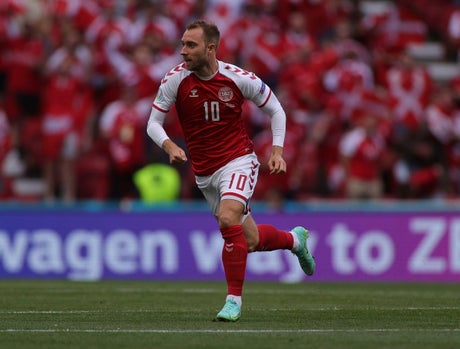
Christian Eriksen is unlikely to play football professionally again after his collapse during the Euro 2020 match between Denmark and Finland, an expert has said.
The former Spurs midfielder suddenly fell to the ground just before half time and was treated on the pitch before being taken to hospital, where he remains in a stable condition.
Professor Sanjay Sharma, professor of sports cardiology at London’s St George’s University, said there were several reasons Eriksen could have suffered a cardiac arrest, such as high temperatures or an unidentified condition.
“Clearly something went terribly wrong,” he said. “But they managed to get him back, the question is what happened? And why did it happen?
“This guy had normal tests all the way up to 2019 so how do you explain this cardiac arrest?”
Prof Sharma also said that it would be up to both the player and the club to assess the risks of continuing to play but claimed that the English FA would probably not allow him to play.
“I don’t know whether he’ll ever play football again,” he added. “Without putting it too bluntly, he died today, albeit for a few minutes, but he did die and would the medical professional allow him to die again? The answer is no.
“I think the Football Association will be very strict about whether he plays again or not. In the UK he wouldn’t play. We’d be very strict about it.”
One of the doctors who treated Bolton Wanderers footballer Fabrice Muamba said it would take time to establish whether Eriksen can make a complete recovery.
Cardiologist Dr Sam Mohiddin told BBC News: "It sounds like he has had successful CPR and he has regained normal cardiac rhythm because of defibrillation but there are other things that will have to be worked through."
He said that some stars with underlying heart disorders have had to stop playing sport because they are considered to be at risk.
Dr Mohiddin added: "The moment of extreme peril is the time of the cardiac arrest and treating that is a matter that requires people to promptly recognise what is happening and really address it quickly with CPR and a defibrillator.
"CPR saves lives. Most of us should learn how to perform CPR for all sorts of reasons and not just because cardiac arrests can affect sportspeople. Many other people will die of cardiac arrest."
Fabrice Muamba suffered a cardiac arrest during the first half of Bolton's FA Cup quarter-final at Tottenham Hotspur in March 2012.
He recovered but announced his retirement from professional football six months later, aged 24. More recently he has worked as a youth coach.
Additional reporting by Press Association