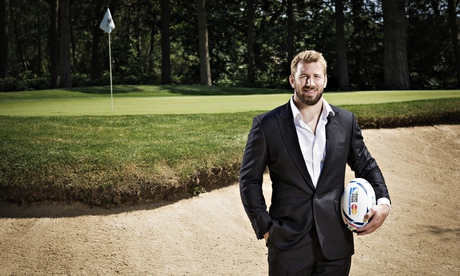
Rugby players come in all shapes and sizes, except, of course, average, normal and inconspicuous. So in the setting of the Woburn Golf Club clubhouse, where unremarkable business executives like to relax in pastel-coloured casual fashions, it’s fair to say that Chris Robshaw, the captain of the England rugby union team, stands out from the rest of the clientele. He looks, in short, like a rugby player.
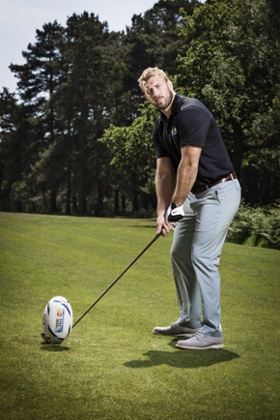
He’s here to do some sponsorship promotion for MasterCard, a wheeze that involves playing golf with… a rugby-shaped ball. The sponsors, I’m informed, are “beyond excited”. Robshaw, by the look of him, rather less so.
Thick-lipped and meaty-faced, he stands with his arms not quite touching his sides, due to his gym-primed excess of bicep muscle. He runs me through his daily input and output regime. “I’ll probably have about four scrambled eggs for breakfast, go to training, do weights for about an hour and have a Maxi shake straight after, then some more breakfast, yogurts, eggs, some sort of meat, maybe a salad and pasta. Then we train for another hour. Then lunch which is meat, carbs and some vegetables. If it’s Tuesday, train again, if not go home and then have an energy bar, then snack on nuts, then dinner of meat and vegetables, then maybe a protein shake.”
Then presumably some indigestion tablets.
At 6ft 2in, he’s far from the tallest player and, weighing in at about 16st 10lb, nor is he the beefiest. But you wouldn’t want to run into him at speed, and still less would you want him to run into you.
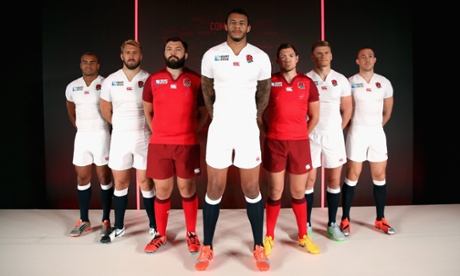
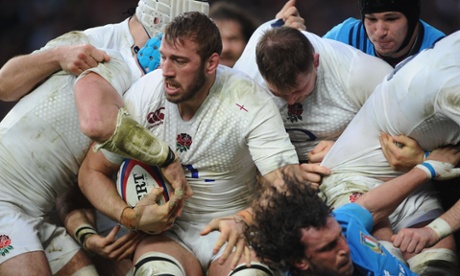
Robshaw, however, spends a great deal of his time running into people, or at least other rugby players, putting his body where boots fly, elbows protrude and bones crunch. You don’t watch him for his elegance, swiftness or the arresting precision of his play. He’s a flanker, a busy back-row position that involves making a punishing amount of tackles, and generally – to employ a technical term – getting stuck in. You watch him because he’s usually where the action is.
At 29, Robshaw is England’s third-most-capped captain, coming behind only Will Carling and Martin Johnson. But unlike those two renowned figures, he’s still curiously low profile beyond the confines of the game. Recently I mentioned to a friend that I was writing about Chris Robshaw and he said “Who’s that?” A meaningless exchange that would hardly be worth mentioning were it not for the fact that the friend is an ex-Fleet Street sports editor.
It is true that Robshaw is yet to win anything as England captain. But he has led England to second place in the Six Nations championship four times. The last England captain to have an appeal outside his sport was Will Carling, who dragged English rugby into the professional era. Martin Johnson, who succeeded him, frequently looked as if he’d rather be pumping his own stomach than answer another question. But then he won the World Cup, earned the right to be lovably surly if he chose, and began to relax almost to the point of forming whole sentences in front of the camera.
Immortality, or at least household-name status, awaits Robshaw if England win this autumn’s World Cup, taking place in this country. But the squad have their work cut out just making it through a qualifying group that includes Australia, Wales and Fiji. Robshaw smiles when I ask him what he thought when he saw the draw. “Hey, it’s going to be tough, but if you want to do well, you have to beat all the teams. Fiji is the first game and we’re going to have to hit the ground running.”
When we meet, he is preparing to go off to the pre-tournament training camp. These things are by reputation so physically demanding that the most pleasant highlight is the obligatory ice bath. Later, one participant would describe it as “brutal”. Did he feel any trepidation about the rigours ahead?
“You’ve just got to get on with it,” he says matter-of-factly, then adds, just in case I’d not fully gathered his philosophy: “If you’re going to do well in life, you’ve got to work hard.”
He speaks in an unrefined accent that you’d describe as classless, if it didn’t sometimes sound a bit earthier than that. In fact he’s a public schoolboy, the middle of three brothers, who attended Millfield, the exclusive boarding school in Somerset. You don’t get the impression he’s putting anything on, however. If you were to point to his social position, you’d have to say: jock.
His father Alan, an architect, died of a heart attack when he was only five; his mother Patricia ran nursing homes with her sister. Robshaw has said that she “sacrificed a lot” to pay the fees for Millfield, a place where she knew he would receive the extra help he needed to deal with his dyslexia.
From an early age he played football, cricket, hockey and, of course, rugby. Rugby was always his preferred sport, mostly because he was big and didn’t mind, then as now, putting himself about. He wasn’t a prodigy, however. He played to a good standard but no one was talking about him as a future England captain. When he was 15 he couldn’t even get into the Somerset county first XV. As he once put it: “I didn’t feel destined for greatness in any way.”
What made the difference was his phenomenal work rate – something he attributes to his mother’s influence. Coaches often say they prefer the less talented player who gives his all to the truly gifted one who sometimes can’t be bothered. And Robshaw’s coaches have always taken a shine to him. None more so than England coach Stuart Lancaster.
Under Martin Johnson’s ill-fated regime as manager, Robshaw narrowly missed out on playing in the last World Cup in 2011, having made a good impact in the training camp leading up to the tournament. He says he “moped around” for a while afterwards and then got his head down and worked even harder. When Lancaster took over he made the inexperienced Robshaw captain.
What was it like walking into the dressing room, having barely played for the team, and suddenly having to command respect from the other players?

“Yeah, it was a difficult situation,” he says. “I think what helped was that there were a lot of new guys there as well, so it did have very much a feel of a new team. It was probably easier than going into a dressing room with guys with 70 or 100 caps.”
England did OK at first, coming second in the Six Nations. Then followed a bit of a battering in South Africa, and further defeats back home to Australia and South Africa again. There was a lot of talk in the press that Robshaw wasn’t up to it, that Lancaster had chosen the wrong leader, and that maybe Lancaster wasn’t up to it either. Suddenly finding yourself the focus of that kind of negative attention must have been a bit of a shock to the system.
“It was tough, there’s no denying it, especially the first couple of times it happened. It wasn’t until I came back to camp on the Sunday night and sat down with some of the more experienced guys – the Ben Youngs and Toby Floods who had been at the previous World Cup and obviously had a lot of stick on the back of that – and they said, ‘Don’t worry mate, we’re in this together. Don’t take stuff to heart. Now you’ve been through it, it will make your shoulders a bit broader.’ And it has.”
In an unlikely coda to that first season in 2012, Robshaw led England to a famous victory over New Zealand, blowing them away 38-21. He says he still looks back with satisfaction on that performance. It was a kind of vindication after the mauling he had received the previous weeks by the media. He says he now takes such criticism with “a pinch of salt”, a claim that perhaps needs to be taken with its own miniature salt supply. As if recognising the slight hollow ring of his words, he adds: “It’s still not nice, but it is what it is.”
What was meted out three years ago will be nothing compared to what he’ll receive if England fail to qualify or make a decent showing on home turf. One of the perennial debates that seems to haunt English team sport, particularly football and rugby, is the question of style. Before each tournament in both sports it is customary to ask whether the team will play a pragmatic, solid, physical game or try to open up and play with flair and adventure.
More often than not it’s an awkward compromise that is neither one thing nor the other. Hence the serial disappointments with a couple of exceptions in football and the magnificent anomaly in rugby of Clive Woodward’s all-conquering 2003 world champions. Did Robshaw have any feelings about how England should set out to play?
“I think at big tournaments it doesn’t matter how you play the game, it’s all about winning. Of course you want to go out there and play an incredible style and score 10 tries a game. But if you look how teams do well in international sport, it’s all about results.” It’s not a statement to set the heart racing, but he’s right insofar as no one will much mind if England grind out a series of victories and nick the World Cup.
The one certainty is that Robshaw will be in peak physical condition when he steps out to play that first game. In a sense that’s the easy part. You just have to put the effort in, and that’s never been a problem for him. The more tricky issue will be his mental condition. He acknowledges that with almost three months of training build-up, there is a danger of losing the killer edge. “One of the biggest challenges for this side is, how do we mentally relax and stay fresh? It’s finding out what works for you. Some guys play golf or like the cinema. Richie McCaw [New Zealand captain] flies gliders. I like to take the dog for a walk with Camilla [Kerslake, his girlfriend] or visit my shop and talk about business.”
Inevitably, flying gliders sounds more butch than walking a dog with your girlfriend, as if New Zealand are one up psychologically even when it comes to relaxing. But as Robshaw says, it’s what works for each individual player. The shop he refers to is a boutique coffee and wine shop in Winchester called Black, White and Red. He opened it a couple of years ago with a school friend and ex-flatmate, Kevin Latouf, whose family are in the restaurant business.
He thought he needed to start looking at what he might do after rugby and found similarities between running a shop and running after a ball. It’s all about improving performance with little tweaks. To that end he’s even been on barista courses – it’s a safe bet that McCaw doesn’t know how to froth a cappuccino.
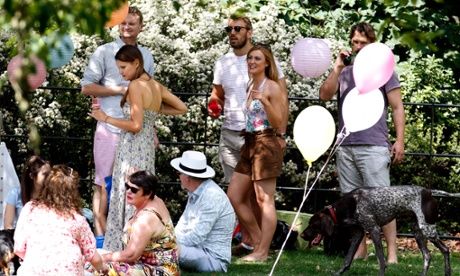
He met his girlfriend, the classical singer Camilla Kerslake, in 2011 when she performed at a charity gala he attended. “Chris and I are on the same page and we definitely plan to get married in the near future,” she told a newspaper this year. For Robshaw, thinking about the future doesn’t begin until after the World Cup. Before that it’s all about making history.
As the tournament draws closer the expectation, attention and tension all dramatically increase. Modern-day rugby players have had to adjust to a level of scrutiny that previously only footballers endured. One trip to the wrong bar – especially if dwarves are being thrown about – and you’re all over the front pages. Most of the other players just have to keep themselves calm and sober, but the captain not only has to find his own combination of zen-like peace and war-like single-mindedness, he also has to make sure that everyone else is on the right track. Can all that responsibility become a bit noisy in the head?
“As a captain you are always trying to read situations, the mood at camps of individuals, their reaction and that kind of thing,” he says with thoughtful authority. “You do have that broader understanding and connection with the team, but you need your downtime as well. It’s hugely important.” He says that earlier in his career, when he first became club captain for Harlequins, he was guilty of trying to do too much. As a consequence his form slipped and he had to delegate. He’s confident that he has learned his lesson and, he insists, England have plenty of other leaders to share the burden.
For the last 12 years the England team have been living in the long shadow of the 2003 side, of Jonny Wilkinson et al. It’s time they stepped out of the past and created a new batch of heroes. “I grew up watching that generation of players,” he says, all but standing to attention and saluting. “That’s what I wanted to be. Whenever I meet one of those guys, I get a huge sense of honour.”
If world cups were handed out for effort and humility, then the brawnily affable Robshaw would be a dead cert to become one of “those guys” himself. With a bit of luck, a lot of home support and a surge of team belief, he may yet do it anyway. In which case the honour will be all ours.
Chris Robshaw is a MasterCard Rugby World Cup 2015 brand ambassador (priceless.com/rugby)