Afternoon summary
- A poll has shown that a majority of people do not think the government has brought the deficit under control. The ComRes survey also shows that more people think the government cannot afford tax cuts than think it can. But it also shows that people trust David Cameron and George Osborne on the economy more than they trust Ed Miliband and Ed Balls. (See 3.36pm.)
-
Nick Hardwick, the chief inspector of prisons, has said he will not reapply for his post when it comes up for renewal next year. He was speaking after Chris Grayling, the justice secretary, made it clear that the did not want Hardwick to serve a second term. (See 1.38pm.)
Nick Hardwick has told Grayling he won't be re-applying for job as chief inspector:"Cant be independent of people you are asking for a job,"
— Alan Travis (@alantravis40) December 2, 2014
That’s all from me for today.
Thanks for the comments.
ComRes has released some polling it has done for ITV about the economy and the autumn statement.
The full findings are available here but, for the sake of simplicity, here are the key points - ranked according to what constitutes good news for the various parties.
Good news for the Conservatives
- David Cameron (33%) and George Osborne (27%) clearly beat Ed Miliband (17%) and Ed Balls (15%) when people are asked to say who they trust to see the country through its current economic situation. The Labour pair are even behind Nigel Farage (18%)
- People are more likely to say the economy will get better under the Conservatives (29%) than they are to say it will get better under Labour (18%). However, for both parties, the number of people saying the economy will not get better under them is higher than the number saying it will. For the Conservatives the net score is -12 (29% minus the 41% who say it won’t better better under Cameron). For Labour the net score is -31.
-
People think the economy is in a better state than it was when Labour was in office. Only 29% think the economy is in a worse state, while 45% do not think it is in a worse state.
Good news for Labour
- Most people (72%) do not feel better off, even though the economy is growing. This is Ed Miliband’s case in a nutshell. Only 22% of people say they have more money to spend on non-essential items than they did last year.
- More people (41%) think the government cannot afford tax cuts than think it can (27%). And the proportion of people who think tax cuts should be a priority for George Osborne has gone down nine points since last year. Now only 34% say they should be a priority, while 33% say they shouldn’t be a priority. This is good for Labour because the Conservatives are going to fight the election on a tax-cutting platform.
-
A majority of people (52%) do not think the government has got the deficit under control. Only 20% do think it has got it under control. This is helpful because, when Ed Balls responds to the autumn statement tomorrow, his message will be that the deficit is not under control.
Good news for the Lib Dems (sort of)
-
A majority of people (54%) do not think the Lib Dems have any real influence over the government. Why is this good news? Because 25% disagree (ie, they think the Lib Dems do have real influence). This is roughly three times as high as the party’s current poll rating.
In the Commons MPs are debating China’s decision not to allow the foreign affairs select committee to visit Hong Kong.
According to the Press Association, Sir Richard Ottaway, the Conservative MP who chairs the committee, said the ban was tantamount to “an attack on the men and women of the free world”.
Ottaway said:
This will do nothing but damage Anglo-Chinese relations, something that I regret. China is a fellow member of the G20. We have a free flow of parliamentarians, officials, businessmen, those involved in cultural exchanges. I say to China if you want to be a member of the G20, you have to behave like a member of the G20. We have Chinese delegations here all the time. It shouldn’t be a one-way street.
Most importantly, this decision points to China’s direction of travel. If there is a commitment to democracy in Hong Kong, you first have to understand democracy. Democracy embraces criticism, and constructive criticism is the most valuable thing that democracy can provide. If China blatantly blocks well-wishers like this Parliament, it raises big unanswered questions which will alarm the people of Hong Kong and the region and this decision will not go unnoticed in Taiwan.
And Sir Malcolm Rifkind, the Conservative former foreign secretary, made a similar argument. He said:
I think the Chinese government have done themselves a disservice by the step they have taken. What they have demonstrated is not their strength, it’s their weakness. Because the idea that simply issuing a veto on visas, that that somehow resolves the issue, simply has not happened. Quite rightly I understand that the committee is going to continue its work and all that has happened is some very adverse publicity for the Chinese government in a way that they could so easily have avoided.

Lunchtime summary
-
Danny Alexander, the chief secretary to the Treasury, has said that a government agency could plan, build and sell tens of thousands of homes on public sector land under new government proposals. As Patrick Wintour reports, the homes would be sold at a profit to the private sector. A pilot project is under way at Northstowe, a former RAF base in Cambridgeshire, with the capacity for 10,000 houses, which would make it the largest planned town since Milton Keynes. Alexander laid out his thinking, first aired at the Liberal Democrat party conference in September, at the launch of the national infrastructure plan 2014 before the autumn statement on Wednesday. He made the announcement as he confirmed plans to spend £2.3bn on flood defences.The details are set out in the 2014 national infrastructure plan.
- George Osborne is to announce a £15m boost towards the search for a cure for dementia, it has been revealed. The news came as a nurse attended this morning’s cabinet to give ministers dementia friends training.
-
Lord Smith of Kelvin, who chaired the commission on new powers for Scotland, has defended the decision not to recommend Edinburgh getting power over corporation tax. Osborne is expected to announce that Northern Ireland will get control of corporation tax in the autumn statement tomorrow. But Smith told a committee in the Scottish parliament that many organisations opposed Scotland getting the same power. He told the MSPs:
The STUC, the employers’ organisations like CBI and others and even an institute that cannot be attacked on its objectivity, the Institute of Chartered Accountants of Scotland, of which I’m a member, a number of these organisations – a large number of these organisations – were saying: ‘Do not tinker with corporation tax. It will lead to strange behaviours and in the end you will regret what you’re doing.’ And that was coming from the trade union side, it was coming from employers, it was coming from disinterested observers who understand tax.
- Chris Grayling, the justice secretary, has suggested that claims from Napo, the probation officers’ union, about his reforms being linked to two murders are misleading. (See 12.56pm.)
- The Green party has announced that its membership has doubled since January. It now stands at more than 27,000.
Chris Grayling accuses probation union of making misleading claims
That hearing did not quite live up to its billing as testy confrontation. But it was informative on a wide range of issues. Here are the key points.
-
Chris Grayling, the justice secretary, suggested that claims from Napo, the probation officers’ union, about his reforms being linked to two murders were misleading. He did not discuss the allegations in detail, but he said they were being investigated. He added:
I have to say that the trade union has on occasions put forward information in a way that has not given, I would have thought, sometimes context, and even the accuracy of the situation.
- He said that serious reoffending has fallen since his probation reforms started being introduced in the summer.
- He said that there had been a huge increase in the number of sex offenders going to jail over the last two years. There were an additional 900 sex offenders in the system, Michael Spurr, the National Offender Management Service chief executive told the committee.
- Grayling has signalled that he does not want Nick Hardwick, the chief inspector of prisons, to get a second term in office. Grayling said that Harwick would not automatically be re-appointed when his term of office comes to an end next year. He would have to reapply if he wanted a second term, Grayling said. There have been reports that Grayling wants him out and this seems to confirm this. As Eric Allison reports, Anne Owers, Hardwick’s predecessor, was given a second term without her post being re-advertised.
- Grayling said that he would take a final decision about privatising some probation services tomorrow. He would go ahead even though Napo is seeking a judicial review of this proposal, he said.
- He said there were 500 more qualified probation officers in post now than there were in June.
-
He confirmed that he is investigating what to do about the conflict of interest created by the fact that Paul McDowell is chief inspector of probation and his wife works for Sodexo Justice Services, which is taking over probation services. The problem has become more acute because McDowell’s wife has recently been promoted, and now runs the business, Grayling said.
Q: Will you appoint a new chief inspector of prisons when Nick Hardwick’s term comes to an end next year?
Grayling says he will give details on this soon. Hardwick has not been excluded from the process. He will be free to apply again, he says.
John McDonnell says Grayling made the wrong call. He cut the number of staff in prisons when he should not have done.
Grayling says the biggest change over the last year or two has been the increase in the number of sex offenders coming through the courts.
Michael Spurr says there are more than 900 additional sex offenders in the system.
Grayling says the suicide rate among young men is higher than it was a generation ago. That partly explains the increase in prison suicides, he suggests.
Grayling says McDowell’s wife has now been promoted at Sodexo Justice Services. She is now in charge of the overall business.
But he says he would not doubt McDowell’s integrity.
In public life many people are married to each other, he says.
Sir Alan Beith goes next. He asks about the conflict of interest issues involving Paul McDowell, the chief inspector of probation. McDowell’s wife works for Sodexo Justice Services, a firm due to take over some probation service contracts.
Grayling says he has a high regard for McDowell. But this issue has to be resolved.
Q: When will this matter have to be decided?
By the time of the share sale, assuming he decides to go ahead with the share sale, Grayling says.
Updated
Labour’s John McDonnell asks about the letter from Napo alleging the reforms may be linked to two murders.
Grayling says there will always be some serious further offences. He hopes the numbers can come down, but there will always be some.
However, since the changes came in in June, the number of serious further offences has fallen.
There will be serious case reviews in these cases, he says.
But sometimes Napo has put forward information without presenting the full context, he says.
Michael Spurr, the National Offender Management Service chief executive, who is giving evidence with Grayling, says the results of serious case reviews are always published.
Grayling says he is not aware of Napo raising these two cases before it submitted its letter.
Grayling says he wants to make a point about workload.
First, there are 500 more qualified probation officers in post today than there were on 1 June.
Second, the probation service is not trying to speed up reports for courts. That is adding to workload pressures.
Q: Should you not wait before taking the decision to move ahead with your probation reforms until you’ve had the outcome of the judicial review?
Grayling says he is being judicial reviewed by the union over a decision he has not yet taken.
And if he does decide to go ahead, that will only mark a decision. Implementation will not have happened.
So he does not intend to delay tomorrow’s decision.
Q: What progress are you making in returning foreign prisoners?
Some progress, but not nearly as much as I would wish, says Grayling.
One problem is that other countries do not want to take these prisoners back.
But more prisoner transfer agreements are being signed.
The government has a prisoner transfer agreement with Albania. But it has to go through a cumbersome process with the Albanian courts to use this.
Christopher Chope a Conservative, goes next.
Q: How will you calculate the savings this programme will make?
Grayling says with the work programme it was very easy to see what savings were being made.
With probation, it is harder.
In terms of value for money, the department is getting more, he says.
Any improvement in reoffending represents value for money. It will reduce pressure on the criminal justice system, he says.
He says it is his hope and desire that the number of people in jail will fall.
Q: You spent £15m on consultants. Did they advise on this?
Grayling says the term consultants includes temporary IT staff.
Updated
Grayling says he does not think there is a conflict of interest in having a private firm running a prison also running probation services. They are not going to think they would be better off having offenders back in prison, he says.
Sir Alan Beith, the chairman, goes next.
Q: Only one mutual bidding for these contracts has won a contract. Are you disappointed by that?
Grayling says in 20 of the 21 bids, there are partnerships involving the voluntary sector. He is pleased with that, he says.
He says he is really excited about the partnership between Ingeus and St Giles Trust.
Q: Last year a Guardian article said staff would face disciplinary action if they spoke out against the reform. What are you doing to protect whistleblowers?
Graying says there have been extensive discussions with the staff about the change, and with the unions.
Q: But you did not attend the Napo conference?
Grayling says there are regular meetings with the unions.
Grayling says very good progress has been made on his probation reforms.
On public safety, only one issue has been raised by a CRC (community rehabilitation company).
The level of reoffending is down, he says.
He says he has asked the chief inspector of probation to come to him if there are any public safety issues. He has not, Grayling says.
He says there are 50,000 people on the streets who served short sentences. Under the current system they are not subject to supervision. They committed 11,000 crimes last year, he says. Under the reforms they would be supervised. That is the public safety issue that concerns him, he says.
Sir Alan Beith says it is “not satisfactory” for Grayling to give documents to the committee so late.
Sir Alan Beith, the committee chairman, goes first. He says the committee received evidence last night from the Ministry of Justice and from others.
Elfyn Llywd, the Plaid Cymru MP, goes first.
Q: In the absence of any credible evidence on the safety of the probation reforms, what can you say to assure us that they are safe?
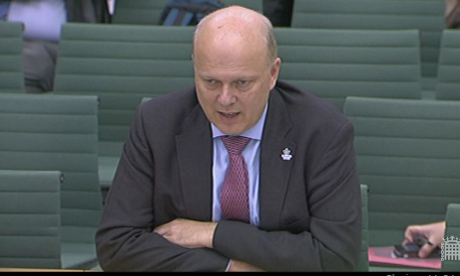
Chris Grayling, the justice secretary, says the committee has the evidence in front of it that he will use when he takes his decision tomorrow on whether to press ahead with his reforms.
Chris Grayling questioned by MPs about probation services
Chris Grayling, the justice secretary, is going to give evidence to the Commons justice committee shortly about his probation reforms.
As the BBC reports, Napo, the probation officers’ union, is claiming that Grayling’s probation reforms may have contributed to two murders. Here’s an extract from its story.
In an 18-page letter to Justice Secretary Chris Grayling, the union highlights a recent case of one offender “with a history of domestic violence” who went on to murder his partner before taking his own life.
It claims the trainee allocated to undertake home visits to the man was “too overworked” to visit every four months as required.
Another probation officer was “unable to spend sufficient time working with an offender”, the letter alleges, because of an “excessive caseload”.
“Left without suitable supervision, the offender committed a murder while under supervision of the CRC,” it added.
Community Rehabilitation Companies - or CRCs - will supervise low- and medium-risk offenders under Mr Grayling’s plans.
The Times is splashing today on a story about Ukip members complaining about the way the party has “manipulated” the selection of its candidates (paywall). Here’s an extract.
Mr Farage has gained support by pitching Ukip as an “anti-establishment” party seeking to shake up the old boys’ club in Westminster. Internal documents reveal, though, that senior figures questioned whether party leaders had tailored interview questions to discriminate against certain MEP candidates or had altered some candidates’ ratings to suit their own preferences.
Instead of allowing local branches to choose candidates for the European elections in May this year, Ukip required potential MEPs to undergo psychometric testing and a series of formal interviews and assessments. They were given a rating out of 100 based on their performance and placed on a shortlist that was voted on by every party member.
“There is the question of whether the final scores were ‘massaged’ by an internal clique to suit pre-determined outcomes,” Andrew Moncrieff, who remains on Ukip’s governing committee, wrote last year. “What started out as an attempt to produce a transparent, equitable system has turned into another classic Ukip ‘behind closed doors’ selection.”
But anyone familiar with how the other parties select their candidates (particularly Labour) will find it hard to see what the fuss is about. Here is Alan Johnson, in his GQ interview this week, describing how he was parachuted into a safe seat by Tony Blair in 1997.
[At the end of a conversation with Blair he said] “I hear you’re interested in being an MP.” I said, “No,” and he said, “Well, I would like you to be!’” He had had a session getting his picture taken with all the candidates and he was worried about the quality. I said, “What if I go for it, and don’t get it, and I have no chance of getting back as general secretary at the CWU?” He said, “Oh, don’t worry about that.” I said, “Where would the seat be?’” And he said, “Where do you want?” I fancied London, but that didn’t work out. We were three weeks into the campaign and the call came – there were two seats coming up. I was selected for Hull.
David Cameron has been tweeting about the dementia friends presentation at cabinet.
A brilliant presentation by @DementiaFriends at Cabinet. I want ministers to ensure staff in their departments join this great scheme.
— David Cameron (@David_Cameron) December 2, 2014
The Sun’s Tom Newton Dunn thinks it is the first tweet from a cabinet meeting.
Here’s the Guardian video of Gordon Brown announcing his decision to step down as an MP last night.
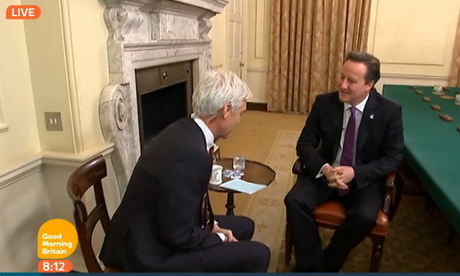
David Cameron was on ITV’s This Morning earlier. He was on to promote Phillip Schofield’s Text Santa charity appeal and he talked about charity work that he and his wife Samantha do, as well as saying that cabinet ministers are going to get “dementia friend” training at today’s cabinet meeting.
The Cabinet is being taught how to be a "Dementia Friend" today and I'm proud to announce more money to help fight this terrible disease.
— David Cameron (@David_Cameron) December 2, 2014
The interview was broadcast live from the cabinet room and Cameron gave Schofield a quick history lesson.
When people come in here I always tell them what an amazing room this is because of course this is the room where in 1940 Churchill sat in this chair and decided to fight on against Hitler. So some pretty extraordinary things have happened [here].
But unfortunately - not for the first time - Cameron got his history wrong. The key meeting of the war cabinet after the fall of France, which decided not to sue for peace with Germany but instead to fight on, took place on 28 May in the House of Commons. This only happened because Churchill faced down Halifax and Chamberlain. It might seem a minor error, but Cameron really ought to know better. Many historians regard this as the most important cabinet meeting in history.
Boris Johnson writes about it rather well here, in an extract from his Churchill biography.
And here’s one of the cabinet minutes.
@AndrewSparrow Yes, 28th May meeting took place at HoC: pic.twitter.com/i8rDKP3rxn
— Aaron Young (@aaz_) December 2, 2014
Cameron’s other historical gaffes including not knowing when America entered world war two and not knowing, or claiming not to know, what Magna Carta means.
Clegg announces £150m programme for young people with eating disorders
Nick Clegg has announced a five-year, £150m programme to improve treatment for children and young people with eating disorders.
I can’t find the news release on the web yet, so here are the details from the press notice his office has sent out. Clegg has identified mental health as a priority and he has said that improving mental health facilities will be one of the top demands in the Lib Dem election manifesto.
The deputy prime minister Nick Clegg has announced an £150m investment to radically reform the treatment of children and young people with eating disorders and pave the way for the introduction of new waiting time standards.
The investment, which will be rolled-out over five years and has been secured by the Deputy Prime Minister in this year’s autumn statement, is part of an ongoing campaign by the government to bring mental health services on a par with physical care.
It comes just a month after research revealed that an increasing number of young people, from as young as five, are being admitted to hospital for treatment of eating disorders with those aged 14 to 25 most likely to be affected.
Today’s announcement will focus on channelling money from expensive institutional care to local provision and act as a base for the development of waiting time and access standards for eating disorders for 2016 by:
* supporting schemes to get young people with eating disorders and self harm early access to services in their communities with properly trained teams, making hospital admission a last resort. * extending access to talking therapies so that children and young people have a choice of evidence-based therapies, a treatment plan agreed with their therapist and monitored and recorded outcomes. This will deliver: * Swifter access to evidence based community treatment * Fewer transfers to adult services – reducing up approximately 70% of those who need to be treated as adults * An end to the current cliff edge of transition for young people with eating disorders when they turn 18 * A more standardised level of provision for children, young people and their families
Danny Alexander, the chief secretary to the Treasury, has been giving a speech this morning launching the government’s 2014 national infrastructure plan.
He has announced that the government is planning to fund its own house building programme from Whitehall.
Direct govt commissioning of house building using govt balance sheet is now being considered says Danny Alexander treasury chief sect.
— Patrick Wintour (@patrickwintour) December 2, 2014
Danny Alexander announces first govt led housebuilding project for a generation to kick start development on former RAF base in Northstowe.
— Steven Swinford (@Steven_Swinford) December 2, 2014
I’ll post more details when I get them.
Alastair Campbell's tribute to Gordon Brown

Earlier Alastair Campbell, Tony Blair’s communications chief, was on the Today programme talking about Gordon Brown. It was one of the best tributes I’ve heard. Here are the key quotes.
-
Campbell praised Brown as a politician “who wanted to do big things”.
I remember my mum - she died last year, alas - she used to say I think Gordon would have been a fantastic prime minister when I was growing up. I used to say what do you mean by that. “Well, you didn’t have this endless, relentless, microscopic scrutiny. Politicians were elected and they got on and they did big things.” Now, Gordon was a politician who wanted to do big things. I think if you compare him, say with David Cameron today. I don’t know what David Cameron really feels passionate about when he wakes up in the morning. He’s on the news every night being passionate about something, and it’s always something different. People knew what Gordon was passionate about. He was passionate about the role that politics could play in meeting challenges, he was passionate about attacking child poverty, debt in Africa, whether it was fighting for economic stability, Bank of England independence. He believed in big things and saw as the pursuit of meeting those big things. And I think that is ultimately what will define him.
-
He said Brown could be brilliant, but also impossible.
Gordon is without doubt one of the political figures of our time, with a great mind, an ability to focus on really big challenges, and understand the role of politics in meeting those challenges. And at his best, he was absolutely brilliant. At his best to work with he was absolutely brilliant.
Equally, at other times, he could be a nightmare to work with. I think sometimes, with really great figures there is perhaps always a downside, and that was the downside. This idea that he was brilliant but also impossible. If he had just been impossible, then that question that was asked the whole time, which is why didn’t Tony [Blair] just get rid of him, the answer was in his brilliance.
I think we were incredibly lucky to have two real titans of recent times.
-
He said he thought high-achievers often had psychological issues. This is what he said when asked to define Brown’s impossibility.
I think how I would define it is maybe as the downside of the brilliance. I think you see this in a lot of people. I’ve just been writing a book about winners and one of the points I make is there is often this link between hyper-achievement and psychological issues. I’ve got them myself. I’ve been very open about that. I’m not remotely putting myself in the same bracket as Gordon in terms of what he’s done as a politician, but I think If you look at the arts, politics, business, sport, often there is this downside.

There’s 24 hours to go until the autumn statement, but already it feels as if it has been going on for two days now. After the the NHS announcement, and the roads announcement, we’ve had two more stories overnight. Oh, and an important EU/immigration one too. Here they are.
The coalition government’s pre-election infrastructure spending bonanza will continue on Tuesday with announcements on increased spending on social housing, flood defences and exploratory talks for the first lagoon power project with potential to provide 8% of the UK’s energy.
The plans, including an innovative scheme whereby the government could act as a direct commissioner of housing, are due to be announced in the 2014 national infrastructure plan prepared by Danny Alexander, the chief secretary to the Treasury.
- And, on Newsnight last night, Poland’s deputy foreign minister with responsibility for European affairs, Rafal Trzaskowski, said trying to alter benefit rules for EU migrants (which is what David Cameron was proposing on Friday) would be a “red line” for Poland. He said:
If one wants to get away with all the benefits that are enshrined in the regulation of EU and treat immigrants from EU differently, and for example only pay benefits after four years of their stay in Britain or extradite people who can’t find work, that would be against all the existing laws of the EU and obviously that would be a red line for us.
The Polish government is quite ready to talk about abuses of existing systems, sham marriages, extraditing criminals and so forth. But to be truthful this is not the problem, it is marginal. When it comes to changing the rules in the EU, when it comes to social support and so forth, when it comes to undermining the existing laws, obviously we are going to react quite strongly and we are going to be against. But the most important thing is that David Cameron wants to talk about it and doesn’t want to change policies unilaterally.
This is an absolute red line, that there is no discrimination on grounds of nationality. If Britain were to change its policy, for example, into contributory system in which everyone has to pay in to get some money from the system we then could talk about changes if they were absolutely non-discriminatory.
It looks a bit patchy today. This is what’s coming up.
11.15am: Chris Grayling, the justice secretary, gives evidence to the Commons justice committee about the probation service. Napo, the probation officers’ union, says Grayling’s reforms may have contributed to two murders.
12.30pm: MPs hold an emergency debate on China’s decision to ban the foreign affairs committee from visiting China.
Afternoon: MPs begin debating the counter-terrorism and security bill.
As usual, I will be also covering all the breaking political news from Westminster, as well as bringing you the most interesting political comment and analysis from the web and from Twitter. I will post a summary at lunchtime and another in the afternoon.
If you want to follow me on Twitter, I’m on @AndrewSparrow.