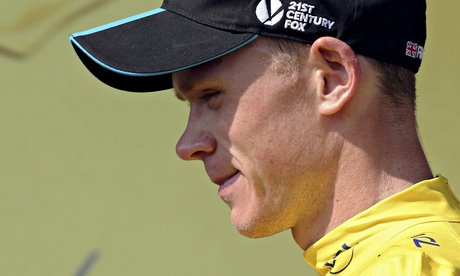
One of the great draws of professional cycling is that it offers fans the chance to get close to their heroes, but the flip side is that occasionally the interaction has a darker, unacceptable side. So Team Sky’s Australian Richie Porte found in the Pyrenees, when he was punched by a spectator, and then had an angry confrontation with a group on the roadside who accused him of doping, while Chris Froome yesterday had a similarly unpleasant experience to Mark Cavendish in 2013, when urine was thrown at him from the roadside. “I certainly wouldn’t blame the public for this,” said the race leader. “It really is the minority of people out there who are ruining it for everyone else.”
Roadside incidents are just part of a wider phenomenon which the French media term la malaise Sky: Sky sickness. No matter what the British team does, it cannot seem to please some in the milieu. Sometimes, Sky simply seem inept due to the intense focus on performance which – it could be argued – is part of their success.
In 2010, Sky were castigated for setting up screens at the start of time trials to shield riders from the fans, a practice that was soon abandoned, but which is echoed in the current rumbling controversy over whether the team’s leaders should be allowed to gain an advantage by sleeping in vast motor homes rather than taking their chance with the hotels booked by the race organisation.
Asked daily about doping – a topic on which he never fails to answer courteously in circumstances that would test others – Froome is indeed paying the price for the long period in which fans and media were never quite sure about what they were watching on the roads of France each July, a period which culminated in the drawn-out unmasking of Lance Armstrong.
The constant sniping – today a masseur who once worked at US Postal, tomorrow who knows what – is the price the team should acknowledge they will pay for a zero-tolerance policy on doping which has proved a millstone rather than a milestone. This year Froome is paying for another episode, one that has been forgotten in the hubbub around Armstrong’s return to France: the saga around the Astana team that followed last year’s Tour de France win for Vincenzo Nibali. In the autumn a string of positive tests for Astana and its feeder team was followed by a drawn-out, contorted battle with cycling’s world body, the UCI, over whether the team should be stripped of its World Tour licence on ethical grounds. Astana remain in “special measures”.
In cycling, memories are short, to the point of hypocrisy. A few yards from the British team’s bus on Saturday morning in Rodez stood none other than Michael Rasmussen, the Dane who did so much to turn the 2007 Tour into a farce. Barely an eyelid was batted. Before Saturday’s finish, French television showed footage of a legendary finish here in 1995 involving its commentator Laurent Jalabert, who Froome rightly said was in no place to criticise him. Were any cyclist to produce a ride comparable to Jaja’s Bastille Day epic this season, the doubt‑meter would go off the scale.
It is important to state that not every voice in France is anti-Froome, far from it. Even the hardened anti‑doping campaigner Antoine Vayer said, perhaps a little disingenuously given the storms he has whipped up in seasons past over power outputs, that he wished the yellow jersey no harm and only desired some openness from Sky. “It’s indecent to cast doubt on the performances of Chris Froome,” said the team manager of Europcar, Jean-René Bernaudeau, echoed in the pages of l’Equipe by the rider Sylvain Chavanel, who said: “People should stop doubting everything. I can feel no unease in the peloton about Sky.”
Regrettable the Porte episode certainly was, but it is part of a bigger picture. History shows that teams and individuals who dominate the Tour de France have rarely been popular and are frequently criticised for killing off the racing; in Sky’s case this coincides with the fall-out from the Armstrong era and resentment at the resources they can call upon.
The most celebrated incident involving a member of the public and a rider came in 1975, when Eddy Merckx was punched in the kidneys as he climbed the Puy de Dôme, an episode that the Cannibal claimed had a direct impact on his defeat in that year’s race.
The heroic “eternal second” Raymond Poulidor was always preferred to his more clinical rival, Jacques Anquetil. But for a team that wishes to win the race overall and is holding the yellow jersey, killing off suspense is the objective of each day’s racing. The goal is to have a structured, predictable stage with a set pattern, with as many team‑mates in attendance at key moments as can be managed.
The punch in Merckx’s kidneys followed several years in which the Cannibal had been criticised as “robotic”, “machinal” and lacking in human qualities, when in fact, the opposite was the case: he was mentally relatively fragile, a sensitive man who put a carapace around him to ward off the vagaries of the world. Anquetil, Bernard Hinault and Miguel Indurain all received similar criticism. It will be scant comfort to Sky as they put on their tin hats for the final week, but they are just the latest in a long line of targets.