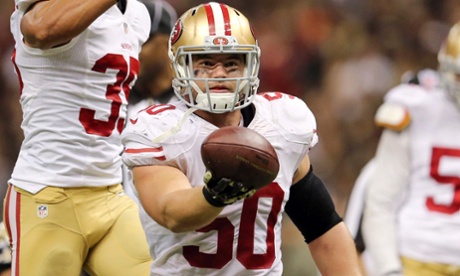
San Francisco linebacker Chris Borland’s decision to retire at age 24 due to his concerns over head trauma will not single-handedly lead to the NFL’s doom. While Borland’s announcement – which both illuminates the inherent dangers of playing football and reminds fans that NFL players are actual human beings – could be the strongest test of the league’s seemingly impenetrable armor yet, it will probably take a while to understand the results.
In the hours following the Borland news, a slew of current players almost unanimously offered support via social media. That doesn’t mean any of them will follow suit.
While playing for Denver between 2013-2014, Wes Welker suffered three concussions, two of which came within a four-game span. Now a free agent, the 5ft 9in Welker turns 34 in May and is a shell of the scrappy, slot guy who was once a pass-catching machine for both Peyton Manning and Tom Brady. But if a team will have him, Welker may return for a 12th season of danger.
In a December interview with ESPN the Magazine, he explained his mentality: “Every time I get clobbered, I pretty much know I’m going to get clobbered. You try not to take those hits, but at the same time, you’ve got to try and make the play, as well. It’s kind of that fine line with stuff.”
It’s a mindset shared by many players. Borland’s rationale for retirement may not inspire Welker to put his future at the forefront, but what if Welker knew today the damage playing the game has inflicted on his brain?
In late 2012, a UCLA research team piloted a study that through brain scans of five former NFL players showed each of them had traces of the protein tau, known to cause football-related brain damage. It was a revelatory discovery and significant step toward being able to diagnose CTE (chronic traumatic encephalopathy) in the living. Currently CTE, a degenerative condition linked to depression and dementia, can only be found posthumously – only symptoms can be determined. Reports following the study’s release suggested we were still a decade away from being able to unequivocally diagnose CTE in the living.
Dr Julian Bailes, who was part of the original research team at UCLA, thinks 10 years is a conservative estimate. “I think we’re on the precipice of being able to diagnose it now,” Bailes told the Guardian last month. “I think we’re very close to being about to detect brain degeneration of this type in living people. “
Bailes wouldn’t put a time stamp on it, though as researchers begin the second stage of the study this month he did suggest that CTE diagnosis in the living would be available in the “very near future”.
Bailes believes this significant breakthrough could have a profound effect on NFL players. “You would think that if players could see early stages of CTE, dementia or any type of degeneration, it could help inform retirement decisions,” he said.
CTE is a disease we’ll continue to hear about in the coming months. ESPN’s Mark Fainaru-Wada, who broke the Borland story, says the young linebacker’s decision to retire was heavily influenced by the death of Mike Webster who, like Borland, played college ball at the University of Wisconsin. Webster, a Hall of Fame center, died from a heart attack in 2002 after his life had taken a downward spiral. He was the first former player to be diagnosed with CTE.
More recently, in 2012, Junior Seau was found to have CTE after he committed suicide. Because Seau is a household name, the story of his death, including the heart-wrenching footage of his devastated mother, is familiar to millions. In August, Seau will be inducted into the Pro Football Hall of Fame as a first ballot inductee. Who stands in his place at the podium in Canton is still unknown but expect his family to be on hand ensuring the public knows exactly why their Junior is not there to give his own speech. The Seau family opted out of the $965m class action concussion settlement and are engaged in their own litigation against the league.
With the attention on Borland’s announcement, which is soon to passed on to Seau, some effect on the league’s enormous fan base is sure to follow. These are humans, not animals simply bred to fill a fantasy roster. As CTE data becomes more mainstream, cheering on a linebacker who has driven a quarterback into ground or crying foul over a defenseless receiver penalty may be harder to stomach.
But this is the NFL and common sense often disappears. Despite a year marked by domestic violence, a commissioner’s complete loss of credibility and a string of Thursday night games so uncompetitive they were comical, the league increased its revenue by a billion dollars. Ratings were as strong as ever. Fantasy participation is only increasing.
The most likely place for impact is in the long-term with parents who will decide whether or not to encourage potential future stars to play football. Participation in youth football has dipped in recent years, though that can easily be attributed more to the rise of electronics than the dangers of the game. The NFL is concerned enough, though, that it has provided USA Football a $45m grant to expand its Head Up programs that promote safe tackling. The league also recently hired its first-ever director of youth football. Whatever information comes out about safety issues, the league has a solution, or at least gobs of money to throw at the problem.
Borland’s decision was brave and thought provoking – after all, this was not a veteran with millions of dollars in the bank, but a talented young player with huge earning potential. The impact may be there in the long haul but for now the NFL continues on as a $12bn force