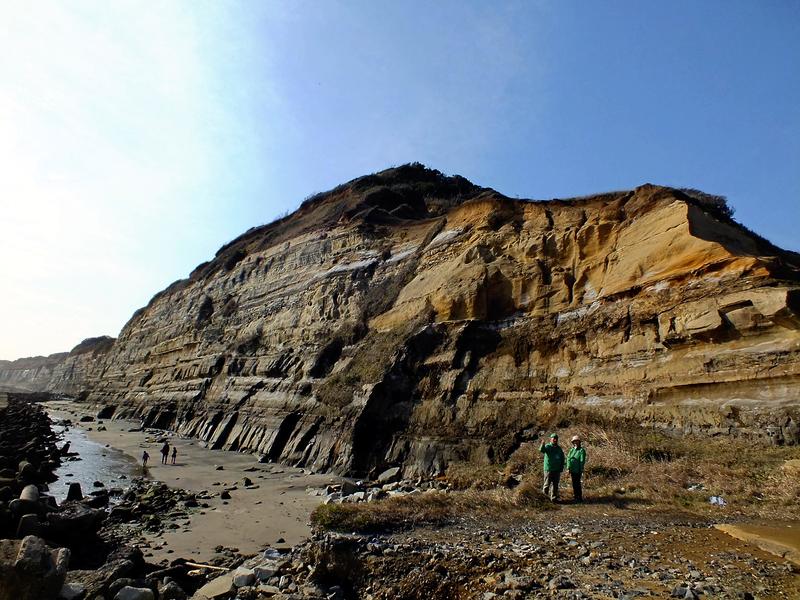
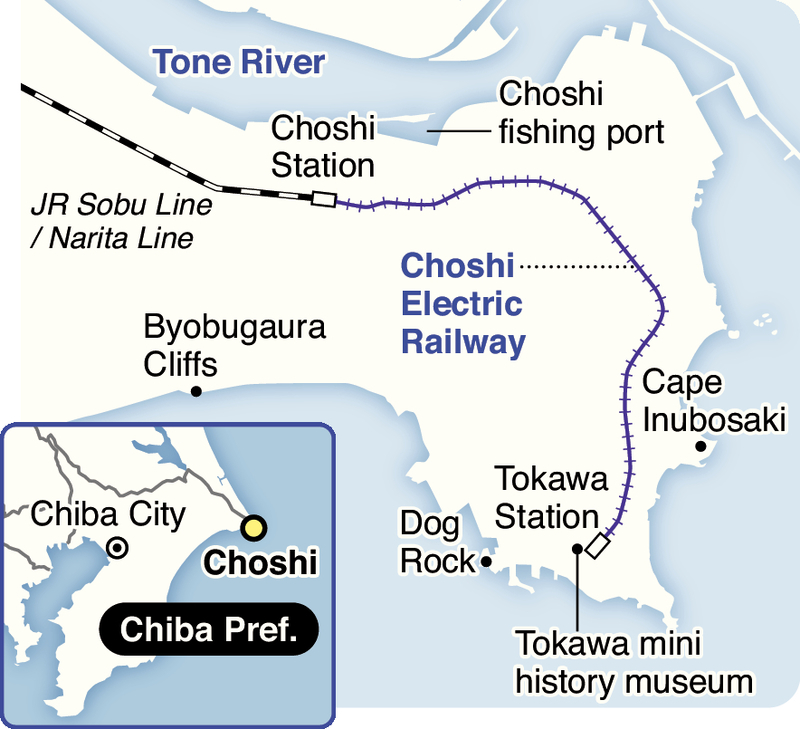
"It's about 50 meters high here," the guide explains as we stand at the base of the towering Byobugaura Cliffs along the coast of Choshi, Chiba Prefecture.
"Byobu" means folded screen, and the scene of the 20- to 60-meter-high cliffs stretching like one for about 10 kilometers to the neighboring town of Asahi is truly spectacular.
Carved out through millions of years of seawater erosion, Byobugaura Cliffs have been dubbed the "Dover of the Orient" for their resemblance to the White Cliffs of Dover on the English side of the English Channel.
"Even though I've never been there myself, I often show photos of the White Cliffs to people I am showing around here," local geoguide Satsue Takumi says with a smile.
The strata of the cliffs provide a glimpse of environmental changes that occurred mainly from 3 million years ago, whether it is a layer of mud originally formed at the bottom of a deep sea, or one of sand deposited when the sea was shallow, or the Kanto Loam bed consisting of volcanic ash.
Takumi has been serving as a sightseeing volunteer guide for many years. With a deep interest in geology, she started to also work as a geoguide in 2012 when all of Choshi city, including Byobugaura, was designated as a Japanese Geopark.
"Observing ancient strata inherently is the same as looking at what is beneath the ground where we live" Takumi says. "That's fascinating, isn't it?"
Together with Takumi, we headed to Inuiwa (Dog Rock), about five minutes away by car. Among the many legends about heroic military commander Minamoto no Yoshitsune being in various places, he is said to have visited Choshi, too.
According to Takumi, one legend says that when Yoshitsune escaped to Oshu (current Tohoku region) as he pursued by his brother Yoritomo, his beloved dog Wakamaru was left on the beach and barked for seven days and nights before turning into a rock.
The two rocks sticking out at the top of Inuiwa certainly look like dog's ears.
There is also folklore that Cape Inubosaki, a little to the north of Inuiwa, was named after the barking of Wakamaru (inubo means "a dog barks"). "But it's not really clear if Yoshitsune really came to Choshi," Takumi says with a wry grin.
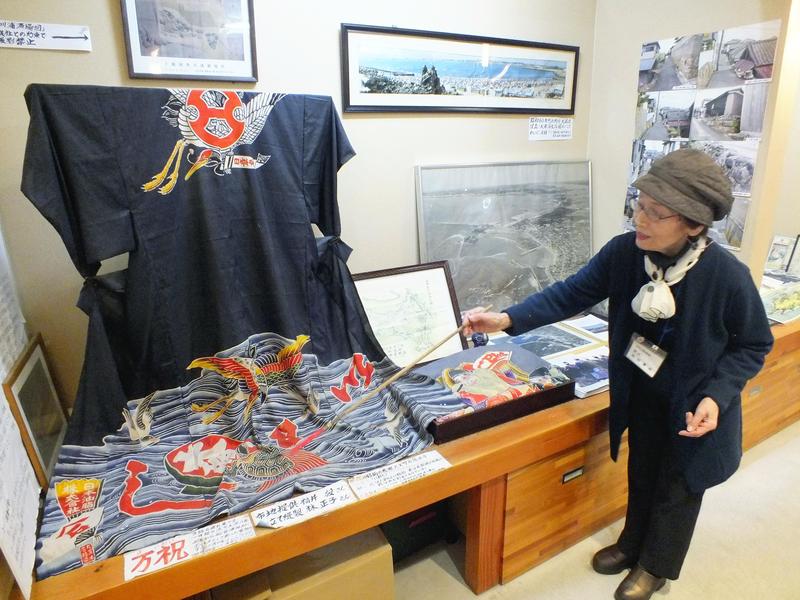
Located near Tokawa Station of Choshi Electric Railway Co. is the Tokawa mini history museum, a private museum exhibiting items on the history of Choshi. Yasue Shimada, 84, a noted museum director who often appears on TV programs in which Choshi is featured, said the museum has everything "from fossils to soy sauce, from fishing gear to materials about geology and the local dialect."
Shimada found many precious items, such as prewar photographs of her family and the local area, from the back of a Buddhist altar when an old house on the grounds of her residence was to be demolished.
She then decided to renovate the house and display the materials there instead, and the history museum opened in 2007. Soon local residents and researchers attracted to her personality began bringing her items such as fishing gear and ammonite fossils.
Also on display are photos taken when the NHK TV drama "Miotsukushi" was shot on location in Choshi. The drama, starring actress Yasuko Sawaguchi and aired in 1985, was about a local soy sauce brewing family.
Shimada said she received a visit from a woman, with a child in tow, who appeared in the drama as an extra, portraying a student. "She said she feels nostalgic for those days more than 30 years ago," said Shimada, adding that the woman talked about how all the locals cooperated with the shooting as if it happened yesterday.
Admission to her museum is still free.
"I was born and raised in Tokawa," Shimada says as she voice resonates in the museum. "I want many people to know about my Tokawa and Choshi. I want to keep running the museum while I'm still healthy."
Datemaki, a rolled omelets, is a well-known dish served at numerous sushi restaurants in the fishing port town of Choshi. It is usually cooked sweet with beaten egg and minced fish among the ingredients, but the minced fish is not added in the Choshi version.
At Okubo, a sushi restaurant near Choshi Station, this style of datemaki was created by a master chef and began to be served in the early Meiji era (1868-1912) in the early days of the restaurant. Both texture and taste are similar to that of pudding.
It is widely said that datemaki was created to give fishermen who returned from a day at sea a sugar rush to help relieve their fatigue quickly. But Toshiko Okubo, 71, the proprietress of the restaurant, said it is not clear how it really started, and some people say datemaki was made as a refreshment when soy sauce or wasabi was too spicy. Still, "Eggs were a luxury item at the time. Datemaki seems to have been welcomed at banquets after a bountiful catch," Okubo said.
Read more from The Japan News at https://japannews.yomiuri.co.jp/