There are people living in northern Georgia who still feel scarred by the 1972 film Deliverance and its depiction of locals as inbred, rapist backwoodsmen. But it took a documentary, 2012’s The Deliverance of Rabun County, to bring those feelings to the surface a full four decades after John Boorman borrowed the sublime American scenery of the Chattooga river for his harrowing thriller, starring Burt Reynolds, Jon Voight and Ned Beatty.
No one in the far-flung region of the Appalachian mountains cared to complain publicly, and it’s unlikely their voices would have been heard if they had, so disconnected was Rabun County from the media hubbub in the 1970s. But in an era where a single tweet can push a grievance into a maelstrom of publicity, it’s no longer rare for film-makers to find themselves being held to account by communities angry that their culture and way of life is being dismissed or stereotyped by Hollywood.
"It's kind of touchy, insecure, second-city paranoia." - @phillipstribune on Chicago violene and new film #Chiraq http://t.co/K03lzierdA
— Carol Costello (@CarolCNN) June 8, 2015
Over the weekend, Spike Lee came under fire over a working title for his new film, starring Samuel L Jackson, John Cusack, Jeremy Piven, Wesley Snipes and local Oscar-winner Jennifer Hudson, about gun violence on the mean streets of Chicago’s south side. “Chiraq” conflates the Windy City’s name with that of a Middle Eastern former war zone, drawing ire from local politicians despite the Do the Right Thing director having promised to adopt a respectful attitude during a press conference last month at which he urged critics to wait for the final movie.
“If you really want to stop the violence, you got to create living wage jobs,” alderman William Burns, who represents parts of the South Side, told CNN. “You got to create hope in these communities, and that means you have to get people to invest in those communities, and if the brand for those communities is ‘Chiraq,’ would you want to risk your capital? Would you want to take on debt to invest in a neighbourhood called Chiraq?”
Over in Los Angeles, a cafe in the east of the sprawling Californian metropolis has taken issue with the upcoming Eva Longoria movie Lowriders, angry at its allegedly stereotypical portrayal of Latinos as street thugs driving lowered cars. “[This] is a community that has a very recent and vivid history with gang violence. We do not appreciate the perpetuation of this stereotype in our community,” reads a Facebook post by the owners of the Eastside Cafe in the neighbourhood of El Sereno.
Noting that the script for the film features scenes of violence, including a drive-by shooting, the writer added: “This is disrespectful and exploiting a deep wound that runs in our streets. We would appreciate communication and respect. We are tired of racist Hollywood portraying our ‘gente’, appropriating our culture and continuing to create narratives that stereotype violence in our neighbourhood. The Eastside Cafe family and community will not tolerate the exploitation and disrespect of any culture, especially our own!”
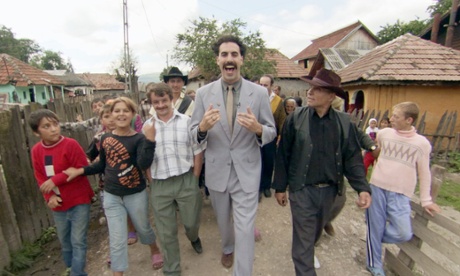
Britain’s Sacha Baron Cohen is something of an arch provocateur when it comes to stirring up local communities, having upset people living in Kazakhstan and the Romanian village of Glod, both of whom complained that the comic portrayed them as incestuous idiots in his 2006 mockumentary Borat. Not to be put off, the British comic’s latest film Grimsby has drawn fury for depicting the Lincolnshire port as a rundown badlands strewn with litter and peopled by beer-swigging children and hooligan parents.
Will Hollywood ever learn? Not, it would appear, unless studios suddenly find themselves hit in the pocket. And that appears highly unlikely (in the US at least) if recent court cases are anything to go by.
In 2013, a New Jersey judge heard a $50m (£32.6m) case brought by several members of the Ramapough Mountain Indians, an Appalachian tribe recognised in two US states, against the makers of the thriller Out of the Furnace, starring Christian Bale. The suit alleged that the film portrayed people living in the mountains, who are often of mixed Native American and white heritage and were once known by the derogatory term “Jackson Whites”, as inbred social outcasts. In particular, it settled on a character named Harlan DeGroat, played by Woody Harrelson, depicted as a sociopathic backwoodsman who takes part in bare knuckle fights up in the mountains.
The judge hearing the case found that the film did not directly refer to any of the plaintiffs, despite a number of them sharing the centuries-old Ramapough surname DeGroat, and threw the case out of court.