The word hung in the Washington air like an accusation of ultimate failure, and the word was “naive”. DeSean Jackson let his verbal indictment loose in the wake of the Redskins’ last-gasp win over Philadelphia last Saturday that effectively removed the Eagles from the Super Bowl play-off picture just three weeks after it had seemed they would be serious contenders.
“I have been there the past couple of years, that’s how they play,” said the former Philly wide receiver after torching his old team for 126 yards on just four catches. “They’re very naive and they play how they play.”
Now it’s possible Jackson is merely airing sour grapes. Having been released by the Eagles after a 2013 season of 82 catches for 1,332 yards and nine touchdowns, he remains convinced the decision was more personal than anything else. Yet his charge remains a valid query against Chip Kelly’s NFL coaching ethos as naivity was definitely one of several words that came to mind watching the Eagles’ play-off eclipse, along with ‘repetitive,’ ‘self-defeating,’ and, ultimately, ‘error-strewn’.
More significantly, after two years in the NFL following his fast-paced and innovative work with the University of Oregon, is the jury still out on whether Kelly can translate his college schemes into the more demanding ranks of the NFL, or can we conclude something less forgiving?
Year One of the Kelly Experiment was a qualified success as Philadelphia eased into the playoffs on the final day of the season by defeating their old Dallas nemesis, only to fall at the first hurdle, at home to the New Orleans Saints.
There was still much to anticipate about the league’s most dynamic offence in 2014, though, with Nick Foles emerging as a quarterback of significant promise, LeSean McCoy defending his 2013 rushing title, a top 20 receiver in the form of Jackson and the imminent return of fellow wideout Jeremy Maclin, who missed all of last year with a torn ACL.
Even when Kelly released Jackson, to raised eyebrows in various quarters, the Eagles still seemed well stocked on offense, with the trio of Maclin, Riley Cooper and promising rookie Jordan Matthews boosted by the free agent capture of do-it-all running back Darren Sproles.
Three wins to start September then seemed reaffirming proof Kelly’s ‘blur’ offense was undeniably a good fit in the NFL. Sure, the defense gave up 68 points, including 34 to Washington (and, perhaps ominously, 117 yards and a touchdown to Jackson), but this appeared little more than a by-product of so much offensive focus, a blip on the road to the playoffs – until a disturbing trend emerged.
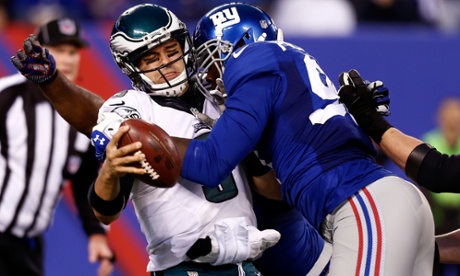
The Eagles lost to fellow contenders San Francisco. And Arizona. And Green Bay. Foles was lost to a broken collarbone and, while New York Jets cast-off Mark Sanchez was initially a more than handy stand-in, steering the team to wins over Houston and Carolina, the Packers game exposed an underlying fault of San Andreas proportions.
Sanchez was still prone to killer interceptions, McCoy was struggling to repeat his mercurial feats of 2013 and the defense was giving up yardage in huge chunks – 477 to Green Bay, 400 to Arizona and even 397 to Tennessee and rookie passer Zach Mettenberger.
More tellingly, the turnover count was rising; three against Arizona and Houston, four at Green Bay and another two against Tennessee.
Thanksgiving arrived with the team at 8-3 for the first of their bi-annual tipping-point games with Dallas, and a crushing 33-10 rout of Jason Garrett’s troops seemed to provide a steadying of the ship, a reaffirmation of Kelly’s methods and total control of the NFC East. In hindsight, it was the most false result of the season.
On 28 November, Tony Romo was still secretly nursing two cracked ribs and was only a month removed from suffering two fractures to the transverse process of his lower spine. The four-day turnaround from a 31-28 win at the Giants was asking too much for the quarterback’s distressed body, and it showed in a limp, off-key performance. For once, Philly limited their turnovers to just one, a McCoy fumble, and the Cowboys conceded three to underline the disparity on the scoreboard.
If that result imbued the Eagles with a false confidence, it was eviscerated in a three-game December swoon of epic proportions. Sanchez’s run as a starting quarterback was exposed for its true back-up nature in a welter of turnovers, while a defense that had been creaking at times in November collapsed under an 89-point avalanche that swept away any lingering playoff hopes. From potential juggernaut to Kelly’s Zeroes in the space of 14 days.
In wildcard terms, Philly were relegated to a distant third behind the NFC North and West, amid plaintive fan complaints that an NFC South winner with a losing record will be in the postseason while their team – who finished 10-6 – sit idle. This latter point, of course, completely misses the point of the league’s playoff structure. Each division winner deserves their place, and there are then two places open to the next best. The Eagles patently failed to last the course in division-winning terms, and they have completely whiffed on a wildcard, too.
Of course, fans can point to the season-ending injury to Foles as a contributing factor. Quarterback remains the one almost irreplaceable commodity in today’s league but that is to assume Foles was playing at the same freakish 2013 level – 27 touchdowns as against only two interceptions – during his eight starts of this campaign, which is also false.
True, he had more pass attempts than Sanchez – 311 to 309 – but, with almost identical playing time, he has a lower pass completion percentage than his back-up – 59.8 compared to 64.1 – and a lower quarterback rating, 81.4 to 88.4. Crucially, while not quite as turnover prone as Sanchez, he still contributed 10 interceptions and three fumbles to the team’s league-leading 36 giveaways this season.
Sanchez, meanwhile, has been the same maddeningly inconsistent player he was during four season with the Jets. Extrapolated over a full season, he would have accounted for a career-best 4,300 yards with 25 touchdowns, only one short of his best campaign with New York, but he would also have thrown 20 interceptions – equalling the total of his rookie year in 2009 – and added another six fumbles.
Overall, Philadelphia’s quarterbacks combined for 4,581 passing yards, good enough for an impressive sixth overall this term, while the touchdown total of 27 ranks 12th. But add in the 28 turnovers – comfortably first in the league, ahead of the likes of the benched Jay Cutler and Jacksonville rookie Blake Bortles – and, again, the underlying picture is fractured.
When you examine the pass attempts for the duo, you are looking at 621 for the year. Only four other teams – the Colts, Saints, Falcons and Raiders – exceeded that figure, all of them with offences heavily weighted towards the pass. The Eagles, ostensibly, are a balanced attack that features a hefty dose of the running game (474 rushes so far, seventh in the league).
Clearly, the passing game has broken down far too often this season but it is in the number of pass attempts that things go awry. Drew Brees and Andrew Luck are able to keep their turnover ratio down to a manageable 2.6% per attempt. The Foles/Sanchez combo is currently at 4.4%, and rising. According to those season-long metrics, Philly’s passing attack was an accident waiting to happen, 2.2 times every 50 drop-backs.
Equally tellingly, this season’s 10-6 record masks a 2-5 success rate against teams with a winning record, or 4-9 over the past two years. Put simply, they usually beat the teams they are supposed to beat but struggle against play-off caliber opponents.
So what does all this mean for Kelly’s vaunted fast-paced scheme? In simple terms, he is pushing it too fast and the breakdowns are inevitable.
Consider that Sanchez’s career stats show he throws an interception once every 27 pass attempts. What happens when you ask him to drop back to pass 50 times in a game (which he had only ever done twice before, in resounding defeats for the Jets in 2011 and 2012, with three interceptions), as Kelly did during the Redskins debacle?
The odds alone say another interception is just around the corner, but the game situation against Washington made the increasing number of passes even more baffling.
In the fourth quarter of a close game, the Eagles passed 22 times and ran just six. With nine minutes to go and the team down 24-21, the ratio was an unhealthy 7-1 on their eight-play field goal drive. Then, with the scores level, 2:36 left on the clock and still with all three timeouts, Kelly called seven straight passes, irrespective of the fact his running game was picking up a good 4.3 yards per attempt.
At the fateful moment, with 1:36 on the clock, Sanchez threw the seventh pass of the drive, his 49th of the night, and it ended, totally predictably, in an interception. Game, set and season.
On the other side of the ball, Bradley Fletcher was fresh from a nightmare outing against Dallas whereby Dez Bryant ran past him for touchdowns at regular intervals. When Jackson started hauling in long passes over Fletcher in the first quarter, you figured the Philly defence would either provide him with cover or change the player, as Cincinnati did in their 37-28 defeat of Denver 48 hours later, when Dre Kirkpatrick stepped in for a victimised Terence Newman and altered the course of the game.
Instead, Kelly left his cornerback out on his own personal wasteland, Devil’s Island as opposed to Revis Island, perhaps, and Washington’s premier receiver promptly enjoyed his best game for six weeks. In the fourth quarter, strong safety Nate Allen finally moved across to provide additional protection and immediately picked off a Robert Griffin III pass, but, by that stage, RGIII had already amassed 220 yards and Sanchez was still throwing at every opportunity, with the aforementioned results.
For all Sanchez’s drop-backs, he had just two passes of 20 yards or more. The Redskins had two passes of more than 50 yards in less than half the attempts. The Eagles also rate just 21st in pass completion rate, hardly the stuff of quick-strike capability.
Is all this naive? That may be harsh in analysing a single game, but the trend is undeniable and Philly fans are certainly asking the question. In many cases, they have also delivered their verdict, with 54% of a recent local radio poll blaming Kelly directly (Sanchez and Fletcher were joint second with 20%). At the very least, his methods look in need of a dose of NFL reality, and, without a Brees or Luck to call on – or a Jackson to throw to – the Eagles look badly suited to progress under their pioneering head coach.