China has tried a veteran journalist for revealing state secrets and dismissed a prominent Uighur scholar’s appeal against a life sentence in cases that human rights groups say were evidence that tolerance of dissent had been considerably lowered.
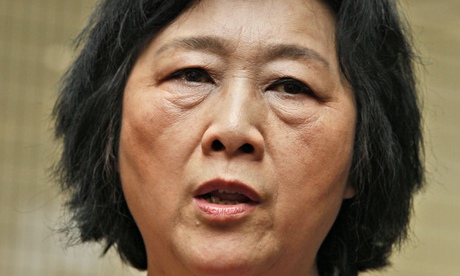
The closed-door hearings came shortly after it also emerged that a celebrated rights lawyer who represented artist Ai Weiwei is accused of up to four offences thought to include the rarely brought charge of inciting racial hatred. The journalist Gao Yu, 70, is charged with giving state secrets to foreign contacts and faces a life sentence if found guilty, as is all but guaranteed in such cases. State media have said she is accused of leaking an internal Communist party document to foreigners.
The charge is thought to relate to Document Number 9, which attacked western democratic ideals and called for tighter ideological controls, but it is impossible to be certain because the evidence is classified as a state secret.
Gao maintained her innocence at a four-hour trial, her lawyer Mo Shaoping said. State television aired images of her making a confession shortly after her detention in May, but Mo has previously said Gao confessed because authorities threatened her son with arrest.
Earlier, Ilham Tohti, China’s best-known advocate for the rights of Muslim Uighurs, learned that his appeal against a life sentence for separatism had been dismissed. The harsh sentence has been condemned by the US and EU.
The 45-year-old economics professor was jailed in September after a 10-month detention and all his assets confiscated. He was well-known for criticising government policies in Xinjiang but had said he did not support independence for the region.
Li Fangping, one of his representatives, told Reuters that Tohti would appeal against the ruling. The hearing took place in the Urumqi detention centre where he is being held, which his lawyers said violated normal procedure and they were unable to attend because of the short notice given. He said Tohti had been kept in leg irons for almost two months.
Nicholas Bequelin, senior China researcher for Human Rights Watch, said: “It is pretty clear the tolerance for dissent has been considerably lowered. All these people who have been active for years and under restrictions or surveillance but nonetheless free, suddenly find themselves on the wrong side of the line.”
He added: “Of course, Xi Jinping wants to accrue as much power as he can, but he wouldn’t have been able to do so if there was not a consensus or at least a majority view [at the top] that the authority of the party must be increased.”
Radio Free Asia reported earlier this week that authorities in Xinjiang were preparing to put several of Tohti’s students on trial. His wife, Guzelnur, said a parent had called to tell her that their son’s trial was due soon.
Asked about Tohti’s case, a foreign ministry spokesman told a regular news briefing that “the Chinese government makes such judicial decisions on the basis of facts and in accordance with the law”.
William Nee, China researcher at Amnesty International, said in a statement: “If Gao Yu and Ilham Tohti were to receive genuinely fair hearings, the charges against them would be dismissed as blatant political persecution.”
The case of Pu Zhiqiang, one of China’s most prominent rights defenders, is being reviewed by prosecutors, his lawyer, Mo Zhaoping, said this week. He is thought to face four charges of illegally obtaining personal information, picking quarrels and provoking trouble, incitement to subversion, and inciting racial hatred, although Mo said he had yet to see documents to confirm the “very rarely seen” fourth charge.
Pu, who was initially accused only of the first two charges, was detained in May, shortly after attending a private event to commemorate the bloody crackdown on 1989’s Tiananmen Square pro-democracy protests.
Liu Zhengqing, who represents another rights lawyer, Tang Jingling, said police told him this week that his client’s case had been transferred to the procuratorate.
Guo Feixiong, another well-known rights activist, is due to go on trial in Guangzhou next week after being held for over a year. Guo, also known as Yang Maodong, is accused of gathering a crowd to disrupt public order.