Chinese authorities have begun investigating a shocking case of industrial pollution in central China’s Hunan province, in which runoff from an aluminium plant’s illegal landfill allegedly gave at least 10 local villagers cancer.
Pollution from the plant, operated by the Changsha-based aluminium products manufacturer Chuangyuan Aluminium Co Ltd., had made parts of the remote rural county of Taoyuan virtually uninhabitable, the government-run Beijing News reported on Sunday.
“The environment [in Taoyuan] was once very beautiful,” the newspaper said in a microblog post. “In 2001, the factory began production, taking up 2,450 mu of land (nearly 230 football pitches), and the high pollution gave the place a trauma that will be difficult to recover from.”
In recent years, widespread outrage over China’s filthy water, soil and air has forced China’s leaders — once the champions of a “grow first, clean up later” policy — to change their tack on the environment. In March, premier Li Keqiang declared a “war on pollution”; one month later, authorities amended the country’s environmental law for the first time in 25 years.
Yet many officials and factory owners still pollute with impunity, making the investigation into Chuangyuan Aluminum an exception, not the rule.
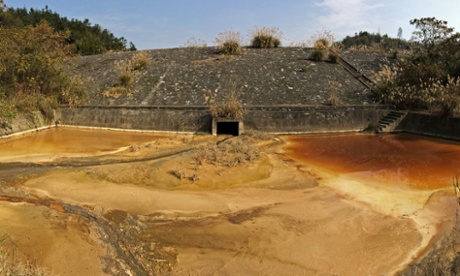
The Sunday report in the Beijing News said that the factory’s aluminium production created highly toxic fluoride runoff, which seeped into the Yuan River, a tributary of the Yangtze; villagers then used the water to irrigate their crops. Pictures on the newspaper’s microblog showed eddies of coffee-coloured water, dusty shrubs with purple-stained leaves, and billowing smokestacks towering over a quiet residential street.
“These have all changed,” one unnamed villager told the newspaper, pointing up at a tangerine tree. “These were originally just tangerines, and then one by one, their skin developed all these little tumours.”
Another villager told the paper: “More than 10 people have died of cancer, one after the other. And a lot of people have become weak — they feel achy and powerless, but check-ups can’t identify any diseases.”
The company could not immediately be reached for comment.
The Taoyuan county government posted to its official website on Sunday that it “attaches great importance to the media reports” about the pollution. The government urged “the leaders of relevant departments to rapidly convene a meeting” and “research the topic” of the pollution allegations.
Another government statement, posted less than 10 minutes later, said that the plant’s waste water and emissions met national standards, but that the plant “has problems in disposing solid waste”. The government promised to boost supervision of the factory, and to help nearby residents find new homes.