Markets in the red after factory slowdown
So much for starting October with a stock market rally.
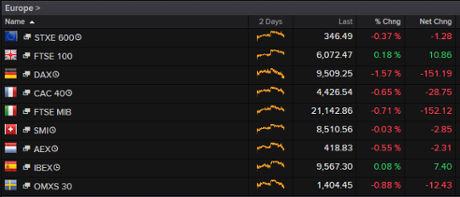
Trading is over for the day in Europe, and most of the main indices finished in the red. The clutch of downbeat factory surveys released through the day have reignited concerns over the global economy.
Conner Campbell of SpreadEX nails it:
Well, that didn’t last long. The jubilant start to the fourth quarter proved to be as unwarranted as it always seemed, with a day full of dismal manufacturing data gradually wearing down even the most optimistic of investors.
A quick recap of that dismal data:
-
China’s factory sector has shrunk at the fastest rate since 2009,
-
In Europe, manufacturing growth has slowed in Germany and Spain
-
UK factories are also seeing weaker conditions, forcing them to start cutting jobs,
- and in America, growth almost stalled last month.
And that wiped 1.5% off Germany’s DAX, and 0.6% off the French CAC. In the UK, the FTSE 100 ended 10 points higher.
Traders are remain nervous ahead of tomorrow’s US jobs report. points out Alastair McCaig of IG:
Having rounded off such a miserable quarter it is understandable why traders have been a little reluctant to rush back into the markets. Throw into the mix that tomorrow will be the first Friday of the month, triggering the US to release the latest non-farm payrolls data, there has been a healthy amount of waiting and watching going on.
And that’s helping to push shares down in New York too:
Wall St stocks extend losses. Dow down 204 pts (-1.2%), S&P down 17 pts (-0.9%), Nasdaq down 57 pts (-1.2%) http://t.co/wBMkndpTTK
— CNBC Now (@CNBCnow) October 1, 2015
Updated
Bloomberg’s Joe Wiesenthal has done a nice piece rounding up the good and bad economic news today.
On the worrying side, manufacturing growth in the US, China, the eurozone and Vietnam have all slowed last month along with South African electricity consumption (just the sort of data that would catch Joe’s eye).
But there is better news too -- consumer confidence and residential housing both picked up last month.
Joe writes:
So there’s your world economy in a nutshell. Emerging markets, China, manufacturing, etc. don’t look very hot, but the twin engines of the U.S. economy -- consumers and housing -- continue unabated.
Want to understand the global economy right now? There's some key data to look at http://t.co/0uGsfCiCBV pic.twitter.com/g3SaWdULGq
— Bloomberg Business (@business) October 1, 2015
The Executive Director at the Consumers’ Association, Which?, believes Volkswagen should have acted faster to suspend car sales:
Adding insult to injury for UK consumers. https://t.co/WtCPLqiMRP
— Richard Lloyd (@RichardJLloyd) October 1, 2015
Updated
Volkswagen UK suspends some car sales
Another Volkswagen development -- the firm’s UK arm is suspending the sale of 4,000 vehicles in Britain.
These cars could contain software at the heart of the emission scandal, so are being taken off the market until a fix is found.
The BBC’s industry and employment correspondent, John Moylan, has tweeted the details:
Volkswagen to suspend sales of around 4 thousand vehicles in the UK with Euro 5 engines which may be equipped with defeat device
— John Moylan (@JohnMoylanBBC) October 1, 2015
VW says the move is a temporary measure - the 4 thousand vehicles will be returned for sale once a fix is identified. #VolkswagenScandal
— John Moylan (@JohnMoylanBBC) October 1, 2015
VW says the 4 thousand vehicles amount to 3% of its stock in the UK - the remaining vehicles unaffected
— John Moylan (@JohnMoylanBBC) October 1, 2015
While #VW now suspending some vehicle sales - it means company has been continuing to sell Euro 5 engine cars which have cheat device
— John Moylan (@JohnMoylanBBC) October 1, 2015
Updated
Jeffrey Lacker, president of the Richmond Federal Reserve, has stirred the markets by predicting that US interest rates could be raised this month.
Asked about the possibility of an October rate hike, Lacker told the Wall Street Journal that:
“I don’t see why not.”
“We will have another labor market report [on Friday]. Presumably that will move us further toward labor market improvement.”
That’s pushing shares a little lower on Wall Street, and also weighing on commodity prices:
Crude oil doesn't like rate hike chatter at all pic.twitter.com/gOgGNgFBpE
— Russian Market (@russian_market) October 1, 2015
Today’s ISM report shows that America’s factories are “barely hanging on”, says Steve Murphy of Capital Economics.
The decline in the ISM manufacturing index to 50.2 in September from 51.1 in August is yet another illustration of the devastating impact that the strong dollar and weak foreign demand is having on the battered factory sector. Things might well get even worse before they begin to get better.
He’s worried by the drop in employment growth too:
While manufacturing output has been no worse than stagnant, employment in the sector has begun to shrink in recent months. The decline in the employment index to 50.5 last month, from 51.2, points to further factory job losses.
Europe’s stock market rally is running out of steam - the FTSE 100 is now down 2 point, having been up 110 points early this morning.
And Germany’s FAX is down 1.5%, with half an hour to go.

A much-awaited review of the Greek economy – vital to initiating talks on the country’s debt problem - will begin this month, officials are saying.
News of the audit was confirmed as Athens and its euro zone partners prepared to finalise the list of measures Greece must implement in return for being bailed out for a third time.
Helena Smith reports.
Greek financial media, citing senior EU officials, are reporting that the review - the first since the country was inducted into its third bailout programme - will begin in October.
This review will determine if Athens receives a €3bn loan tranche; it would be paid in two tranches, once the Athens parliament has voted on and enforced a list of prior actions.
Under the terms of the bailout accord, prime minister Alexis Tsipras’ newly elected government has to implement as many as 105 prior actions, including structural reforms and budget cuts, by early November.
The measures are expected to be fine-tuned at a meeting of senior euro zone finance ministry officials conducting a Euro Working Group teleconference call on Friday. They will then be formally approved at a Euro Group of euro area finance ministers on Monday. Tsipras and his leftist-led government have openly said they disagree with many of the measures - on the basis that they will exacerbate Greece’s recession and debt deflationary cycle.
But earlier this week the young prime minister repeated that he will enforce them so that talks on debt relief can begin once the review is concluded in the coming months.

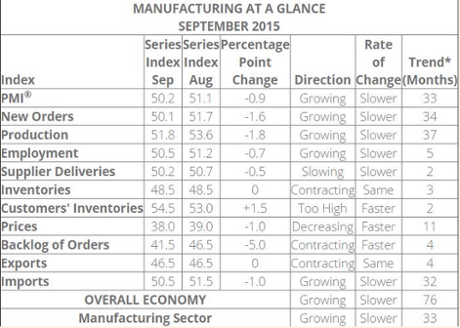
Here’s the detail of today’s US factory report, showing slower growth in new orders, production, employment, exports and imports:
US factory growth grinds to a halt
Yikes. Growth in America’s factory sector all-but vanished last month, according to the monthly manufacturing report from the Institute of Supply Management.
The ISM’s US manufacturing PMI fell to just 50.2 in September, barely above the break-even mark, down from 51.1 in August.
That’s the lowest reading since May 2013, and lower than economists expected.
The ISM reported that new orders, employment and import growth all fell last month, indicating that America experienced the same slowdown as China and Europe in September.....
*U.S. SEPTEMBER ISM MANUFACTURING INDEX FALLS TO 50.2 FROM 51.1
— Michael Hewson (@mhewson_CMC) October 1, 2015
*U.S. ISM FACTORY GAUGE DROPS TO LOWEST LEVEL SINCE MAY 2013
— Michael Hewson (@mhewson_CMC) October 1, 2015
Over in Athens, Greeks have been told that debilitating capital controls may be lifted by the beginning of 2016.
Our correspondent Helena Smith reports
With the long-awaited recapitalization of the Greek banking system expected to begin next week, senior finance officials in Greece are predicting that capital controls could soon be ended.
As the Union of Greek banks republished an updated version of the restrictions this afternoon, bankers said there were “improved hopes” the controls would gradually be phased out. In an address last night to the Athens chamber of commerce, the president of the National Bank of Greece, Luka Katselli announced the restrictions could be lifted by the end of the year, if not early 2016, if the recapitalization process was concluded promptly.
The European Central Bank is due to conduct stress tests of Greek banks, and an asset quality review, to determine exactly how much extra capital they require. Fears of the country’s ejection from the euro zone triggered a massive run on deposits with Katselli estimating that around €118bn in deposits had fled the system between 2008 and 2015.
Under the country’s third EU-backed rescue programme, as much as €25bn have been earmarked for the recapitalization of the Greek banking system. The controls - imposed to avert a collapse of the financial system at the end of June - have been the death knell for thousands of small and medium sized businesses now unable to pay suppliers.
Katselli said provided “political and economic stability” were restored liquidity could finally be pumped into the real economy, adding:
“2015 will be a landmark year for the rebooting of the economy but for it to happen we must all work together.”
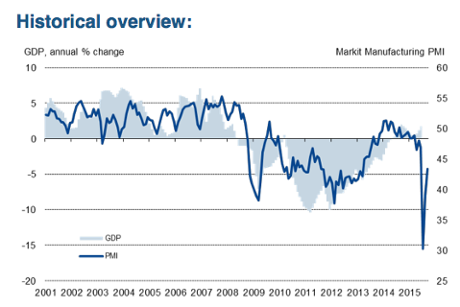
This morning’s factory data showed the impact of capital controls. Output slumped in August and was still below the 50-point ‘no change’ mark in September.
Updated
The technology-heavy Nasdaq index is down 0.75% in early trading too.

Wall Street is making a muted start to the fourth quarter, as trading gets underway in New York.
The Dow Jones industrial average is currently down 16 points, or just 0.1%, at 16,269.
Traders are digesting the news that Chinese factory output shrank again last month, while growth eased in Europe and the UK. They’re also edgy ahead of tomorrow’s Non-Farm Payroll report - a strong reading could put an early Fed rate hike back on the table.....

One of Glencore’s directors, John Mack, has shown he still believes in the company by snapping up 550,000 shares.
Mack bought the shares on Tuesday, according to a stock market filing, the day after the mining and trading firm’s share price slumped by 30% to a record low. That prompted Glencore to insist that it has a solid future, despite the commodities rout.
Mack’s move echoes chairman Tony Hayward, who bought 100,000 shares yesterday. Entertainly, Mack got a rather better price -- 81p, against Hayward’s 90p. Timing is everything in the City....
Mack the (falling) knife? https://t.co/mlpJnWKqOA
— Katie Martin (@katie_martin_fx) October 1, 2015
After an early rally, Glencore shares are down 2.8% today at 89p.
$GLEN reversed morning gains, now leading losses in $FTSE. (-2.80%)
— Ipek Ozkardeskaya (@IpekOzkardeskay) October 1, 2015
Updated
The number of American’s signing on for unemployment benefits rose last week, according to the latest US weekly jobless figures which are hitting the wires now.
This is our final glimpse into America’s labour market before tomorrow’s Non-Farm Payroll report.
And they show that the initial claimant count rose to 277,000 last week, up from 277,000 a week earlier. That’s still a fairly low figure, suggesting a robust labour market.
Updated

Speaking of Volkswagen, German prosecutors say today that former CEO Martin Winterkorn isn’t being formally investigated over fraud allegations.
They just released a clarification of their earlier statement three days ago, saying they have no evidence of wrongdoing by Winterkorn. who quit a week ago.
They said:
“There is currently no formal investigation against Winterkorn.
The Braunschweig prosecution regrets that this impression may have been created as well as the irritation that (Monday’s) press release caused.”
On Monday, the prosecutors office said it was investigating Winterkorn over “allegations of fraud in the sale of cars with manipulated emissions data” based on charges filed by about 10 unidentified individuals.
Updated
The Volkswagen emissions scandal has the potential to hurt factories across Europe in the next few months.
Italy’s deputy industry minister, Carlo Calenda, is already worried.
He told an event in Milan today that:
“The risk is very big. Volkswagen is a group that buys a lot from Italy’s supply chain, especially in the north-western part of the country.”
Meanwhile in the UK, a former minister has said diesel cars are “literally killing people”, and that the government here blundered by encouraging drivers to switch from petrol.
Updated
Investors struggled to avoid taking big losses in the last three months, whether they put money into stocks, gambled on commodities, or dabbled in the foreign exchange market.
Government bonds were the place to be - especially Italian debt (BTPs), as this chart from Deutsche Bank shows.
Congrats to the BTP investors. Here's Q3 asset performance from Jim Reid: pic.twitter.com/rn6dzvf0ox
— Tracy Alloway (@tracyalloway) October 1, 2015

Wall Street is expected to open higher later today, despite these latest signs of manufacturing weakness around the globe.
The Dow Jones industrial average is tipped to rally by around 100 points at the open, to 16376 points.
Bad news appears to be good news for stocks today, if it means central bankers don’t tighten monetary policy as fast.
Brenda Kelly of London Capital Group explains:
Eurozone manufacturing PMI was for the most part disappointing with only France managing to beat estimates, but this coupled with the fact that the euro area officially fell into deflation only boosts the notion that the ECB will provide additional monetary stimulus and potentially extend the current programme beyond September 2016.
Updated
UK productivity problems might finally be easing.
The Office for National Statistics has reported that output per hour worked rose by 0.9% in April to June, compared to the previous quarter.
That takes productivity to the highest level on record, but it was still 15% below where it would have been without the financial crisis.
UK productivity has topped its pre-recession peak. Only took SEVEN YEARS. pic.twitter.com/d1LqI0DU9y
— Sarah O'Connor (@sarahoconnor_) October 1, 2015
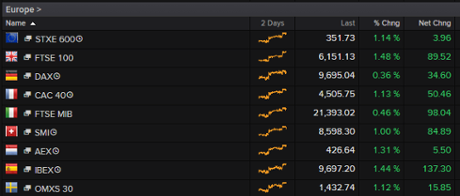
This morning’s flurry of mediocre factory data hasn’t prevented Europe’s stock markets from posting solid gains.
The main indices are up at least 1%, as investors start the final quarter of 2015 in positive mood. Here’s the state of play:
Analysts say there is relief that China’s manufacturing data wasn’t worse. Plus, poor data may mean more stimulus measures, or less risk of interest rates being hiked.
Neil Williams, chief economist at fund manager Hermes, has a good explanation (via Reuters).
“The clouds are clearing a bit. Overall China is clearly slowing but what does give me comfort is that its policy dashboard has a lot more buttons to press on it than ours in Europe.
“I’m now expecting China to cut quite aggressively its interest rates and reserve requirements, and even move towards a fiscal splurge.”
Updated
UK factories face some serious challenges right now, warns Mark Stephenson, UK manufacturing industry leader at Deloitte, including:
....the recent high profile scrutiny on the automotive manufacturing sector; a strong Pound and weak Euro continuing to make for difficult export conditions and squeezed margins; and the prolonged period of economic volatility in China creating supply chain uncertainty and impacting demand.
All of these factors mean that the remainder of the year could be challenging for the industry.
Mike Rigby, head of manufacturing at Barclays, is alarmed that UK factories didn’t perform better last month.
“With virtually zero inflation, low unemployment and weak oil prices, manufacturing would have been looking to make up ground over the past quarter.
He blames the weakening global economy:
However, ongoing weakness in export orders, which is being exacerbated by the strength of sterling, continued lacklustre growth in the Eurozone as well as the slowdown in China, have continued to thwart export opportunities for manufacturers and the sector remains reliant on domestic demand to keep it steady.”
Updated
UK factories cut staff as growth slows
Britain’s factory sector has also hit a stickier patch, with growth slowing and firms cutting jobs again.
Data firm Markit reports that output growth hit a three-month low in September, with the manufacturing PMI falling to 51.5 from 51.6 in August.
That’s a “lacklustre” performance, it says, partly due to a “marginal decrease in employment” for the first time in two years.
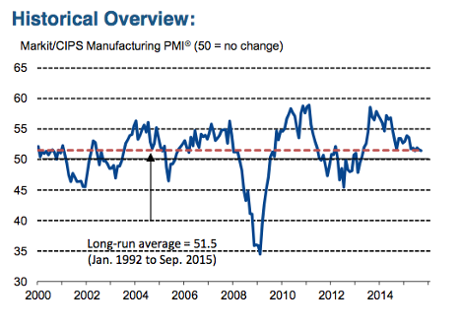
It’s a fairly gloomy picture, as David Noble, CEO at the Chartered Institute of Procurement & Supply, explains:
“The sector appears to be sidestepping any significant growth this month and offering little in the way of an upbeat performance, and unnerving those who expected a less disappointing result.
Noble is particularly worried that the sector has stopped hiring new staff:
“The domestic market continued to be the main contributor to any growth, though the export market showed a flicker of life as order levels improved marginally. The bigger worry is in staffing levels and it was not a good month for the intermediate goods producers on that score with that sector showing the biggest fall in employment. The overall employment index is now hovering just below the no-change mark, its lowest level for two-and-a-half years.”
Updated
Eurozone factory growth hits five-month low
Manufacturing growth across the eurozone has slowed to a five-month low, according to this morning’s PMI reports.
The overall eurozone manufacturing PMI, based in data from thousands of firms, has just come in at 52.0, down from 52.3 in August. That shows another month of growth, but not enough to tackle Europe’s economic problems.
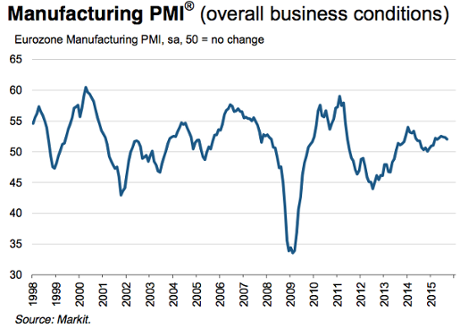
Chris Williamson, Chief Economist at Markit, said:
“Despite unprecedented central bank stimulus and substantial currency depreciation, the eurozone manufacturing sector is failing to achieve significant growth momentum and even risks stalling again.
“The pace of expansion has been range-bound since the uplift following the start of QE earlier in the year, remaining disappointingly modest and even slipping to a five-month low in September.”
And worryingly for the European Central bank, factories are cutting prices again too. Not good for deflation. Markit says:
Cost pressures shifted to the downside, however, with input costs and selling prices falling during the month.
The report also slows that Greece’s factory sector contracted sharply again, but at a slower rate than August’s slump. That’s the impact of capital controls, making it hard for firms to buy raw materials from overseas.
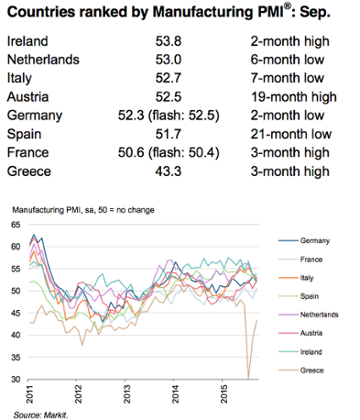
Germany’s factory growth has slowed with its manufacturing PMI dipping to 52.3 in September from 53.3 in August.
Oliver Kolodseike, economist at Markit, says:
“Germany’s manufacturing sector lost some of its growth momentum in September, with the headline PMI down slightly since August.”
Firms reported a rise in new orders and output, but job creation has dipped.
Good news from France! The factory sector is expanding again.
The French PMI has crept back over the crucial 50-point mark to 50.6, showing the fastest growth in 18 months.
It’s not that great. Although output rose, new orders did fall and staffing levels were unchanged. But still, Markit says the sector is on a “firmer footing’.
Updated
Growth in Italy’s factory sector has also slowed, with the Italian PMI dropping to 52.7 from 53.8. That’s the slowest growth since February.
Spain's factory growth hits 21-month low
The Spanish manufacturing PMI for September is just out, and it’s not great.
Spain’s factory PMI fell to 51.7 last month, from a healthier 53.2 in August. That’s the slowest rate of growth in 21 months.
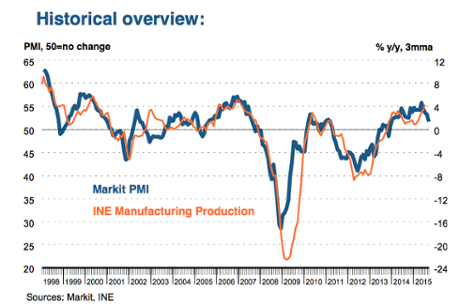
Markit, which compiled the report, found that new orders are rising at the slowest rate since December 2013, suggesting Spain’s impressive recovery may be coming off the boil.
Andrew Harker, senior economist at Markit, warns:
The outlook for the remainder of the year is looking uncertain, but with macroeconomic risks skewed to the downside there is the possibility of outright declines in output and new orders being recorded.
After several wild days, Glencore’s share price has just clawed back this week’s losses.
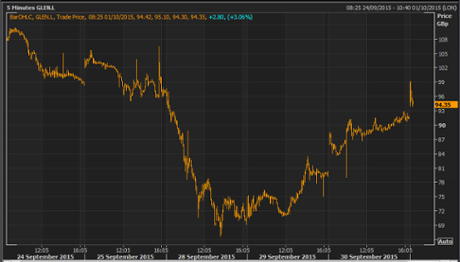
They jumped almost 8% at the start of trading to 99p, back to the level before Monday’s 30% slump.
Glencore has been insisting that it is in better financial health than some analysts have claimed, despite the slump in commodities prices. Maybe the message is getting through...
#BREAKING: #Glencore rallies for third day and recovers all of the 30% record drop of Monday #commodities #mining pic.twitter.com/GyJhozYNAG
— Javier Blas (@JavierBlas2) October 1, 2015
China gives London stock market a lift

In the City, shares have jumped at the start of trading.
The FTSE 100 is up 73 points, or 1.1%, at 6134, led by mining stocks such as Glencore and Rio Tinto.
Traders are taking their cue from today’s Chinese manufacturing reports, with relief that the official PMI survey showed that the slowdown has stabilised.
But what about the gloomier Caixin report, showing the biggest decline since 2009? Well, that appears to be fuelling hopes that Beijing might embark on more stimulus measures soon.
#FTSE100 called to open +75pts at 6135 after China data improves slightly, but still contracts, adding to stimulus and Fed hike delay hopes
— Mike van Dulken (@Accendo_Mike) October 1, 2015
There’s also relief that the Chinese stock market is now closed for a week.
Tony Cross of Trustnet Direct explains:
Some passable PMI data was released from China last night, with both the official and private readings posting contraction, but the rate wasn’t quite as lows as had been expected.
As a result we’ve seen mining stocks driven to the top of the index although it’s worth noting that with the Shanghai market now closed for the national day holiday, again this is removing some uncertainty from the equation.
There are also signs of economic weakness in the latest survey of Japanese manufacturers, which shows a sharp drop in export orders.
Japan’s factory PMI slipped to 51.0 in September, showing weaker growth after August’s 51.7.
That’s worrying.... however, the Japanese stock market has rallied today, by almost two percent. Traders may be anticipating yet more stimulus measures from the Bank of Japan to ward off a new recession.
#Japan's Nikkei rallies 1.9% to 17722.42 brushes off weak econ data. pic.twitter.com/Pnxh92dHdw
— Holger Zschaepitz (@Schuldensuehner) October 1, 2015
Chinese factory output falls again.
Two rival surveys of the Chinese factory sector have been released today, and both show that the slowdown continues.
According to the Caixin China General Manufacturing PMI, operating conditions are deteriorating at the fastest rate since March 2009. It found that production is still falling, forcing firms to lay off more jobs as unsold goods piled up.
Here’s their top line:
Total new work fell at the quickest rate in over three years, partly driven by a steeper fall in new export business. As a result, companies cut output at the sharpest rate in six-and-a-half years, while staff numbers fell at the quickest pace since the start of 2009. Reduced production schedules also prompted firms to lower their purchasing activity again in September, while disappointing sales led to the strongest increase in stocks of finished goods for over three years.
On the price front, both input costs and output charges fell at sharper rates.
And that dragged the PMI down to 47.2 in September, from 47.3 in August, showing a sharper contraction.
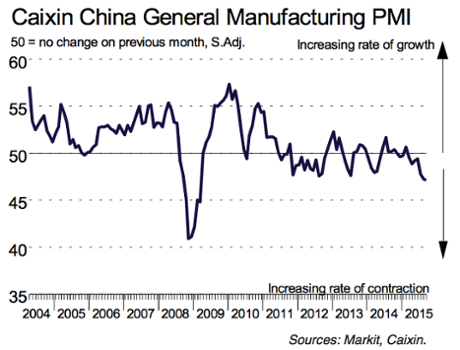
However, the official manufacturing PMI calculated by the Beijing government was less pessimistic -- although it also showed another contraction.
It came in at 49.8, up from 49.7 in August, closer to the 50-point mark that shows that activity was unchanged. That could indicate that the slowdown is bottoming out.
Zhang Liqun, researcher at the Development Research Center of the State Council (a government think tank) is optimistic, saying:
“The figures showed that pro-growth policies are taking effect, pointing to signs of stabilizing for China’s economy,”
It all depends which report you believe, really. The Caixin survey is seen as more independent, and may also give a better picture of how smaller Chinese firms are faring.
The agenda: World factory reports in focus

Good morning, and welcome to our rolling coverage of the world economy, the financial markets, the eurozone and business.
It’s PMI Day, when surveys of factory output across the world are released. Investors will be scrutinising these Purchasing Manager Indexes for signs that the economic slowdown continued in September.
Poor data in Europe could raise the chances that the European Central Bank launches fresh stimulus measures.
We might even spy signs that the Volkswagen emissions scandal has hurt German manufacturers (although it could be early days).
And the US PMI report, due this afternoon, will help influence whether the Federal Reserve takes the plunge and raises interest rates next month.
Here’s some timings:
-
Spanish Manufacturing PMI: 8am BST
-
Italian Manufacturing PMI: 8.45am BST
-
France Manufacturing PMI: 8.50am BST
-
German Manufacturing PMI: 8.55am BST
-
UK Manufacturing PMI: 9.30am BST
- US Manufacturing PMI: 3pm BST
It’s also the start of a new financial quarter. More than $10 trillion was wiped off global shares in the last three months, so investors will be hoping that Q4 gets off to a better start.
Updated