
European Central Bank president Mario Draghi has repeated his readiness to defend the euro, as the central bank officially took charge of regulation of the major EU banks. MNI reports:
“In a context where the integrity of the euro area had been threatened, the Council and the Parliament entrusted the ECB with supervisory tasks,” Draghi said at the inauguration ceremony of the ECB’s new role as chief banking supervisor for the eurozone. “We were and remain determined to protect the euro.”
Draghi added that the new role was tantamount to an expansion of its original mandate of ensuring price stability for the euro area.
“The ECB has at the core of its mandate the protection of price stability. We now need to protect the economy in one additional way, by preventing excessive risks in the banking sector,” he said.
The ECB president hailed the creation of the Single Supervisory Mechanism (SSM) as the “largest step towards integration since the creation of our Economic and Monetary Union” and said that the successful completion of the process could serve as a model for ongoing Eurozone integration.
“We need to further think about how we can improve our union, not only in the banking sector but also in relation to capital markets and in the economic and fiscal realms,” Draghi said. “The experience of setting up the SSM and the banking union can inspire us in this respect.”
Full story here:
Draghi: ECB Remains ‘Determined To Protect The Euro’
On that note, it’s time to close up for the evening. Thanks for all your comments, and we’ll be back tomorrow.
Updated
Another mixed day for Europe
Weak eurozone growth and confidence figures, along with stalled factory growth in China, undermined sentiment in European markets, writes Nick Fletcher. But it was a mixed picture by the end of the day, with most markets down but Germany managing to edge higher following the strong US manufacturing news from the Philadelphia Federal Reserve. The closing scores showed:
- The FTSE 100 finished 17.70 points or 0.26% lower at 6678.90
- Germany’s Dax added 0.12% to 9483.97
- France’s Cac closed down 0.75% at 4234.21
- Italy’s FTSE MIB fell 0.88% to 19,209.22
- Spain’s Ibex ended 1.62% lower at 10,209.2
On Wall Street, the Dow Jones Industrial Average is currently 10 points or 0.06% higher.
A week ago, we were wondering whether Germany was in recession. Last Friday’s growth figures showed it wasn’t (hurrah!) but the relief has now worn off..
If anyone was under any illusions post 3Q GDP, today's PMIs underline how weak the #eurozone economy really is. http://t.co/xqVzZxaFT5
— Paul Hannon (@PaulHannon29) November 20, 2014
After an unexpected lift in Germany, a nasty surprise as consumer confidence in euro zone falls http://t.co/Z25GqoK9Qu via @reuters
— John O'Donnell (@johnodonnell21) November 20, 2014
More disappointing news for Eurozone growth hopes -- consumer confidence has fallen to a nine-month low.
The European Commission’s monthly survey of consumer morale weakened to -11.6 this month, from -11.1 in October.
Updated
Here’s some stronger US economic data – the Philadelphia Federal Reserve’s survey of manufacturing in its region has surged to its highest level in over 20 years.
The Philly Fed index showed that new orders doubled month-on-month, and the employment measure also jumped.
Phily it s huge on everything... including capex pic.twitter.com/sAyAM1a6pJ
— Theodore Stanton (@TTStanton) November 20, 2014
Updated
Confirmation that today’s US PMI report suggests economic growth will ease up as 2014 grinds to a close.
Flash Manufacturing #PMI data are consistent with view that US economy will show slower growth in Q4 http://t.co/9o4DvbMG5q
— Markit Economics (@MarkitEconomics) November 20, 2014
Updated
US factory PMI hits 10-month low
Growth in America’s factory sector is also slowing this month, as export growth drops.
That’s according to Markit’s monthly PMI survey, just released.
The flash US manufacturing PMI dipped to a ten-month low of 54.7, down from 55.9 in October. That means the sector is growing at the slowest pace since January.
On the upside, it does still shows growth, so America is outpacing Germany, France or China (details here)
But still, it’s another sign that the global economy is cooling this month.
— Joseph Weisenthal (@TheStalwart) November 20, 2014
Latest flash #PMI data for US shows export market weakness: largest drop in export orders for nearly one and a half years
— Markit Economics (@MarkitEconomics) November 20, 2014
Over in New York, shares have dipped in early trading after the latest PMI surveys from Europe and China showed growth slowing.
Stocks open lower on weak Europe manufacturing data; Dow down 75 points: http://t.co/bLEsDY9kqA pic.twitter.com/C79ybGlkTr
— CNBC (@CNBC) November 20, 2014
This morning’s disappointingly weak eurozone PMI surveys show that the European economy is in rather worse shape than three years ago when the debt crisis began.
So reckons bond expert Nick Spiro, of Spiro Sovereign Strategy, anyway. Here’s his take:
- True to form, France’s private sector continued to contract in November, with manufacturing output performing even worse than expected and at its lowest level since August. Last week’s better-than-expected third quarter GDP print - which in any case was flattered by yet more government spending - is already a distant memory. France continues to flirt with recession, boding ill for the fiscal and structural reforms it’s seeking to implement and playing into the hands of the National Front’s Marine Le Pen.
- As if France’s November PMI wasn’t bad enough, German private sector output was particularly weak, with manufacturing activity - suffering from the sharpest decline in new orders in almost two years - narrowly avoiding an outright contraction. The services sector, moreover, which performed relatively well in October, is now slowing significantly.
- The two grim surveys speak volumes about the breadth and depth of the economic downturn in the eurozone which has spread deep into the core of the bloc. The eurozone economy is now in significantly worse shape than at the time of the severe escalation of the financial crisis in 2011.
Europe GDP still hasn't recovered to pre-crisis levels. pic.twitter.com/xjld4BEoDd
— ian bremmer (@ianbremmer) November 20, 2014
Updated
We also have new US jobs data. And the number of Americans filing new claims for unemployment benefit fell by 2,000 last week, to 291,000.
Economists had expected a bigger fall, to 285,000, but on the upside it’s the 10th week running that initial claims has been <300k.
The number of ‘continuing claims’ also fell, to 2.33m -- the lowest level since December 2000.
Continuing jobless claims looking nice pic.twitter.com/8e9s0GTBdu
— Joseph Weisenthal (@TheStalwart) November 20, 2014
US inflation flat in October

Just in -- US inflation was unchanged last month, with consumer prices unchanged compared with September.
On an annual basis, the Consumer Prices Index rose by 1.7% in October, for the third month running.
But there are signs that inflation pressures are building. Core inflation, which strips out food and energy, rose by 0.2% during the month, pushing the annual rate up to 1.8%.
Greece to hold teleconference with Troika today
Over in Greece, finance minister Gikas Hardouvelis will shortly hold a teleconference with troika representatives.
It is a bid to break the impasse in negotiations between the two.
From Athens, my colleague Helena Smith reports:
Officials are saying the teleconference will take place this afternoon, barely a day after prime minister Antonis Samaras’ government sent the troika an email outlining the measures it plans to take to successfully exit its bailout programme. The proposals will be the focus of the talks, well-briefed sources say.
The sticking point appears to be how Greece will plug a fiscal gap that the troika reckons will be no less than €3.6bn. This has led to negotiations between the two sides all but breaking down this week.
Helena explains:
Hardouvelis, an economics professor, believes the gap will be much smaller and is sticking by his guns arguing that prognostications of a larger-than-expected fiscal gap this year also failed to materialize. Auditors representing the EU, IMF and ECB have been examining the proposals with officials saying that today’s teleconference will determine when mission chiefs return to Athens to complete their last review of the Greek economy. Much hangs on that decision. Discussions over a precautionary credit line – seen as the first step to Greece effectively exiting its bailout programme – can only begin once the review is completed successfully.
Racheting up the pressure on the government, pensioners took to the streets today, demanding that they be compensated for all the cuts they have had to suffer as the price of international aid to keep the Greek economy afloat.
And here are some photos of those protesting pensioners:


Updated
Warwick Business School’s professor of financial economics, John Thanassoulis, has suggested a way to end the clash between the UK and Brussels over bankers’ pay.
He reckons the UK should accept the principal of a bonus cap but lobby to have the cap reinterpreted as a bonus pool cap, based on a bank’s appropriately weighted assets.
That would improve financial stability, not damage it, he says, and reduce pay in the sector.
“If the bonus cap becomes a bonus pool cap it has the main effect of stopping banks over-stretching their balance sheet to bid for bankers at ever more inflated levels. This hobbles poaching banks, so taking the steam out of the market for bankers and so lowering pay levels. The well run banks can then hire the bankers they would have done in any case, but more cheaply. This lowers the banks’ cost base and enhances their stability.
“This proposal is research based and is founded on peer-reviewed articles published in scholarly journals.
INEOS shows slide of shale gas well in Texas. Nick Steinsberger says he drilled 1000s in US "all safely". pic.twitter.com/sJWDcHss9N
— Joel Hills (@ITVJoel) November 20, 2014
Chemicals and oil producer Ineos is announcing plans to spend £640m searching for commercially viable shale gas sites in Scotland and Northern England.
Ineos says it will “lead” the shale revolution in the UK, and is promising to share the proceeds with local residents. Environmental firms are concerned, though:
Chemicals giant Ineos to announce £640m UK fracking investment
INEOS says it will "lead the shale gas revolution" in UK. Big ambition but only 2 licences to-date. pic.twitter.com/5H52sk9Gh9
— Joel Hills (@ITVJoel) November 20, 2014
Updated
The opposition Labour party reckons the government was wrong to take the bank bonus tax row to the European Court of Justice.
Cathy Jamieson MP, Labour’s Shadow Financial Secretary to the Treasury, says:
“While working people face a cost-of-living crisis and lending to business is falling it’s astonishing that George Osborne’s priority has been to spend taxpayers’ money fighting a cap on bankers’ bonuses.
“It shouldn’t have taken the EU to act to rein in excessive bonuses, but there has simply been no action from the Chancellor here in Britain.
“We will repeat Labour’s tax on bank bonuses and use the money to fund a paid starter job for every young person out of work for over a year.”
The Open Europe thinktank reckons that the ECJ advocate general has overlooked some important issues, as he swept aside the UK’s opposition to the bank bonus rules....
...including the impact of the caps on financial stability (ie, what happens if bankers are simply paid more?)
One of the UK’s main arguments is that this law will result in higher fixed pay which makes remuneration less flexible and raises fixed costs for banks, thereby undermining any attempt to improve financial stability. This issue is not addressed at all in the opinion.
Furthermore, while the opinion addresses the issues of remuneration impacting risk and the fact that fixed pay can still vary it does not look at how the two can interact. It is clear that as a result of this fixed pay will increase substantially but there is no question of how this impacts stability.
This may be more an economic/financial point but given the issues are discussed separately their interaction should also be examined.
Here's our analysis of ECJ AG opinion on the bankers bonus cap - a few issues are glossed over in the opinion http://t.co/pR9BR67nGc
— Open Europe (@OpenEurope) November 20, 2014
The Treasury has now issued a harder-hitting response over this morning’s bank bonus cap ‘ruling’.
They argue that the European Court of Justice’s Advocate General has shown why the cap is a bad idea:
The detail of the opinion also demolishes the case for the fixed ratio by pointing out that it doesn’t equate to a cap on bankers pay because there is no limit on basic salaries.
This is precisely the reason why we, the PRA [Prudential Regulatory Authority] and the Bank of England have been opposed to this policy.”
That doesn’t change the fact that the ECJ is now very likely to reject the UK’s case next year.
PMI data weak across the board so far this morning - China, France, Germany all miss expectations. Not good!
— Mitch Fraser-Jones (@Mitchell_FJ) November 20, 2014
The weak eurozone PMIs have hit shares across Europe.
The FTSE 100 and German DAX are both down 0.7% , while the French CAC has shed 1.2%.
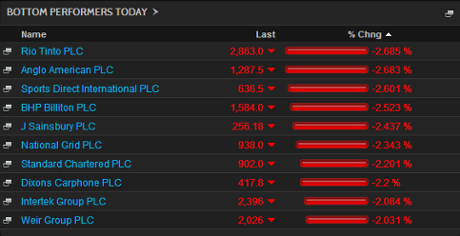
Mining shares are leading the fallers in London, as traders calculate that weaker economic growth in Europe and China will dent demand for commodities.
My colleague Nick Fletcher explains:
Last night’s US Federal Reserve minutes are providing little impetus, and a weak French purchasing managers report and data from China showing growth in the country’s manufacturing sector had stalled this month are also pushing shares down.
So with metal prices weak, Rio Tinto is down 70.5p at 2871.5p, Anglo American has lost 32p to 1290.5p and BHP Billiton has fallen 36.5p to 1588.5p.
Nick’s early market report has full details:
FTSE falls as miners hit by weak Chinese data but Johnson Matthey shines
This morning's euro zone flash PMI data in three charts. pic.twitter.com/KQX56YUeTi
— The EIU Europe (@TheEIU_Europe) November 20, 2014
European growth slows to 16-month low
The gloom over the global economy has darkened, with the news that the eurozone’s private sector is suffered its weakest growth in 16 months.
The latest deterioration in France’s private sector this month (see 8.20am), and the surprise stagnation at Germany’s factories (see 8.43am) has dragged back growth across the region.
With Chinese factory growth falling to a six-month low, concerns over world growth look increasingly valid.
Markit’s headline Eurozone PMI, which measures business activity in the manufacturing and services economies, fell from 52.1 in October to 51.4, its lowest since July 2013.
Firms across the single currency reported that new orders fell this month, and employment levels were flat with companies unwilling to hire. Selling prices fell, showing the eurozone continues to suffer from deflationary pressures.
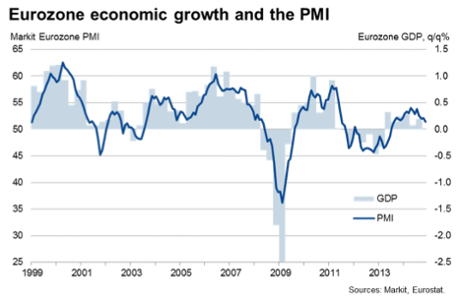
Another disappointing PMI survey in the Eurozone. Clear slowing of an already slow "recovery".
— Duncan Weldon (@DuncanWeldon) November 20, 2014
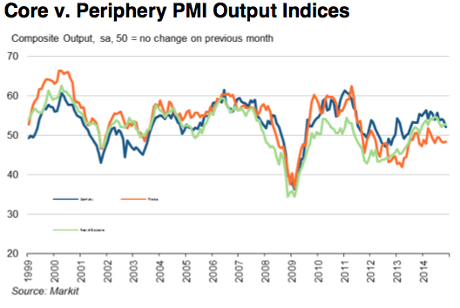
France is a “a key area of weakness”, Markit says, with business activity falling for a seventh consecutive month and job cuts continuing.
Germany’s slowdown, is also a worry, with business activity growing at the weakest rate since July 2013 amid a stagnation of new orders.
And growth in the rest of the eurozone has “slowed marginally” this month.
Chris Williamson, chief economist at Markit, fears the eurozone could slip into a ‘renewed downturn’
“The single currency area is struggling to eke out any growth, with the PMI indicating that GDP is likely to have risen by just 0.1-0.2% in the fourth quarter. A drop in new orders for the first time in almost one-and-a-half years, albeit only very marginal, suggests growth could slow further in December.
And this means the European Central Bank could face fresh calls for more action (even though it argues repeatedly that monetary policy can’t solve Europe’s problems):
“Policymakers will no doubt be disappointed that recent announcements and stimulus measures are showing no signs of reviving growth. The deteriorating trend in the surveys will add to pressure for the ECB to do more to boost the economy without waiting to gauge the effectiveness of previously-announced initiatives.”
Updated
Lawyer Alexandria Carr of Mayer Brown (who we quoted earlier), also reckons the ECJ’s Advocate General has ignored part of the UK’s case against bonus caps:
“The Advocate General argues that the legislation does not impose a “cap” or limit on pay because banks are free to raise basic pay which would permit the amount of the bonus to be increased also, as the legislation fixes the level of bonuses by reference to basic pay.
This ignores the UK’s main concern: that the legislation actually breaks the link between compensation and performance by driving banks to increase basic pay which, unlike bonuses, cannot be clawed back in the event of performance issues relating to the bank or individual.
The UK concern is that, rather than enhance the stability of the financial system, this legislation is in danger of undermining it. It is not clear, from the press release at least, that this Opinion has paid any heed to this legitimate and fundamental concern.”
ECJ advisor backs bankers' bonus cap: What the experts say
Back to the European Court of Justice advisor’s ruling against UK over the bankers bonus cap.
Tom Gosling, head of PwC’s reward practice, reckons the ECJ will take the same view, in its final decision next year:
It seems unlikely now that the Court will overturn the Advocate General’s Opinion, so banks should continue planning on the basis that the bonus cap will still be in force next year. It’s probably cold comfort for many, but at least one of the many sources of regulatory uncertainties for banks’ pay seems to have been removed.
“The bonus cap alone is too blunt an instrument to curb risk taking in the banking industry and brings with it many unintended consequences, particularly an increase in fixed pay and a reduction in the level of bonuses available for clawback in the event of future prudential or conduct issues. Bonus levels in the industry needed to, and have been, coming down, but in our view other remuneration reforms are more effective at curbing risk.
“It’s unlikely that the bonus cap itself causes existing business to up sticks and move away from London. However, it does make London somewhat less attractive as a place to build new capability, and so the impact is likely to be felt over a number of years rather than immediately.
Jean-Francois Gerard, a lawyer from Freshfields, reckons Brussels will take a closer look at the ‘allowances’ which some banks have introduced to get around the cap.
“EBA and the EU Commission have already said they don’t like “fixed” or “role based” allowances, which some banks introduced, so the debate is likely to now move from arguing about the validity of the cap to arguing about the validity of new practices such as these allowances.”
Paul Randall, head of incentives partner at international law firm Ashurst, reckons bankers’ fixed pay will now come under scrutiny (as Mark Carney suggested this week)
“As expected, it looks like the bonus cap is here to stay and that could lead to further regulation if basic, non-performance related, salaries rise as a result.
The Governor of the Bank of England has suggested this week that fixed pay may itself need to be subject to clawback, leaving the whole pay package exposed.”
And Ashurst regulatory partner Rob Moulton suggests Britain could be chastened by the defeat:
“While this is not necessarily the end of the UK’s challenge, it doesn’t give the UK much hope of success when the Court hands down its decision early next year. Some may even say it’s a clear indication of the likely winner in the power struggle between the EU and the UK.
“The Advocate-General’s view may signal the end of the UK’s campaign of organised disobedience against the EU’s rules on pay in banks.”
UK retail sales rose faster than expected last month, thanks to an increase in demand for furniture and generally lower prices, according to data just released.
The ONS reports that retail sales volumes jumped by 0.8% month-on-month, after shrinking 0.4% in September.
Clothing sales remained weak, as people continued to resist buying new winter clothes as the autumn was so mild.
The figures also show that prices fell by 1.5% year-on-year, as firms slash prices. That’s the biggest decline since 2002!
Disinflation alert! Disinflation alert! UK Average store prices fell by 1.5% in October 2014 compared with October 2013 #GBP
— Shaun Richards (@notayesmansecon) November 20, 2014
Seriously, big number in retail sales is deflator, -1.5% overall, -1.2% ex auto fuel. So volumes strong cos prices down. #goodeflation
— kit juckes (@kitjuckes) November 20, 2014
Updated
Rachel Farr, employment lawyer at Taylor Wessing LLP, also believes the European Court of Justice will side with Advocate General Jääskinen and uphold bankers bonus caps.
http://t.co/iBhINYQZFY AG does not accept UK's bonus cap argument - what are the chances of the ECJ saying different? Not great I'd suggest
— Rachel Farr (@rarfarr) November 20, 2014
Alexandria Carr, regulatory lawyer at international law firm Mayer Brown, reckons the UK’s attempt to fight EU bonus caps looks doomed, now that the European Court of Justice’s advisor has recommended rejecting Britain’s pleas.
She says:
“The Opinion of the Advocate General is not unanticipated and is in line with the general direction of travel of EU financial services regulation post financial crisis which has seen increased EU intervention in matters which were previously regarded as matters best left to the discretion of each individual country.
Although this Opinion is not binding, and the Court chose not to follow this very Advocate General’s Opinion in respect of the UK’s challenge to the short selling regulation, it would be surprising if the Court chose to depart from the Opinion in this case.”
The UK Treasury has issued a brief statement:
“The government notes the Advocate General of the European Court of Justice’s Opinion on our legal challenge against the EU ‘bonus cap’.
We are considering the Opinion and its implications in detail.”
The government's attempt to appeal against EU bank bonus cap looks like it's unravelling. ECJ Advocate General decides it's "valid".
— Joel Hills (@ITVJoel) November 20, 2014
ECJ opinion is not final word on UK's challenge to bankers bonus cap - but will likely be rejected next year.
— Piers Scholfield (@inglesi) November 20, 2014
ECJ advisor recommends upholding bank bonus caps
The Advocate General at the European Court of Justice has concluded that European legislation limiting bankers’ bonuses is valid, in a blow to the UK government.
Britain had asked the ECJ to strike down EU rules which limit a bankers’ bonus to 100% of their base salary, or 200% with shareholder approval.
But Advocate General Niilo Jääskinen – advisor to the Court – has considered the matter, and recommended that the UK’s pleas should be dismissed.
That’s a recommendation rather than the final verdict from the ECJ, but it does suggest that the UK will not win this fight.
ECJ advocate general suggests all UK complaints against caps on bankers bonuses should be rejected. Final ruling next year.
— Chris Morris (@BBCChrisMorris) November 20, 2014
The UK had argued that the EU could not impose caps on bankers bonuses because this was an issue of “social policy” and as such within the competence of the Member States.
The ECJ explains:
The UK also argued that the provisions infringe the principles of proportionality and subsidiarity, that the directive violates the principle of legal certainty, that the conferral of powers to the EBA is illegal, and that the regulation’s measures requiring disclosure of remuneration infringes the right to privacy and data protection rules.
But:
In his Opinion today, Advocate General Niilo Jääskinen suggests that all the UK’s pleas should be rejected and that the Court of Justice dismiss the action.
Jääskinen concluded that:
..fixing the ratio of variable remuneration to basic salaries does not equate to a “cap on bankers bonuses”, or fixing the level of pay, because there is no limit imposed on the basic salaries that the bonuses are pegged against.
(true, but opponents of the cap point out that basic salaries, unlike bonuses, cannot be clawed back easily, so it won’t help fight bad behaviour in the City.
ECJ finds that banker bonuses haven't been capped - you can still increase the salaries they're pegged against! (HT @jamestitcomb)
— Peter Spence (@Pete_Spence) November 20, 2014
And he also rejected the claim that the plan “infringes the principles of proportionality and subsidiarity”. Basically, he didn’t agree that national governments could create a uniform regulatory framework of risk management better than the EU.
So, a disappointment for the UK. But not an unexpected one, really.
Updated
German private sector growth falls to 16-month low

Crumbs. Germany private sector growth has fallen to a 16-month low, as its factory sector stalls.
Markit reports that the flash German manufacturing PMI dropped to exactly 50 this month, showing the sector stagnated, as firms report a drop in new orders.
And growth in the service sector slowed too, with the flash PMI dropping to 52.1, from 54.4.
Firms reported that there was no increase in new business this month, while new work fell at the steepest rate in nearly two years.
This was blamed on economic uncertainty and weaker demand from both domestic and foreign markets.
Germany #PMI: Private sector activity growth drops to 16-month low as new orders stagnate http://t.co/KxgfgPxbe0 http://t.co/HAZSsrE4wC
— Markit Economics (@MarkitEconomics) November 20, 2014
German manufacturing at 50 - any lower then manufacturing industry would fall into contraction
— RANsquawk (@RANsquawk) November 20, 2014
Oliver Kolodseike, economist at Markit, reckons the data suggests the German economy may not achieve any meaningful growth in the fourth quarter of 2014, having grown by just 0.1% in July-September.
“Private sector output growth in Germany slowed to a 16-month low in November. Moreover, it seems Germany’s service sector has started to lose momentum, with activity growth in the sector the weakest since July last year, while manufacturing growth remained sluggish. Companies reported that economic uncertainty and lower demand from both domestic and foreign markets hampered stronger growth in Germany’s private sector.
“The combination of weak output growth, ongoing spare capacity and a lack of new order wins (despite a further reduction in charges) paints a worrying picture of the underlying health of the German economy.”
More economic woe for France as private-sector output falls for the 7th successive month as its November #PMI comes in at 48.4
— Shaun Richards (@notayesmansecon) November 20, 2014
French private sector contracts again

France’s private sector has shrunk for the seventh successive month, with factories reporting another sharp fall in output in November.
That’s according to Markit’s latest PMI surveys, which show that activity across the private sector is still falling.
Here are the key points:
- Flash France Composite Output Index rises to 48.4 (48.2 in October), 2-month high
- Flash France Services Activity Index climbs to 48.8 (48.3 in October), 3-month high
- Flash France Manufacturing Output Index falls to 46.5 (48.0 in October), 3-month low
- Flash France Manufacturing PMI drops to 47.6 (48.5 in October), 3-month low
Reminder, any reading below 50 shows a contraction.
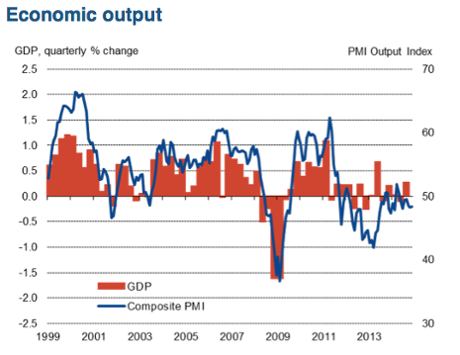
French companies reported a drop in new business and new export orders, and another fall in employment (although jobs were shed at the slowest rate in a year).
It suggests that the French economy, which grew by 0.3% last quarter, continues to struggle.
Zut alors.
— kit juckes (@kitjuckes) November 20, 2014
Jack Kennedy, senior economist at Markit warns that private firms aren’t contributing to growth in France:
“November’s Flash PMI data point to another weak performance by France’s private sector economy, with output showing a further modest fall.
Increased government spending helped support a 0.3% rise in third quarter GDP, but the continued softness in private sector activity signalled by the PMIs suggests an ongoing drag on growth during the fourth quarter from this area of the economy.
Another round of job shedding by companies during November meanwhile provides little hope of bringing down the high unemployment rate.”
Updated
RBS fined £56m over IT meltdown
In the UK, Royal Bank of Scotland has been fined a total of £56m over a meltdown in its consumer systems in 2012, that locked 6.5 million customers out of their bank accounts for several days.
The 81% taxpayer owned bank issued an apology for the problems and said it had docked the bonuses of staff responsible for collapse of the IT systems which affected customers at RBS, NatWest and Ulster Bank .
The FCA, which imposed a £42m penalty (the rest comes from the PRA) says banks must improve their computer systems.
Tracey McDermott on @BBCBreakfast: "Firms have to change. They recognise that. It's a process they have to carry on" pic.twitter.com/kw64XDhgV2
— FCA (@TheFCA) November 20, 2014
But it’s remembering that even the Bank of England isn’t immune to IT failure.
Last month the BoE’s CHAPS system the handles large money transfers in the UK failed for most of the day, delaying many house purchases.
Cough. BOE. CHAPS. Cough. RT @TheFCA: We fine RBS, NatWest and Ulster Bank Ltd £42 million for IT failures http://t.co/QlnUNEWLqx"
— Katie Martin (@katie_martin_FX) November 20, 2014
Updated
The disappointing Chinese data will hit sentiment in the City, says Mike van Dulken, head of research at Accendo Markets.
He writes that the PMI report:
...adds to signs that more stimulus is needed to offset slowing growth in the world’s number 2 economy.
There is talk of China boosting banks’ lending power to help spur growth, with more flexible loan-to-deposit ratios (short term boost, longer term danger?).
The drop in the Chinese factory PMI shows “just how choppy China’s economy is at the moment”, says Stan Shamu of IG.
This chart from Reuters shows how the pace of growth in China’s factory sector has been slowing, pretty much, for the last few years
#China #factory growth stalls, at 6-month low #hsbc flash #PMI ReutersChina http://t.co/SujgMyYG6S @ReutersGraphics pic.twitter.com/UJ435Lznzu
— Global Markets Forum (@ReutersGMF) November 20, 2014
Japanese factory activity grew at a slightly slower rate in November as new order growth dipped, in another sign that demand eased this month.
Japan’s manufacturing PMI fell to 52.1 in November from 52.4 in October, signalling a slight slowdown (but still in expansion territory over 50)
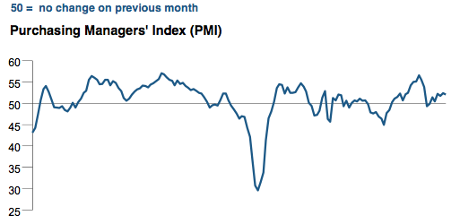
But production output did jump at the fastest rate since March, suggesting the country’s recession could be short-lived.
Chinese manufacturing PMI hits six-month low
Growth in China’s factory sector has stalled this month, in the latest signal that the global economy is slowing.
HSBC’s survey of Chinese firms, released this morning, shows that activity across the sector was flat in November. And output is actually contracting, for the first time in six months.
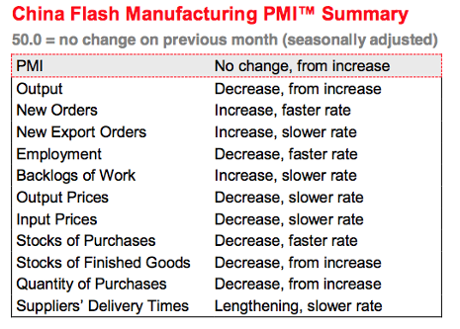
HSBC reports that the ‘flash China Manufacturing PMI’ came in at exactly 50, the tipping point between growth and expansion. That’s a six-month low.
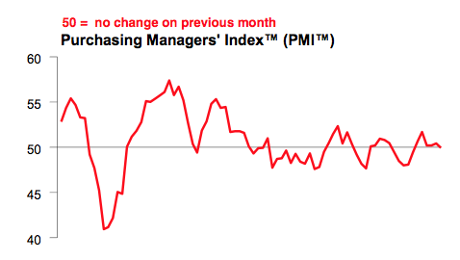
Output fell into contraction territory, hitting a seven-month low of 49.5.
Growth in new exports slowed, while employment at Chinese factories decreased at a faster rate than in October.
Hongbin Qu, HSBC’s chief economist for China, says the report shows that Beijing needs to do stimulate growth:
Disinflationary pressures remain strong and the labour market showed further signs of weakening. Weak price pressures and low capacity utilization point to insufficient demand in the economy. Furthermore, we still see uncertainties in the months ahead from the property market and on the export front.
We think growth still faces significant downward pressures, and more monetary and fiscal easing measures should be deployed.”
Updated
The agenda: Eurozone PMIs show whether economy is recovering
Good morning, and welcome to our rolling coverage of the world economy, the financial market, the eurozone and business.
Coming up this morning... ‘flash’ estimates of how the eurozone’s two largest economies, Germany and France, are performing this month.
Data provider Markit is expected to report that activity in France’s private sector is shrinking again this month, while German service firms and manufacturers continue to grow.
Regular readers will already know that Markit’s PMI reports are based on interviews with purchasing managers at a range of companies. They explains how output, employment, new orders and suchlike has changed this month, and Markit come up with a number -- where anything over 50 shows growth.
Economists expect French manufacturing to come in at 48.8 (up from 48.5) and services PMI at 48.5 (up from 48.3), at 8am GMT.
German manufacturing is tipped to inch up to 51.5 (up from 51.4) and 54.5 (up from 54.4), at 8.30am,
A weak performance will add to concerns that Europe is teetering on recession, after growing by just 0.2% in the last quarter.
We also get the latest US inflation data and weekly jobless report, (1.30pm GMT) and eurozone consumer confidence at 3pm.
In the eurozone, we’ll be watching Greece as it struggles to get a deal with its lenders.
The latest word from Athens is that it will table the final draft of its 2015 budget in Parliament on Friday without having secured the approval of the country’s creditors.
More here: Budget to be tabled without troika approval
I’ll be tracking all the key events through the day....