Greece could default if no creditor agreement by end of April, says FT
Greece could default if it does not reach agreement with its creditors by the end of the month, the Financial Times is reporting:
Greece is preparing to take the dramatic step of declaring a debt default unless it can reach a deal with its international creditors by the end of April, according to people briefed on the radical leftist government’s thinking.
The government, which is rapidly running out of funds to pay public sector salaries and state pensions, has decided to withhold €2.5bn of payments due to the International Monetary Fund in May and June if no agreement is struck, they said.
“We have come to the end of the road . . . If the Europeans won’t release bailout cash, there is no alternative [to a default],” one government official said.
A Greek default would represent an unprecedented shock to Europe’s 16-year-old monetary union only five years after Greece received the first of two EU-IMF bailouts that amounted to a combined €245bn.
The warning of an imminent default could be a negotiating tactic, reflecting the government’s aim of extracting the easiest possible conditions from Greece’s creditors, but it nevertheless underlined the reality of fast-emptying state coffers.
Greek eurozone default creeps closer. 1 May begins a long bank holiday weekend… http://t.co/gF2cTYmndu
— Bruno Waterfield (@BrunoBrussels) April 13, 2015
On that note, it’s time to close up for the evening. Thanks for all your comments, and we’ll be back tomorrow for, among other things, the UK inflation figures.
Updated
Markets turn in mixed performance
With weak Chinese export data and continuing uncertainty over Greece, not to mention the latest European Central Bank meeting later this week, investors started the week in fairly cautious mood. There was little in the way of corporate news to influence the mood, prompting a rather mixed day. The closing scores showed:
- The FTSE 100 finished down 25.47 points or 0.36% at 7064.30
- Germany’s Dax dipped 0.29% to 12,338.73
- France’s Cac closed up 0.26% at 5254.12
- Italy’s FTSE MIB added 0.55% to 24,008.91
- Spain’s Ibex ended 1% better at 11,866.4
- The Athens market added 1.06% to 776.03
In the US, the Dow Jones Industrial Average is currently barely changed.
Updated
Back with the UK election, and Lord Ashcroft’s latest poll shows the two main parties neck and neck:
Tories 33% Labour 33% LibDems 9% Ukip 13% Greens 6% Ashcroft poll latest http://t.co/eUigv9rqwd
— Paul johnson (@paul__johnson) April 13, 2015
Updated
Stock markets are having a mixed day of it. The FTSE 100 is down around 26 points or 0.37%, with the index weakened by the mining sector in the wake of China’s disappointing export figures.
But European markets are generally edging higher ahead of this week’s European Central Bank meeting, with France’s Cac, Italy’s FTSE MIB and Spain’s Ibex up between 0.4% and 1%. Germany’s Dax is an exception, dipping 0.27%.
On Wall Street, the Dow Jones Industrial Average is currently up 30 points or 0.17%.
Updated
ECB president Mario Draghi is likely to flag up an improving eurozone economy and the success of its quantitiative easing programme on Thursday after the bank’s latest policy meeting. But worries about Greece remain the unsettling backdrop for the meeting, with another deadline looming for the cash-strapped country. Reuters reports:
European Central Bank policymakers gathering on Wednesday will examine possible further emergency funding for Greece’s banks as they take stock of a wider economic picture showing early signs of improvement.
With falling prices in the eurozone beginning to stabilize, ECB President Mario Draghi will be able to claim an early success for the quantitative easing scheme -- money printing to buy chiefly government bonds -- launched by the bank in March.
The ECB’s borrowing rates are all but certain to be held at record lows, but continued wrangling between Greece and the euro zone over reforms and aid is casting a cloud of uncertainty over the 19-country currency bloc.
Athens has until the middle of this week to improve a package of reforms required for the release of eurozone loans that it needs to stay afloat.
Meawhile Oxford Economics said:
April’s press conference is unlikely to throw up any major policy changes and President Draghi will probably once again talk up the success of QE and the ECB’s other unconventional policies implemented over the past year. Although the minutes revealed that some Governing Council members consider the longer-term forecasts to be too pessimistic, GDP growth in the first quarter looks set to exceed the ECB’s own forecast.
No surprises from #ECB on Thursday - early tapering not on agenda despite good growth figs http://t.co/4kyDdu6e5V pic.twitter.com/h1Vkjm5NJK
— Oxford Economics (@OxfordEconomics) April 13, 2015
The full Oxford Economics report is here (subscription).
Time for a mid afternoon summary
- After last week’s record highs for stock markets around the world, trading has fallen back to earth. The FTSE 100 is down 0.34% and Germany’s DAX is flat. But the Dow Jones index has opened up on 0.23%.
- Greece has been forced to deny rumours of an early election, while the European official in charge of the euro has said that negotiations over the Greek bailout are..... complicated.
- A French court has found the heiress to the Nina Ricci perfume fortune guilty of tax fraud - the first person to be prosecuted through the HSBC leaks files.
- A sharp fall in Chinese exports has raised fears of a slowdown in the world’s second-largest economy.
After a Guardian/ICM poll showed the Conservative party six points ahead of Labour, the pound has gained 0.2% against the dollar.
And...
Bit of a surprise: Tories 39% Labour 33% LibDem 8% Ukip 7% Greens 7%. ICM poll http://t.co/tTABgvZAXi
— Paul johnson (@paul__johnson) April 13, 2015
Should the west write off Ukraine’s debts? The conventional answer is yes - and Ukraine’s western creditors have duly promised a $40bn assistance programme.
This includes a $17.5bn bailout from the International Monetary Fund and up to $20bn in write-offs on previous loans.
Ukraine is practically bankrupt, destablised by war and corruption, and the new government cannot afford to repay these crippling debts.
But not everyone agrees with the logic of a debt write-off. In an article on the Guardian’s New East Network, Russian newspaper publisher Alexander Lebedev and economics professor Vladislav Inozemtsev make the case for asset recovery.
They argue that creditors should not offer debt forgiveness to corrupt elites who stole public money, often hiding it in western tax havens.
The new government has been left in charge of a country crippled by both war and corruption, with external debts of $72.9bn at the beginning of this year. The finance ministry in Kiev – and the IMF – believe at least $20bn of this should be written off – because, after all, those responsible are no longer in power.
But why would creditors, many of whom are ordinary investors, be willing to do this? Why are they not asking whose debt is being forgiven - is it a new, free nation whose citizens have sacrificed dearly for their pro-European views? Or is it the former elite who are spending their retirement far from Kiev, wealthy and happy?
In Moscow, people are as interested in getting their money back as they are in Washington or Brussels – and in some cases they are in a better position to do so. The Kiev club could base its stance on the findings of the tribunal and could offer to drop its claims against the Ukraine government in return for transferring them to the former officials, politicians and oligarchs responsible. When so much money is at stake, it’s likely that the culprits will be brought to justice more efficiently than if the search is left solely to Interpol.
World Bank cuts Africa growth forecast
Breaking news: the World Bank has cut its GDP forecast for Sub-Saharan Africa to 4% from 4.5% for 2015 because of falling commodity prices.
Updated
Modest gains in oil prices
What is happening to oil prices?
After sinking like a stone and losing half their value in less than a year, oil prices have been creeping up again (a little).
A barrel of Brent crude has risen 1.23% today to $58.58 a barrel, having earlier touched $59.54 a barrel.
The US has been cutting rig production, which has focused minds on an imminent decline in oil output, say analysts. But gains in oil prices were held back by weakening trade figures from China.
Ole Hansen at Saxo Bank
The market is choosing not to focus on the ample supply we have at the moment.
It is also worth noting that Shell’s plan to splash out £47bn on oil explorer BG is based on an oil price ranging from $70 to $110 per barrel for Brent crude.
Updated
Greece denies early election rumours
You know things must be rocky over Greece’s eurozone bailout when this snap makes its way to the newswires.
13.34 Greek govt official dismisses speculation of early elections, says Athens seeking deal with creditors.
13.55 update: The denial was a response to a story originating in the German tabloid newspaper Bild, which said that the Greek prime minister Alexis Tsipras was considering early elections, as he thought it likely he could get a absolute majority. Syriza is the largest party in Greece’s anti-austerity coalition.
Updated
Nina Ricci heiress found guilty in HSBC tax fraud case
The heiress of the Nina Ricci perfume fortune has been found guilty of tax fraud following a trial based on the leaked lists of people using HSBC’s bank in Switzerland.
Arlette Ricci, the 73-year old granddaughter of Nina Ricci, was sentenced to three years in jail, with one year suspended, and ordered to pay a fine of €1m (£720,000).

She was tried on charges that she hid $22m from the French authorities using accounts based in Panama.
The Ricci case was the first from the HSBC files to be brought to court, following the leak of documents by HSBC Private Bank employee Hervé Falciani to the French authorities three years earlier.
Ricci had denied the allegations, saying measures taken to optimise her tax bill were perfectly legal. In 2012, her lawyer called for the case to be thrown out, arguing that the Falciani documents could not be used as they had been stolen from HSBC Private Bank. France’s highest judicial appeal court dismissed the appeal.
Further reading: HSBC files show how Swiss bank helped clients dodge taxes and hide millions
HSBC files timeline: from Swiss bank leak to fallout
Arlette Ricci case information on International Consortium of Investigative Journalists site.
Updated
Sky-high youth unemployment persists in eurozone
The average jobless rate in rich countries has declined slightly, although high youth unemployment persists in the eurozone.
The 34 countries that make up the Organisation for Economic Co-operation and Development saw unemployment fall by 0.1 percentage points to 7% in February, according to data that has just been released.
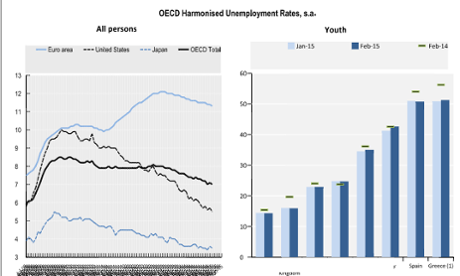
In the euro area, the unemployment rate fell by 0.1 percentage point, to 11.3% in February.
Unemployment fell almost everywhere in the eurozone, although there were increases in the jobless rate in Finland, Portugal and Italy.
But youth unemployment remains stubbornly high:
- Greece =51.2% in December, the latest data available
- Italy =42.6%
- Spain 50.7%
The overall unemployment rate in the United States fell to 5.5%, its lowest level since May 2008, while in Japan the jobless rate fell to 3.5%.
Updated
As news arrives of the death of Günter Grass, it is worth remembering that one of the writer’s last works was an angry rebuke to Europe for its treatment of Greece.
In a poem entitled “Europe’s Disgrace” Grass described Greece as a “poverty-doomed country” that was “barely tolerated”.
He compared the country to Socrates, forced to drink poison by the European Commission.
You’ll waste away mindlessly without the country, whose mind invented you, Europe.
The poem was first published in the daily Sueddeutsche Zeitung in 2012 and an English translation is available on allpoetry.com
(Hat-tip to jonsnow92)
Labour more likely to form a government - Deutsche Bank
Labour have a better chance of forming a government than the Conservatives, according to Deutsche Bank.
George Buckley, Deutsche Bank’s lead economist, follows the lead of pollsters in an updated note on the elections and financial markets. “The polls continue to point to a hung Parliament when the dust settles after 7 May.”
No big surprises here, but the note reflects how the City sees the election: uneasy about a Labour-led government that has pledged to slow down austerity and abolish non-dom status, but jittery about a Conservative-led government that has pledged a referendum on the UK’s EU membership.
Speaking earlier this month, Martin Sorrell, the chief executive of the world’s largest advertising agency WPP, was blunter, when he described the election as a no-win choice for business.
Here is Deutsche Bank’s verdict:
Consider first a Labour-led government – based on current polling there looks to be more chance of this given the willingness of the SNP to lend its support and the more natural left-leaning ideology of the Liberal Democrats. Unlike the current coalition, where the Liberal Democrats acted as a brake on some of the Conservatives’ more right-wing policies, the SNP could encourage Labour to move further to the left in government. The result would be increased taxes (mansion tax, top rate income tax, abolition of the ‘non-domicile’ regime), less austerity and likely a slower reduction in the deficit. One consequence could be higher short- and longer-term interest rates as markets reassess the UK’s willingness to accumulate sovereign debt, and the Bank of England responds to higher near-term growth thanks to stronger government spending.
But, will this be seen by the markets as any worse than the possible consequences of a Conservative-led government? In particular, the promise of an EU referendum by 2017 – assuming the Conservatives can convince their governmental partners to include this in a coalition agreement – could have negative consequences for both investment and sterling. After all, the UK is the second most important destination in the world for inward investment after the US. Whatever the result of the referendum itself, its announcement would mean two years of uncertainty over whether the UK remains in the single market. This would undoubtedly present a serious test of the resilience of foreign direct investment, and would likely depress the currency as a result.
Meanwhile, Labour’s manifesto launch is getting underway now.
Updated

Evidence of tentative green shoots in Italy, as rising factory production boosts hopes of recovery.
Industrial output rose 0.6% on the previous month in February, according to the Istat statistics institute.
Although a 0.2% decline on the same period last year, this was still an improvement after January’s contraction and in line with economists’ forecasts.
The Italian government has forecast that the economy will emerge from recession in 2015, with economic output of 0.7% after three straight years of recession.
The rouble has reversed earlier gains and slipped against the dollar on Monday, bringing a halt to the remarkable recovery of last week.
The Russian currency has gone from being one of the worst performers, to the fastest-recovering, having gained 17% this year.
The rouble is currently at 52.48 against the dollar, a fall of 2.1% on the day, although analysts are still expecting further gains in the coming weeks.
From Bloomberg’s report:
The money flowing in shows confidence that the ceasefire in Ukraine will prevent any further ratcheting of US.-led sanctions against Russia. It’s likely to send the rouble rallying as much as 16 percent to 45 per dollar in the coming weeks, according Alfa Bank, the nation’s second-largest private lender.
Not everyone’s rushing back. Peter Wilson, a senior
portfolio manager at Wells Fargo Asset Management in London,
says Russia is an “unstable” investment.
FinMin Varoufakis book (talking-to-my-daughter-about-the-economy) on sale at Athens Airport #Greece pic.twitter.com/68pYtm9KwF
— Derek Gatopoulos (@dgatopoulos) April 13, 2015
Valdis Dombrovskis’ interview on the upcoming talks with Greece is now available to view on Bloomberg. Twitter highlights 8.44
The talks are apparently “very complicated”, following a weekend of claim and counter-claim.
Well worth reading is this analysis by Reuters’ European affairs editor, Paul Taylor, on how Greece could have blown its best hope of a debt deal.
Since outright debt forgiveness is politically impossible, the next best solution would be forGreece to pay off its expensive IMF loans early, redeem bonds held by the European Central Bank and extend the maturity of loans from eurozone governments to secure lower interest rates for years to come.
“This step would save Greece’s budget billions of euros, while reforming the Troika arrangement, eliminating the IMF’s and the ECB’s financial exposure to Greece,” said Jacob Funk Kirkegaard, senior fellow at the Peterson Institute for International Economics, who advocates such an arrangement.
It would lower the effective interest rate on Greek debt to less than 2 percent, far less than Athens was paying before the eurozone debt crisis began in 2009, and radically reduce the principal amount to be repaid over the next decade, giving Greece fiscal breathing space to revive its economy.
And unlike ideas floated by Greek Finance Minister Yanis Varoufakis to swap euro zoneloans for GDP-linked bonds and ECB holdings with perpetual bonds, paying out the IMF and the ECB early would be legal and supported by precedent.
But if the economics make sense for Greece, the politics no longer add up for its partners.
A euro zone official said there had been exploratory talks with the previous conservative-led Greek government about such a plan last year, before then Prime Minister Antonis Samaras chose to bring forward an election he lost rather than complete a bitterly unpopular bailout programme.
“Now it’s a political non-starter,” said a euro zone official. “There’s just no appetite in theeuro zone for a grand bargain to take over Greece’s debt to the IMF and the ECB.”
Remember the campaign the get women on bank notes?
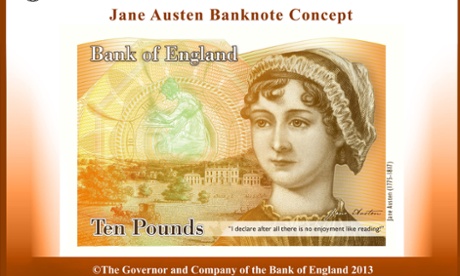
A campaign is now underway in the US to put a woman on the $20 bill, with similar debates playing out around the world, according to this really interesting BBC article.
Here is a flavour:
“The United States needs to show the world that we, too, recognise and value the contributions of women,” says Susan Ades Stone, executive director of the campaign group Women On 20s.
Our money says something about us and what we represent as a society. So if we’re all about gender equality and diversity and inclusion, let’s walk the walk.”
The US currently has seven bills in circulation, all of which feature distinguished, deceased American statesmen.
Women On 20s conducted an online poll and asked people to choose which of 15 historical female leaders they would most like to see on the note.
The candidates included civil rights activist Rosa Parks, birth control pioneer Margaret Sanger, suffragette Susan B Anthony and Harriet Tubman who escaped slavery and went on to lead other slaves to freedom.
More than 200,000 people voted in the first round, and the second round - set to last a few weeks - is currently underway.
More technical talks on Greece's bailout
If it is Monday (or any other day ending in ‘y’) it must be time for more talks about Greece’s EU bailout.
E Kathimerini reports that technical talks between Greece and its lenders are expected to get underway in Brussels and Athens today, to prepare the ground for a finance ministers meeting on 24 April.
Kathimerini understands that the deliberations will resume after discussions during Wednesday’s Euro Working Group ended with an agreement that Athens should have a comprehensive proposal to make within six working days. The reform proposals will have to cover fiscal, pension, labor and privatization issues, according to creditors.
Meanwhile the vice president of the European Commission, Valdis Dombrovskis, has been talking up progress on the negotiations, in an interview with Bloomberg.
#EU Dombrovskis says there cld be more progress on #Greece, working on scenario w Greece staying in #euro, willing to work w Greek govt ~BBG
— Yannis Koutsomitis (@YanniKouts) April 13, 2015
.@markbartontv Dombrovskis says Greece deal - a lot of time wasted initially - picking up speed now! No Secret negociations some unhelpful
— Manus Cranny (@ManusCranny) April 13, 2015
Updated
European markets fall on weak China data
The main European markets are all slightly down this morning, following weaker-than-expected trade data from China.
- FTSE100 -0.28% at 7069 points
- France CAC 40 -0.09% at 5235 points
- Germany’s DAX -0.18% at 12352 points
Updated
Another week; another survey of business attitudes to the EU.
This one shows that more than 8 in 10 business leaders in Europe want the UK to stay in the EU, while around three quarters thought a British exit would damage the British economy.
Here are some details from a report of the survey in the Financial Times.
Of 437 business leaders surveyed across 32 countries, 76% said a British exit would hurt the UK economy, while 56% said it would damage their own business.
Mikal Hallstrup, founder of Designit, a Danish technology firm, said a Brexit could influence how Europe was viewed internationally. “You can trade across borders so UK exit wouldn’t lead to other countries leaving . . . but it would be like a grey cloud following us — like a football team when one person is sent off.”
China slowdown to reverberate across Asia-Pacific
Hot on the heels of Monday’s disappointing Chinese trade figures, the World Bank has warned that the slowdown in China will hit countries across the Asia-Pacific.
Developing East Asian economies, such as Indonesia and Malaysia, will grow more slowly than previously thought, while rich countries, such as Australia will see falling demand for commodities such as iron ore.
Chinese growth in 2014 was the weakest since 1990 but the World Bank said things were set to get worse – just a month after the Chinese government cut its growth target to 7%.
Chinese growth would ease from 7.4% in 2014, to 7.1% in 2015, 7% in 2016 and 6.9% in 2017.
But cheaper oil prices will give some governments room for manoeuvre.
Bloomberg has further details:
The slowdown in China reflects efforts by policy makers to address vulnerabilities in the financial system and make growth more sustainable, the bank said. Growth in the rest of developing East Asia will climb half a percentage point to 5.1 percent as the drop in energy costs spurs demand in Southeast Asia, [the World Bank] said in the report, released Monday.
“The region will still account for one-third of global growth, twice the combined contribution of all other developing regions,” Axel van Trotsenburg, the World Bank’s vice president for the area, said in a statement. Cheaper oil will give governments room to “push fiscal reforms that will raise revenues and reorient public spending toward infrastructure and other productive uses.”
Updated
Summary
Good morning, and welcome to our rolling coverage of the world economy, the financial markets, the eurozone and the business world.
The week begins with some surprisingly bad trade data from China, heightening concern about the slowdown in the world’s second-largest economy.
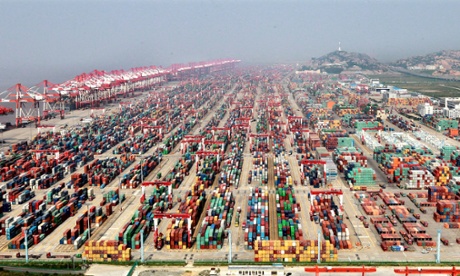
China’s exports fell 15% in March, while imports fell at their fastest rate since the 2009 financial crisis, according to data released by China’s customs administration on Monday.
The monthly trade surplus is at its lowest level in 13 months.
Louis Kuijs, an economist at RBS in Hong Kong, sums it up:
It’s a very bad number that was much worse than expectations.
It leads to warning flags both on global demand and China’s competitiveness.
Via Reuters
Meanwhile, sterling has hit a fresh low against the dollar*, amid growing uncertainty about the economic policies of a multi-party coalition after the election.
Our Saturday story has more background:
Sterling hits five-year low against dollar as election fears spook investors.
On Monday the pound fell to $1.4567, its lowest level since June 2010.
While many in the UK will be focused on the launch of Labour’s manifesto, it is otherwise a quiet day for economic and business news. We will try to bring you what news we can.
Corrected 8.50: removing reference to euro.
Updated