European markets bounce back
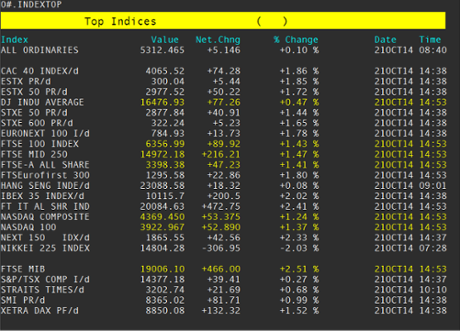
Reports that the European Central Bank might start buying corporate bonds as part of its attempts to lift the flagging eurozone economy were enough to boost European stock markets. Better than expected Chinese GDP figures also helped sentiment, while Wall Street also got off to a good start following positive home sales numbers and well received numbers from technology companies Apple and Texas Instruments. The final scores showed:
- The FTSE 100 finished 105.26 points or 1.68% to 6372.33
- Germany’s Dax added 1.94% to 8886.96
- France’s Cac climbed 2.25% to 4081.24
- Italy’s FTSE MIB rose 2.79% to 19,057.72
- Spain’s Ibex ended 2.39% better at 10,152.1
In the US, the Dow Jones Industrial Average is currently 169 points or 1% higher.
On that note it’s time to close up for the evening. Thanks for all your comments, and we’ll be back tomorrow.
Following the earlier fines for Libor fixing, the European Commission has also slapped down another cartel.
Four banks - Royal Bank of Scotland and JP Morgan (both again) as well as UBS and Credit Suisse - were found to have operated a cartel on bid-ask spreads of Swiss franc interest rate derivatives.
The commission has imposed total fines on the banks of €32.35m, but again RBS received immunity from fines for revealing the cartel’s existence. UBS will pay €12.65m, JP Morgan €10.53m and Credit Suisse €9.17m. Commission vice-president in charge of competition policy, Joaquín Almunia, said:
Unlike in previous cartels we found in the financial sector, this one did not involve any collusion on a benchmark. Rather, the four banks agreed on an element of the price of certain financial derivatives. This way, the banks involved could flout the market at their competitors’ expense.
Back to the worsening UK public finances, and economists are saying the poor figures mean an early return of the UK’s triple A credit rating is not on the cards. Howard Archer, chief economist at IHS Global Insight, said:
It is worth noting that the UK’s weakened public finance performance makes it even more unlikely that either Moody’s or Fitch will restore their AAA credit rating for the UK anytime soon. Both Moody’s & Fitch have kept their credit rating for the UK one notch below AAA and in both cases the outlook on this is stable. This is partly because both rating agencies have appreciable concerns about the UK’s public finances.
However, if the UK continues to see weaker-than-expected public finances and growth falters over the coming months, there could be a renewed risk to the UK’s one remaining AAAA rating from Standard & Poor’s. S&P actually revised up the outlook on its AAA rating for the UK back up to stable from negative in June.
Updated
Adding to the more positive mood in the US, existing home sales hit a one year high in September, indicating a continuing recovery in the housing market.
According to the National Association of Realtors, sales rose 2.4% to an annual rate of 5.17m units, compared to forecasts of 5.10m, up from August’s 5.05m.
US existing home sales highest for just over a year in Sep. New home sales also rose in Aug (highest since May 2008) pic.twitter.com/NZZekGI0Cv
— Chris Williamson (@WilliamsonChris) October 21, 2014
Updated
Wall Street has opened, and the US market is joining in the positive party.
Technology shares rallied after a positive reaction to results from Apple and Texas Instruments, with the S&P 500 up 0.6% and the Dow Jones Industrial Average 77 points or 0.47% higher in early trading.
Updated
RBS and JP Morgan guilty of fixing Swiss libor rate
Royal Bank of Scotland and JP Morgan have been found guilty by the European Commission of operating a cartel to rig the Swiss franc Libor interest rate.
The offences took place between March 2008 and July 2009, with the banks trying to distort the normal pricing arrangements.
RBS was let off a fine because it revealed the existence of the cartel to the commission, while JP Morgan has to stump up €61.6m, reduced for co-operating with the investigation. Commission vice-president in charge of competition policy, Joaquín Almunia, said:
This is the third case where the Commission finds a cartel related to the manipulation of a financial benchmark, in which major banks colluded instead of competing with each other. Our economy needs a healthy, transparent, well-functioning financial sector. This is why antitrust rules in this sector must be strictly enforced.
Full commission statement
Lunchtime summary
A quick recap.
Britain is on track to miss its borrowing targets for this year, having borrowed 10% more during this financial year than in 2013-14.
Public finance figures for September, released this morning, show that borrowing jumped last month.
Economists blame weak income tax receipts, and predicted that George Osborne would struggle to offer many giveaways in December’s Autumn Statement.
The Treasury warned that the weak global economy was hurting the UK....
...but the opposition Labour party, and the Unite and TUC unions, said the chancellor was to blame.
Elsewhere....
European stock markets jumped on a report that the European Central Bank might start buying corporate bonds in a new bid to stimulate the eurozone economy. The FTSE 100 is up 55 points, or 0.9%, and the French CAC has jumped 1.5%.
ECB insiders are saying that any corporate bond-buying plan isn’t on its agenda. (but has the agenda even been written yet?!)
Fwiw, I doubt the agenda for the November @ecb is set yet, let alone the December one.
— Lorcan Roche Kelly (@LorcanRK) October 21, 2014
The French prime minister has led the tributes to Total’s CEO, Christophe de Margerie, who died last night in an aeroplane crash in Moscow
PM Manuel Valls said France had lost “an extraordinary business leader who turned Total into a world giant.”
And China’s economy has grown at its slowest rate in almost six years, expanding at an annual rate of 7.3% in the third quarter of 2014.
#China economy expands at slowest pace in five years at 7.3% in third quarter http://t.co/7fvxM0L4EH pic.twitter.com/o4MlRkC1mA
— Pedro da Costa (@pdacosta) October 21, 2014
Economists reckon the figures show that China’s economy is slowing, but aren’t too alarmed.
And with that I’m handing over to my colleague Nick Fletcher.
Updated
McDonalds profits fall by 30%
Fast food giant McDonald’s problems continue.
Earnings at McDonalds fell by 30% in the third quarter of 2014, according to figures just released. It made just $1.09 per share, versus $1.52 a share last year.
Global same-store sales slid by 3.3%, worse than the 2.8% analysts had expected. Sales in its core US market are also down by 3.3%, versus forecasts of a 2.5% drop.
Chief executive Dan Thompson warned that the troubles will continue, with global comparable sales expected to be negative in October.
And McDonald’s investors are not loving it -- shares are down in pre-market trading.
McDonalds down 2% in pre-market $MCD
— Brenda Kelly (@BrendaKelly_IG) October 21, 2014
We’re collecting all the best reaction to today’s public finances here: #Youarewelcome
Government borrowing rises: what the economists say
Unions criticise government over deficit failings
Back in the UK, unions are blasting the government for its failure to lower Britain’s borrowing.
The Trades Union Congress argues that the 10% jump in the deficit in September (details start at 9.45am) show that the chancellor has blundered.
TUC chief Frances O’Grady says:
“It’s time for George Osborne to admit he got his strategy wrong. Today’s figures show the deficit getting bigger as tax revenues dry up.
“The 90,000 people who marched through the streets of London on Saturday calling for a pay rise understand that it’s not just British workers who need wages to go up, but that’s what the Treasury and the economy needs too.
“Only a wages-led recovery can bring about the boost in demand that businesses need and the boost in revenue that the government needs to cut the deficit and invest for the future.”
Wage increases are only running at around 0.7% annually at present, well below the rate of inflation (1.2%).
Unite general secretary Len McCluskey argues that Conservative politicians shouldn’t be pledging tax cuts in the next parliament:
“George Osborne’s track record is one of failure and broken promises.
He’ll have to cut borrowing by a massive 37 per cent over the next six months, if he’s to keep to his target for the year.“David Cameron has no right to promise ‘giveaways’ paid for by the poor, while his chancellor is running the economy so poorly.
“It’s a dismal record and the figures show that his so-called ‘economic plan’ is doomed and that the recovery is nothing more than an illusion for millions of people struggling to make ends meet.
Osborne’s record in tatters as public borrowing surges, warns Unite - http://t.co/nK88Qf45bX
— Unite the union (@unitetheunion) October 21, 2014
More charts. This one shows the different assets which the European Central Bank could mop up. So far, it’s only aiming for asset-backed securities and covered bonds.
The #ECB has a pool of up to €14 trillion assets it could buy. From Citi: pic.twitter.com/ZpIRj4U8OL /via @ReutersJamie #euro
— Yannis Koutsomitis (@YanniKouts) October 21, 2014
And this one shows how the ECB has actually been tightening monetary policy, as banks repay low-cost loans taken out when the eurozone crisis was more intense.
As ECB mulls buying corporate bonds, a reminder of how much the ECB's "silent taper" has shrunk its balance sheet: pic.twitter.com/9KgqZQSiKi
— Jamie McGeever (@ReutersJamie) October 21, 2014
European stock markets continue to climb today. Stoxx 600 now up 1.5%, DAX 30 up 1.5% and CAC 40 1.7% higher.
— Sara Sjölin (@sarasjolin) October 21, 2014
Italy and Spain bourses are up > 2% on these ECB rumours ....
— Steve Collins (@TradeDesk_Steve) October 21, 2014
Eurozone peripheral bonds are strengthening too, pushing down bond yields.
Portuguese yields reverse rise, Italian, spanish yields hit day's lows on ECB mulling corporate bond buys- Tradeweb
— Fabrizio Goria (@FGoria) October 21, 2014
It’s hard to believe that Germany would welcome the ECB widening its bond-buying programme to cover corporate debt, as rumoured this morning (see earlier post).
Jens Weidmann, Bundesbank chief, opposed the current plan to buy asset-backed bonds; an extension could raise his ire.
Jonathan Ferro of Bloomberg tweets:
— Jonathan Ferro (@FerroTV) October 21, 2014
This chart, from Credit Agricole’s top analyst Frederik Ducrozet, shows why it would be very significant if the ECB started buying up corporate bonds:
My long-held 'ECB private QE' slide: corporate bonds would add around EUR 1.4 trn to buying universe. pic.twitter.com/JVr3e6s8Bk
— Frederik Ducrozet (@fwred) October 21, 2014
Stock rally on reports of new ECB bond-buying plan
Europe’s stock markets have jumped, and the euro has fallen, following a report that the European Central Bank is working on a new bond-buying stimulus plan.
Reuters is reporting that the ECB is considering buying corporate debt (bonds issued by companies), to help stimulate growth and fight deflation. It could activate the plan as soon as December.
That sparked an immediate rally. Most of the main indices are up at least 1%, while the euro has lost around 0.25% against the US dollar to €1.276.
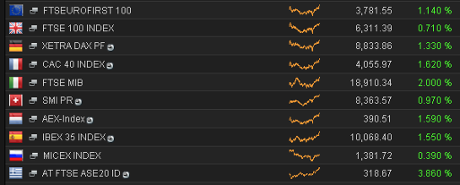
Reuters says:
The European Central Bank is considering buying corporate bonds on the secondary market and may decide on the matter as soon as December with a view to begin buying early next year, several sources familiar with the situation told Reuters.
The ECB has already carried out work on such purchases, which would widen out the private-sector asset-buying programme it began on Monday - stimulus it is deploying to try to foster lending to businesses and thereby support the euro zone economy.”
The pressure in this direction is high,” said one person familiar with the work inside the ECB, speaking on condition of anonymity.
Asked about the possibility of making such purchases, an ECB spokesman said: “The Governing Council has taken no such decision.”
Yesterday, the ECB began buying up ‘covered bonds’ (securities backed by revenue from debts such as mortgages). Targeting corporate bonds would extend the Bank’s firepower.
Reaction to follow....
Updated
Read the news story here
Here’s our story on Britain’s rising deficit:
Government borrowing 10% higher than last year
The TaxPayers’ Alliance argues that the solution is to cut more aggressively:
CEO Jonathan Isaby argues:
”At a time when the deficit should be shrinking rapidly because of healthy economic growth, it’s very alarming to see it growing. Unless the Government gets a proper grip on spending, borrowing will continue to go up and the next generation will have to deal with the consequences.
Families across the country make budgets to ensure they don’t spend more than they bring in, and the Government should be no different.”
John Maynard Keynes was unavailable for comment.....
The Telegraph’s Jeremy Warner also blames low wage growth for Britain’s deficit reduction pains:
Thanks to low wage growth, deficit reduction is proceeding at glacial pace. Gov borrowing again up last month pic.twitter.com/WuWEMCcSKu
— jeremy warner (@JeremyWarnerUK) October 21, 2014
Economist Rob Wood of Berenberg Bank agrees that weak wage growth is hampering the government’s debt reduction efforts, pushing the deficit higher this year.
He writes:
It is still early days and the figures could be significantly revised. But the trends seem clear enough.
The economic recovery is creating plenty of jobs which should help keep a lid on benefit spending, but still weak wage growth along with the Chancellor’s decision to increase the amount people can earn tax free has hurt income tax receipts and means borrowing stubbornly refuses to decline.
And that’s why income tax receipts is up just 0.1%, whereas VAT is up 3.9%, stamp duty has surged 25.2% and corporation tax has grown by 5.4%.
Some of that income tax weakness is a distortion related to shifting timing of bonus payments in 2013, but there is more to it than just a distortion.
The rising deficit means George Osborne may have little opportunity to woo voters with pre-election goodies.
Howard Archer of IHS Global Insight says:
Mr. Osborne faces an awkward fiscal backdrop as he announces his autumn statement in December as the May 2015 general election draws every nearer. This gives him little scope to announce any major sweeteners.
Capital economics: "continued run of poor UK public borrowing figures looks set to severely hamper the CHX’s ability to announce giveaways"
— Duncan Weldon (@DuncanWeldon) October 21, 2014
And further cuts/tax rises will be required after the election, Archer adds:
Fiscal policy and the public finances will be a key battleground for the political parties. Any tax promises and spending initiatives by the political parties in the run-up to the general election will need to be closely examined.
Labour: Borrowing figures are a blow to Osborne
And here’s the rebuttal from Chris Leslie MP, Labour’s Shadow Chief Secretary to the Treasury.
He says today’s public sector finance figures, showing a 10% rise in borrowing this year, undermine the chancellor’s credibility.
“These figures are a serious blow to George Osborne. Not only is he set to break his promise to balance the books by next year, but borrowing in the first half of this year is now 10 per cent higher than the same period last year. As the OBR said last week, stagnating wages and too many people in low-paid jobs are leading to more borrowing.
Leslie adds that Labour will “balance the books and get the national debt falling as soon as possible in the next Parliament”, but in a fairer way than the Conservatives:
“We will reverse the £3 billion tax cut for the top one per cent of earners, stop paying the winter fuel allowance to the richest pensioners, raise child benefit by just one per cent for two years and cut ministers’ pay by five per cent. And we will act to secure a strong and balanced recovery that delivers more good jobs and rising living standards for the many, not just a few at the top.”
Treasury: the plan is working
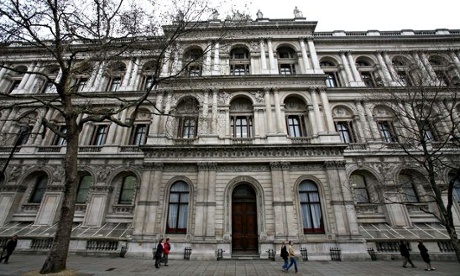
The Treasury claims that the recovery is on track, despite today’s disappointing borrowing figures showing the deficit is rising.
A spokesman says:
“The government’s long term economic plan is working: delivering the fastest growing economy in the G7, putting more people into work than ever before, and reducing the deficit by more than a third.
We have seen stronger growth in receipts this month, but as today’s figures show, the impact of the great recession is still being felt in our economy and the public finances. At the same time, we have to recognise that the UK is not immune to the problems being experienced in Europe and other parts of the world economy.
That’s why we will continue working through the plan that is building a resilient British economy.”
It looks increasingly unlikely that George Osborne will achieve his target of cutting the deficit this year, compared with 2013-14.
Today’s figures show that Britain has already borrowed £5.4bn more than a year ago.
But... a late surge in tax revenues next year, when self-assessment tax receipts land, could still save him....
Unless the exchequer gets a huge self assessment bumper in January it looks like borrowing will be up this financial year on last.
— Duncan Weldon (@DuncanWeldon) October 21, 2014
Updated
£58.0bn public sector net borrowing excl. public sector banks Apr-Sept 2014, up £5.4bn on same period 2013 http://t.co/Wq99eesYIX
— ONS (@ONS) October 21, 2014
Weak wage growth is hitting tax receipts
Why is Britain borrowing more than a year ago, even though the economy has been growing pretty strongly over the last year?
The answer is weak wage growth, which means that income tac receipts are barely higher in April-September 2014 compared with 2013.
The ONS reports, that in the first half of this financial year:
- VAT receipts increased by £2.3 billion, or 3.9%, to £61.5 billion;
- income tax-related payments increased by £0.1 billion, or 0.1%, to £71.5 billion;
- stamp duties (on shares, land & property) increased by £1.5 billion, or 25.2%, to £7.3 billion;
- corporation tax increased by £0.9 billion, or 5.4%, to £18.4 billion;
Growth better than OBR expected, hours worked higher & unemployment lower but borrowing overshooting. One big reason: weak wage growth.
— Duncan Weldon (@DuncanWeldon) October 21, 2014
The UK is learning the same lesson as much of the Eurozone - when inflation & wage growth are v low, it's hard to bring a govt deficit down.
— Duncan Weldon (@DuncanWeldon) October 21, 2014
UK public finances worsen again
Britain’s public sector finances have worsened, according to the latest figures.
The Office for National Statistics reports that the UK borrowed £11.8bn in September, which is 15% or £1.6bn more than a year ago.
So despite the recovery, Britain is having to borrow more to balance the books.
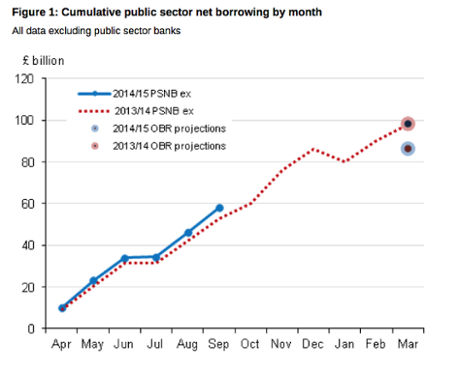
And that means that public sector net borrowing excluding public sector banks (PSNB ex) from April to September 2014 was £58.bn, an increase of £5.4bn compared with the same period in 2013/14.
That takes Britain further away from its goal of borrowing less in the 2014-15 financial year, than in 2013-2014, as this chart shows:
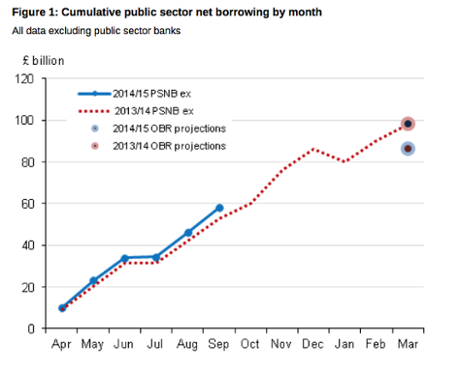
The ONS reports that central government receipts rose by £1.4bn, or 3.1% compared with September 2013.
But central government expenditure (current and capital) in September 2014 rose by £2.9bn, or 5.4%, meaning more borrowing was needed to cover the gap.
Economists aren’t impressed.
Another pretty awfulUK psnb fig at £11.1b.
— kit juckes (@kitjuckes) October 21, 2014
Ouch! Not again! UK PSNB ex was £11.8 billion in September 2014, an increase of £1.6 billion compared with September 2013. #GBP
— Shaun Richards (@notayesmansecon) October 21, 2014
More reaction to follow....
Updated
Chinese GDP: What the experts say
Back to the Chinese slowdown...and economists are arguing that today’s data could have been worse.
Duncan Innes-Kerr, China analyst at the Economist Intelligence Unit, says
- Perhaps the most important take-away from the GDP numbers is that there were no unpleasant surprises. In a week when the markets have been looking jittery, many will take comfort in the fact that the world’s second largest economy is continuing to churn ahead at such a fast pace.
- With the economy able to grow by 7.3% in the third quarter, the government is not likely to be launching big stimulus policies in the near future. The relief measures that are provided will remain modest and targeted, and will do little to reverse the overall slowdown.
- Worryingly, credit is still growing much faster than GDP, so we are looking at a growth story that is built on debt - a very shaky foundation. China will need to begin deleveraging at some point in the future, and when that happens the economy will have to brace for even more pain. However, there is no reason to think that this process needs to begin in the next year or two.
Marc Ostwald of ASM Investor Services argues that we should welcome the news that growth slowed to ‘just’ 7.3% in the last quarter.
Perhaps the most pertinent observation on the China GDP data is this, the pessimists will point to this being the slowest pace of China GDP growth in five years, and then wax lyrical about China’s structural problems above all in terms of its bad credit/loans problems (which are very real), but the fact remains that China’s economy is now ca. 50% larger than it was five years ago.
Thus to expect it to sustain an annual GDP pace of 7.5-8.0% is in fact to show a complete misunderstanding of statistics, and if growth were to accelerate rather than decelerate further as it should given this base effect, is in effect to demand that the Chinese economy to overheat, and by extension to ensure that its bad loans/credit problems get worse.
webuyanycar owner #BCA has scrapped its £1.2bn #IPO due to "volatility in global markets" -> the latest #float flop casualty
— Ashley Armstrong (@AArmstrong_says) October 21, 2014
But they won’t sell any shares
Updated
BCA calls off IPO, blamed 'volatility'
Market volatility strikes again!
BCA Marketplace, the UK used car seller (formerly called British Car Auctions), has just called off its stock market flotation, which would have valued it at £1.2bn.
It says:
Given the volatility in global equity markets, the Board and Shareholders of BCA Marketplace (“BCA”) have chosen not to proceed with its initial public offering at this time.
The Board and Shareholders were very encouraged by the broad engagement and interest in BCA shown by investors and remain excited about supporting the next phase of the Group’s growth.
Last week, Virgin Money decided not to float on the stock market his month, and challenger bank Aldermore called off its IPO.
Updated
Profits at fashion website Asos slump 14% to £47m. Founder Nick Robertson says: "It's been a challenging year, whichever way you skin it".
— Andrew Clark (@clarkaw) October 21, 2014
Shares in ASOS, the UK web fashion retailer, have jumped 15% this morning after it reported a 27% surge in sales over the last year.
Pre-tax profits fell by 14%, to £46.9m, due to the strength of the pound and a fire at its main warehouse last summer.
Chief executive Nick Robertson, who has reported three profit warnings in the last year, was upbeat:
“Despite all that happened this year, we still delivered 27% growth in sales, with the UK a standout performance at 35% growth.”
Consumer goods giant Reckitt Benckiser is leading the FTSE 100 fallers, down 2.1%.
Reckitt, whose products include Dettol, Nurofen painkillers and Veet hair-removal creams, said annual sales growth will be at the lower end of expectations.
It cited slowing markets in southeast Asia and Latin America, which overshadowed a strong performance in its key European markets.
Rakesh Kapoor, CEO, said:
Weak markets across South East Asia and Latin America contributed to weak growth in the LAPAC [Latin America and Asia Pacific area] areas.
European stock markets down in early trading
European stock markets have opened in the red, as the slowdown in Chinese growth weighs on investors.
The French CAC dipped by 0.6%, with Total dropping 1.5% following the death of CEO Christophe de Margerie at Moscow’s Vnukovo international airport.
The German DAX fell 0.75% in early trading.
The FTSE 100 is flat, though, lifted by microchip maker ARM Holdings which posted a 9% rise in profits in the last quarter.
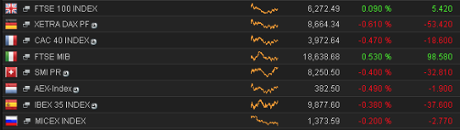
Over in Asia, Chinese stocks fell after growth slowed to its lowest rate since the early days of the financial crisis:

Updated
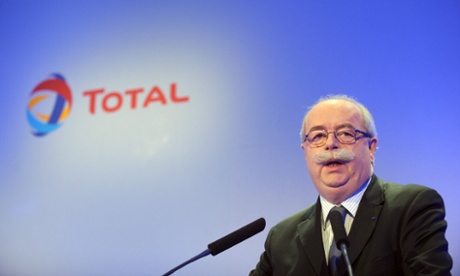
Russian president Vladimir Putin has expressed his condolences over Total CEO’s Christophe de Margerie death in Moscow.
TASS cited his spokesman as saying that “Vladimir Putin has long known de Margerie and had a close working relationship with him.”
“The president highly appreciated de Mergerie’s business skills, his continued commitment to the development of not only bilateral Russian-French relations but also on multifaceted levels,” Peskov also said.
Alexei Kudrin, Russia’s former finance minister and a noted economic liberal, tweets that Christophe de Margerie had done a lot to bring investment to Russia.
He describes the Total chief’s death as a heavy tragedy:
Погибший во Внуково президент нефтегазовой компании Тоталь Кристоф де Маржери многое сделал для прихода инвестиций в Россию.Тяжелая трагедия
— Алексей Кудрин (@Aleksei_Kudrin) October 21, 2014
Updated
Tributes to Total chief Christophe de Margerie
France’s prime minister has led the tributes to Christophe de Margerie, following the Total CEO’s death at Moscow’s Vnukovo international airport over night.
PM Manuel Valls said France had lost “an extraordinary business leader who turned Total into a world giant.”.
And Pierre Moscovici, France’s former finance minister, hailed de Margerie as “a great captain of industry, a patriot, a man of conviction and friendship”.
Touché par la mort de C. de Margerie: un grand capitaine d'industrie, un patriote, un homme de conviction et d'amitié. Tristesse et respect
— Pierre Moscovici (@pierremoscovici) October 21, 2014
Here’s our latest story:
Total oil CEO Christophe de Margerie killed in Moscow plane crash
De Margerie, and three crew members, died when his private jet collided with a snow plough at Moscow’s Vnukovo international airport on Monday night.
Russian probe finds snowplow driver in total CEO crash was drunk - from Russian investigators
— Francine Lacqua (@flacqua) October 21, 2014
Total confirms the death of Chairman and CEO Christophe de Margerie http://t.co/1k8UB5QOzh
— Total (@Total) October 21, 2014
The Chinese slowdown is likely to weigh on European stock markets this morning. The main indices are being called down a few points:
Updated Opening Calls - #FTSE 100 expected to open -8 #DAX to open flat #CAC40 to open -12
— Michael Hewson (@mhewson_CMC) October 21, 2014
Chinese growth figures fuel fears over global economy
Economists are warning that China’s economy remains a concern after economic growth slowed to a five-year low in the last quarter.
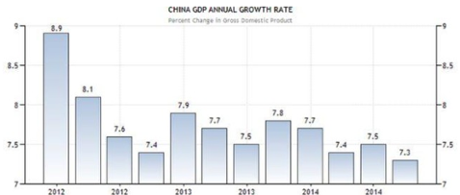
GDP rose by 7.3% , year-on-year, in the July-September quarter, according to data released overnight. That’s slightly better than the 7.2% which was forecast, but otherwise there is little to cheer.
Beijing’s official target is to achieve growth of 7.5%. But the slump in its housing market, weaker domestic demand and slowing industrial production are all holding it back.
Other data this morning also showed that retail sales slowed for the fourth month running, up 11.6% year-on-year in September.
Factory output beat expectations, but fixed asset investment was weaker than forecast.
Chinese growth beats expectations but still at a five year low.
— Duncan Weldon (@DuncanWeldon) October 21, 2014
As Nomura analyst point out, recent stimulus measures have only stabilised the ship:
“Powerful headwinds from the property market correction and severe overcapacity in many upstream industries, coupled with the reduced potency of policy easing amid an overleveraged economy, means the policy response seems to have only succeeded in stabilising growth rather than driving a strong rebound.”
ING economist Tim Condon predicts that the Chinese government won’t be jolted into new measures:
“As long as growth holds up, though, they’re not going to panic.”
And if China is weak, the ramifications for the world economy are serious:
Every 1% drop in China growth = 0.2% off annual US growth = effect of a $20/barrel rise in oil prices - Moody's Analytics chief econ #ausbiz
— Brooke Corte (@brookecorte) October 21, 2014
Updated
The Agenda: UK public finances coming up
Good morning, and welcome to our rolling coverage of the financial markets, the world economy business, and the eurozone.
Four items on the agenda today.
1) Overnight, Chinese GDP data has shown that its economy grew at the slowest pace since 2009, at an annual rate of just 7.3%.
2) Development and reaction to the sad news that the chief executive of Total was has died in an aeroplane crash in Moscow.
3) We get the new UK public finance figures at 9.30am, showing how much Britain borrowed in September.
4) And we’ll keeping a stern eye on the Bank of England, after yesterday’s payment system crash hit house buyers and delayed billions of pounds of transactions between banks for most of the day.
Plus any other developments through the day.
Updated