Stock markets slide again
Investors suffered another bruising day, with shares falling sharply as global growth concerns continued to weigh on sentiment. It started off badly with weak Chinese inflation figures, adding to recent concerns about a slowdown in the world’s second largest economy.
Then came disappointing US retail sales, followed by news of a warning on earnings from Wal-Mart, which sent US markets sharply lower and added to the generally downbeat mood. The final scores showed:
- The FTSE 100 finished 72.67 points or 1.15% lower at 6269.61
- Germany’s Dax dropped 1.17i% to 9915.85
- France’s Cac closed down 0.74% at 4609.03
- Italy’s FTSE MIB fell 0.95% to 21,838.20
- Spain’s Ibex ended 0.77% lower at 10,037.6
- In Greece, the Athens market dipped 0.32% at 676.13
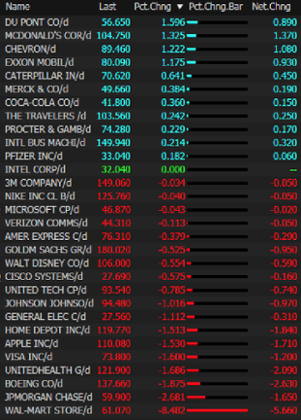
On Wall Street the Dow Jones Industrial Average is currently down 116.25 points or 0.68%. Here are the main movers - with Wal-Mart the standout loser after its warning on earnings:
On that note, it’s time to close up for the evening. Thanks for all your comments and we’ll be back tomorrow.
Updated
Wal-Mart's really taking this "Everyday Low Prices" thing pretty far... pic.twitter.com/mQ6xjjkdmC
— Downtown Josh Brown (@ReformedBroker) October 14, 2015
Here’s AP’s take on the Wal-Mart warning:
Wal-Mart said it expects profit to fall for its next fiscal year and cut its sales outlook for this year as it works to fend off intensifying competition and perk up stores with better customer service.
The world’s largest retailer said it expects sales growth to be flat for this fiscal year, as it faces unfavorable currency exchange rates. The company had previously forecast sales growth of 1 to 2%.
The disappointing guidance comes as Wal-Mart faces a tough economy and pressure from rivals including traditional grocers, dollar stores and Amazon.com. At its annual investor meeting in New York City on Wednesday, chief executive Doug McMillon sought to reassure [them] the company is working to transform in a rapidly changing retail landscape.
“We all know that retail has changed and will continue to change at an accelerating pace,” said McMillon, who took the job in February 2014.

Under McMillon, Wal-Mart has accelerated the pace of smaller store openings and stepped up its e-commerce efforts. The company is spending $1.2 billion to $1.5 billion in online investments for the current fiscal year, up from last year’s $1 billion.
Such investments are expected to take a toll on profit in the near term, the company said. For its fiscal 2017, it said it expects earnings per share to be down 6 to 12 percent. That also reflects its investment in keeping its prices low and raising wages for workers, Wal-Mart said.
By fiscal 2019, it expects earnings per share to be up 5 to 10 percent from this year.
The company had lowered its profit forecast for this fiscal 2016 in August, saying it expects earnings to be between $4.40 and $4.70 per share, down from $4.70 to $5.05 per share.
The company also authorized a $20 billion share buyback program for the next two years.
At today's low, $WMT fell 9.9%, wiping out approximately $21,000,000,000 in market cap (more than mkt cap of $TWTR) pic.twitter.com/yVP5BJzW3c
— CNBC Now (@CNBCnow) October 14, 2015
$WMT - expect this to change. pic.twitter.com/LSUOHLZfpp
— Brenda Kelly (@Brenda_Kelly) October 14, 2015
Walmart Management meeting: "When should we put this profit warning out?" "How about just after U.S. Retail Sales miss?" "Good thinking."
— Lorcan Roche Kelly (@LorcanRK) October 14, 2015
Wal-Mart shares slump on earnings warning
Wal-Mart shares are on track for their worst daily performance in more than 17 years.
They have fallen around 9% after the company told CNBC the strong dollar was likely to knock some $15bn off its full year revenues and then warned on earnings.
The world’s largest retailer gets around a third of its revenue - which totalled $485bn last year - from outside the US.
In a presentation to investors, it said that expenditure on its US and e-commerce businesses - including wages and training - would mean a 6% to 12% fall in earnings per share in 2017. But by 2019 it expected earnings growth of 5% to 10% compared to the year before.
Analysts had been expecting earnings growth of around 4% in 2017.
Walmart $WMT trading frenzy has led to over 32 mln shares of volume & it's only 11:10 am ET...avg vol last 3 mos is 8.6 mln shares full day
— Dominic Chu (@TheDomino) October 14, 2015
$WMT has 3,205,941,803 shares out = $19.65B in market cap gone.
— Ben Berkowitz (@BerkowitzBT) October 14, 2015
Updated
Another vote for a likely US rate rise in December despite the recent run of disappointing data comes from Unicredit Research. Economist Dr Harm Bandholz said:
While the headline number matched our (below-consensus) forecast, the downward revision to the August figure and the unexpected decline in core retail sales were a disappointment. Against this backdrop, it might be tempting to conclude that global headwinds have finally spilled over to the US consumer and that financial market volatility has taken its toll. We, however, disagree and rather see the September data as an outlier in series of very strong consumption reports.
But while today’s report does not impact our fundamental outlook for consumer spending, it certainly does increase the downside risks to GDP growth in the third quarter of 2015 . We already knew that inventories and trade have most likely been significant drags on growth in the summer... But with today’s weaker data the contribution from consumer spending will be smaller than hoped for...
The Fed is certainly taking note of these developments, but it is not going to overemphasize them. Most Federal Open Market Committee members have already acknowledged that the third quarter of 2015 will be weaker due to the inventory correction. And...consumer spending kept its solid momentum throughout the summer.
We therefore think that the upcoming two employment reports will be more important for the timing of the liftoff than the third quarter GDP number. And as we anticipate some improvement in payroll gains and a further decline in the unemployment rate, we continue to expect the first 25 basis point rate hike for December.

The weak US retail sales numbers make it even more unlikely the Federal Reserve will raise rates this month, with only a strong jobs figure in November likely to prompt an increase in December, according to ING. The bank’s James Knightley said:
US retail sales are disappointing, rising just 0.1% month on month in September versus 0.2% consensus while August’s growth rate was revised down two-tenths of a percent to flat. The control group is down 0.1% versus +0.3% consensus with another two-tenth downward revision to August. This control group supposedly better matches consumer spending numbers that feed through into GDP. We had been looking for much better numbers given the firm consumer confidence data and robust auto volume sales.
Looking in the details auto sales did rise 1.8% month on month but there were falls in electronics, building materials, grocery stores and general merchandise with a substantial 3.2% decline in gasoline station sales. This latter figure is due to price falls, but even so there is very little to be positive about in this report.
Meanwhile, the PPI report showed a distinct lack of inflation pressures with headline prices falling 0.5% month on month versus a -0.2% consensus prediction with the core rate – excluding food and energy – falling 0.3% versus an anticipated +0.1%.
These reports reinforce the view that the Federal Reserve won’t be doing anything later this month with analysts (including us) predicting a December rate hike really needing to see a very strong labour report next month to give them any confidence the Fed will hike in December.
Neil Saunders, chief executive of retail consultants Conlumino, says the US retail sales figures are actually not that weak, once petrol sales are stripped out:
While September cannot be described as a stellar month for retail, it is encouraging to see growth picking up after a very weak August. Across all categories sales rose by 2.5% on a year-over-year basis, this compares favorably to 1.4% in August.
Overall growth was dragged down by the lower price of gas, which resulted in sales at gas stations plummeting by 20%. When these are removed from the equation, retail sales increased by a robust 5.2%, with particularly strong performances coming from the auto and foodservice segments. The numbers are all the more impressive given that the comparatives from last year are fairly tough, mostly thanks to the boost to household finances that started to filter through in September 2014 due to the lower cost of fuel.
Within core retail, performance across the categories remains uneven. The home related sectors continue to forge ahead, helped by reasonable levels of activity within the housing market. However, electricals remains very sluggish with a 5.2% decline in sales over last year; that said, we expect this to reverse as new consumer electronics products are released in time for the holiday season. On a more positive note, clothing saw an upswing this month with year-over-year growth of 5%, aided by the boost to household budgets as well as a colder, wetter period of weather across many parts of the country which fuelled sales of fall collections.
Without robust growth in the underlying fundamentals of the consumer economy, sales over the next few months will be dependent on the direction of gas prices: these will make the difference between a reasonable and a good holiday season for retailers.”
Wal-Mart’s chief executive Doug McMillon said the strong dollar would reduce the company’s revenues by $15bn this year. The world’s largest retailer also announced that it was hiring 3,000 department managers in the US ahead of the holiday season, to improve its kerbside grocery pickup service.
Today, the dollar is losing ground, however, as chances of a Fed rate hike this year receded somewhat. Retail sales barely grew in August, up 0.1%, and producer price data were also weak.
Updated
Wall Street has opened flat after the weak US retail sales and produce price figures, while earnings from Bank of America and Wells Fargo came in ahead of expectations. European stock markets are still down.
Updated
Royal Bank of Scotland shares are a “compelling investment” and could almost double in value over the next three years, according to the co-head of Goldman Sachs Investment Partners, Raanan Agus.
Reuters reported that Agus told the Sohn Investment conference in Tel Aviv:
From the largest bank in the world... RBS is becoming a highly focused UK retail and commercial bank in a domestic market with attractive returns.”
The comments failed to boost RBS shares, which are currently down 0.7% at 320.8p.
GSIP manages investments more than $8bn.
Exclusive: 3 ex-City Link directors face criminal charges
Guardian exclusive: Three former directors of City Link face criminal charges over the firm’s collapse last Christmas, which led to the loss of 3,000 jobs.
David Smith, the former managing director, the former finance director Robert Peto, and their colleague Thomas Wright, have been charged with failing to notify the business secretary of plans to make staff redundant at the firm and will go on trial in November.

VW veteran lined up for top US job quits
The man lined up by Volkswagen to head its North American business has quit the German carmaker, in a further blow to the scandal-hit company. Winfried Vahland, who currently heads up VW’s Czech division Skoda and previously oversaw VW’s rapid expansion in China, will leave after more than 25 years at the group.
Vahland had also been seen as an outside candidate for the top job at VW after Martin Winterkorn resigned over the scandal, but the carmaker’s board picked Porsche boss Matthias Müller instead.
Skoda said Vahland’s decision to leave was “not connected to the current events around the diesel topic” i.e. the emissions-rigging scandal.
Eurozone industrial production slumps
In the eurozone, industrial production slumped by 0.5% in August. The weak figures will put pressure on the European Central Bank to expand its stimulus programme when it meets next week in Malta. You can read the full story here.
While France had a strong month, with production up 1.6%, Germany – normally the eurozone’s industrial powerhouse – posted a 1.2% drop.
Updated
Dollar falls after weak US retail sales
The dollar is falling, hitting a session low of $1.14420 against the euro, after weak US retail sales figures. Retail sales edged up 0.1% in September after being flat in August.
Factory gate prices fell by 0.5% last month, separate figures showed.
Updated
Wells Fargo, the biggest mortgage lender in the US, has reported its first quarterly profit since last year, helped by its acquisition of commercial loans from General Electric. It made a net profit of $5.4bn in the third quarter to the end of September, better than expected.
The San Francisco-based lender bought a chunk of GE’s commercial real restate loans worth $9bn earlier this year. On Tuesday, Wells Fargo bought another portfolio of commercial loans and leases worth mover than $30bn from GE.
Updated
US bank earnings season: Bank of America swings to profit
The bank earnings season is in full flow on Wall Street. Bank of America made a quarterly net profit of $4.1bn in the third quarter, compared with a loss of $470m a year ago (which was caused by massive mortgage-related costs). The second-biggest US bank beat analysts’ forecasts, despite falling revenues. Chief executive Brian Moynihan has been reducing costs, by slashing jobs and restructuring the business.
The bank, which has paid more than $70bn in legal expenses since the height of the financial crisis in 2008, said its legal costs fell for the third quarter in a row, to $231m from $6bn a year earlier. Revenues, however fell by 2.4% to $20.9bn, with the bank pointing to turbulent markets.
Moynihan said:
The key drivers of our business – deposit taking and lending to both our consumer and corporate clients – moved in the right direction this quarter and our trading results on behalf of clients remained fairly stable in challenging capital markets conditions.”
Goldman Sachs is due to report its quarterly results on Thursday at lunchtime, followed by Citigroup.
Updated
Germany trims growth forecast
Germany has trimmed its growth forecast for this year, blaming weakness in China and other major emerging economies. Economy minister Sigmar Gabriel said Berlin now expects the German economy to grow by 1.7%, down from the 1.8% predicted in April. Next year’s forecast was left unchanged at 1.8%.
Gabriel said the emissions-rigging scandal at Volkswagen, which has led to fears that the “Made in Germany” brand could be damaged, “has no enduring effect” on current economic forecasts.
He also said that money being pumped into education to help cope with the influx of refugees into Germany could work “a bit like a stimulus programme” starting next year.
Gold hits 3 1/2 month high, stock markets and dollar down
Let’s take a look at the markets. Gold prices have hit 3 1/2 month highs as concerns over weak inflation and growth in China reinforced expectations that the long-awaited US interest rate hike is still some way off.
The Fed surprised markets when it left rates unchanged at its September meeting, citing concerns about the global economy, but Fed chief Jane Yellen subsequently said the central bank was on track to increase borrowing costs later this year. However, there are signs of divisions within the Fed: Daniel Tarullo, a member of the Fed’s board of governors, told CNBC on Tuesday that it would not be “appropriate” to raise rates this year.
Spot gold rose to $1,176.20 an ounce earlier, its highest level since the end of June.
Stock markets have slipped for a second day and the dollar slid to its lowest level in nearly a month after fresh signs of a slowdown in the Chinese economy.
The FTSE 100 index is down 0.6% at 6306.45, a fall of more than 35 points. Germany’s Dax has also lost 0.6% while France’s CAC has slipped 0.3%.
German utility E.ON has clinched a $1.6bn deal to sell its Norwegian oil and gas business to Russian billionaire Mikhail Fridman. Norway’s oil and energy minister said the deal will be handled like another other – despite EU sanctions against Russia, which were imposed over the Ukraine crisis. Norway is not a member of the European Union.
Tord Lien said in a statement sent to Reuters:
An application for such an approval will be handled the usual way. The restrictive measures apply to activities in Russia. That international firms wish to invest on the Norwegian continental shelf is good.”

Shares in E.ON turned positive on the news and are now trading up 2.6%.
Fridman’s LetterOne fund had emerged as the frontrunner to buy the German company’s Norwegian North Sea assets after the billionaire, who is of Ukrainian descent, was forced to sell his British North Sea assets due to the western sanctions.
Updated
The Institute for Public Policy Research has looked at the regional disparities in the UK labour market. The think tank’s new chief economist, Catherine Colebrook, said:
The latest data suggests the economy is continuing to create jobs, with the employment rate at a new high, and unemployment at its lowest level since 2008.
However, a closer look at the data suggests weaknesses remain: there are big regional disparities, with the employment rate in the North East a full 10 percentage points lower than that in the South West.
And inactivity across the UK remains high, at just over a fifth of the working-age population. The government will have to tackle these weaknesses if it is to succeed in creating two million more jobs over the next five years.”
Here’s Heather Stewart on today’s jobs report:
Summary: jobless down, employment at record high
Here are the main points from today’s labour market report, covering June to August 2015 (you can scroll back to 9.30am for full coverage)
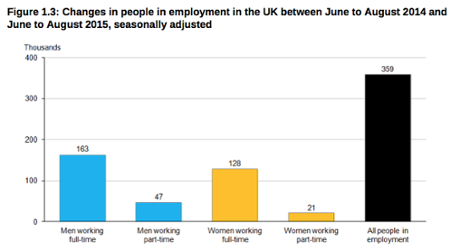
- There were 31.12 million people in work, 140,000 more than for March to May 2015 and 359,000 more than for a year earlier.
- There were 22.77 million people working full-time, 291,000 more than for a year earlier. There were 8.35 million people working part-time, 68,000 more than for a year earlier.
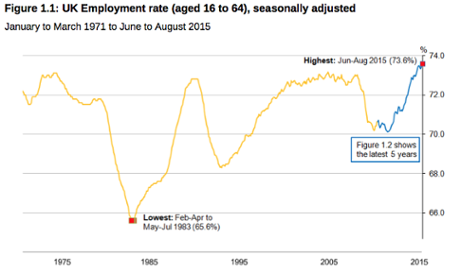
- The employment rate (the proportion of people aged from 16 to 64 who were in work) was 73.6%, the highest since comparable records began in 1971.
- There were 1.77 million unemployed people (people not in work but seeking and available to work), 79,000 fewer than for March to May 2015 and 198,000 fewer than for a year earlier.
- There were 970,000 unemployed men, 125,000 fewer than for a year earlier. There were 803,000 unemployed women, 73,000 fewer than for a year earlier.
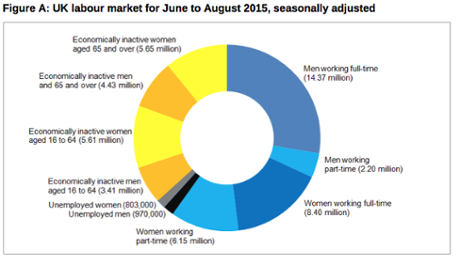
- The unemployment rate fell to 5.4%, lower than for March to May 2015 (5.6%) and for a year earlier (6.0%). It has not been lower since March to May 2008. The unemployment rate is the proportion of the labour force (those in work plus those unemployed) who were unemployed.
- There were 9.01 million people aged from 16 to 64 who were economically inactive (not working and not seeking or available to work), little changed compared with March to May 2015 but down slightly (13,000) compared with a year earlier.
- The inactivity rate (the proportion of people aged from 16 to 64 who were economically inactive) was 22.1%, little changed compared with March to May 2015 and with a year earlier.
- Comparing June to August 2015 with a year earlier, pay for employees in Great Britain increased by 3.0% including bonuses and by 2.8% excluding bonuses.
The full report is online here (as a pdf).
Updated
The CBI, which represents Britain’s businesses, has welcomed today’s labour market report - and implicitly criticised George Osborne’s new National Living Wage:
Matthew Fell, CBI interim chief policy director, says:
“We’re encouraged by businesses creating more jobs, leading to rising employment. It’s also good to see falling unemployment, particularly among those out of work for more than one year dropping by 44,000.
“While we want to see higher pay growth, this must go hand in hand with increases in productivity. It’s crucial that the Low Pay Commission retains autonomy over future National Living Wage rises to avoid unnecessary political interference and help boost jobs.”
Last month, outgoing CBI chief John Cridland warned that raising the minimum wage to £9 an hour by 2020 was “a gamble” that could cost jobs.
Resolution Foundation: Pre-crisis pay packets still far away
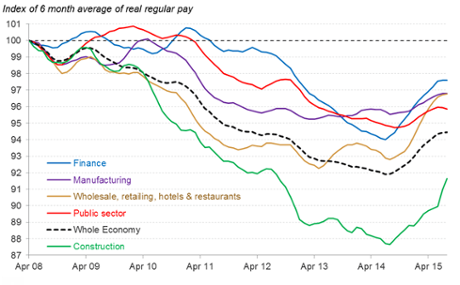
Workers in Britain’s financial sector are closest to seeing their real pay hit pre-crisis levels, according to the Resolution Foundation.
The thinktank also flags up that construction workers’ wage packets are lagging far behind.
This chart shows how real wages (pay rises minus inflation) began to fall when the financial crisis struck.
Matthew Whittaker, chief economist at the Resolution Foundation, explains:
“It’s encouraging to see unemployment falling again, after a pause earlier this year. But there is significant variation in the extent to which this jobs revival has been shared across the country. Many parts of the UK remain a long way short of their pre-recession levels.”
“Private sector employees are enjoying a mini pay surge that is helping to narrow the substantial wage gap that opened up after 2008. However, maintaining this momentum will prove much harder once inflation starts heading back towards its target rate next year.
Whittaker also fears that the public sector pay cap will lead to problems:
“As recovery builds, attention will turn to who is benefiting from it. The strong recent performance of wages in the low-paying retail sector is encouraging, but the picture is much less promising in manufacturing and construction. Meanwhile, ongoing pay constraint in the public sector is likely to translate into increasing recruitment and retention difficulties in the coming months.”
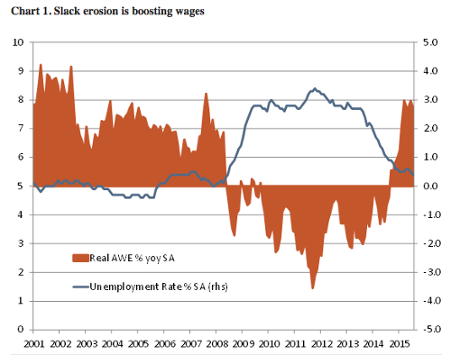
German bank Berenberg have produced a chart showing how real wage growth (adjusted for inflation) has picked up as the jobless rate has fallen:
Kallum Pickering, Berenberg’s senior UK economist, explains:
Falling unemployment is boosting wages! The risk that low inflation might hamper growth in wages now looks misplaced, with wage data continuing to show stable progress (see chart 1) despite weak headline inflation. The pace of real wage growth is now broadly consistent with the pre-crisis average, though unemployment is still around 0.3pp higher.
Our view is that the labour market still has some more progress to make before the unemployment rate finally settles. This further improvement however, is unlikely to bring about further real wage gains. Further slack erosion in the labour market will be consistent with higher nominal wages but, it will take place as inflation recovers.
Today’s labour market report also shows how Britain and the US benefitted from massive monetary stimulus programmes after the financial crisis struck:
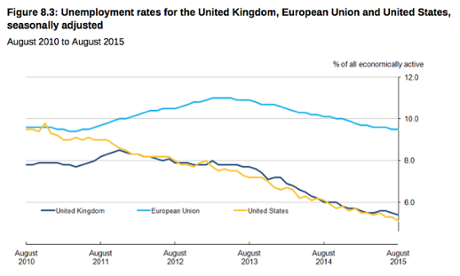
Many public sector workers are missing out on the recent increase in wages, because chancellor George Osborne has enforced a 1% pay rise freeze that could last until 2019.
Perhaps someone should remind the Department of Work and Pensions....
Britain’s workers are getting a deserved pay rise #getbritainworking pic.twitter.com/SRLTIDpPb7
— DWP Press Office (@dwppressoffice) October 14, 2015
Apart from public sector workers, who only deserve 1%, presumably... https://t.co/DMpQqojtbX
— Heather Stewart (@heatherstewart3) October 14, 2015
Updated
Britain’s economic productivity is still below its potential, warns Ian Brinkley, chief economic adviser at Lancaster University’s The Work Foundation.
Brinkley says:
“The employment growth pause that we saw in the first half of 2015 is over – job growth resumed over the three months to August compared with the previous three months, driven by more young people and older workers in employment.
Looking ahead, we can expect productivity to grow faster and employment to grow more slowly than they have in recent years as the labour market starts to return to normal. But a full recovery in productivity could be long and slow. Even with the recent boost we are still 15 per cent below where we would have been had the pre-recession productivity trend continued, and manufacturing productivity still gives serious cause for concern.”
Around four-fifths of the 359,000 jobs created last year are full time:
The fall in the jobless rate indicates there’s little slack in the UK labour market, which could mean borrowing costs rise in early 2016.
Dean Turner, Economist at UBS Wealth Management, explains:
“Rising wage pressures will likely prompt the Bank of England to hike interest rates soon, most likely in the first quarter of next year.
However, tighter monetary policy is unlikely to derail the UK from its current growth trajectory, as nascent signs productivity growth should keep inflation pressures in check, the consequence being that the path of rate increases will be gradual.”
Wages have been rising this year because companies are managing to increase their productivity, argues economist Howard Archer of IHS Global Insight.
He says:
One factor that seems to be limiting employment growth compared to earlier in 2015 is that UK productivity is now seeing genuine improvement – with earnings growth stronger, UK companies are likely stepping up their efforts to lift productivity by getting more out of their existing workers.
Public sector keeps shrinking
Britain’s public sector workforce has shrunk again to just 17.2% of the working population, the lowest since records began in 1999.
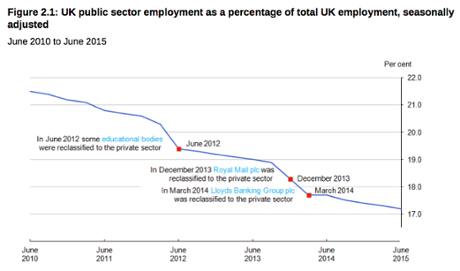
Today’s labour market report shows that there were 5.36 million people employed in the public sector for June 2015. This was:
- down 16,000 from March 2015
- down 59,000 from a year earlier
- the lowest figure since comparable records began in 1999
In contrast, there were 25.74 million people employed in the private sector for June 2015. This was 58,000 more than for March 2015 and 472,000 more than for a year earlier.
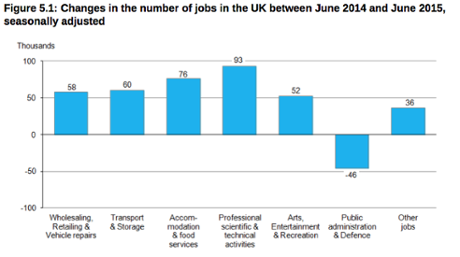
Here’s where jobs were created, or destroyed, in the last year:
After several years of suffering falling real wages, British pay packets have now been outpacing inflation for the last year or so.
UK real wages have come a long way. Great news for consumer spending pic.twitter.com/VCrqlsXX4W
— Inflation Survey (@inflationsurvey) October 14, 2015
Chancellor George Osborne likes the look of today’s figures:
New stats show highest rate of employment in our history at 73.6%, youth unemployment rate at 7 year low & pay rising strongly at 3%
— George Osborne (@George_Osborne) October 14, 2015
Our plan's creating jobs & increasing pay. Today we lock it in with vote in parliament on fiscal charter committing us to running a surplus
— George Osborne (@George_Osborne) October 14, 2015
My colleague Andrew Sparrow is covering all the drama around the fiscal charter vote in his Politics Live blog:
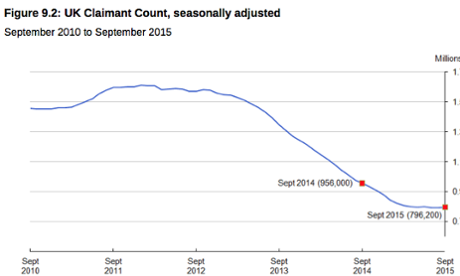
The number of people claiming jobless benefits appears to have bottomed out just below 800,000, with the claimant count rising by 4,600 last month.
UK unemployment falls to 7-year low 5.4%, employment highest ever. But number of unemployment benefit claimants rises the most in 3 years.
— Jamie McGeever (@ReutersJamie) October 14, 2015
Basic pay growth slows
Wage growth continues to outpace inflation, but not by as much as expected.
Basic pay, excluding bonuses, rose by 2.8% annually in the three months to August. That’s a slight fall compared to the 2.9% recorded a month earlier. Economists had expected a rise to 3%.
Total earnings, including bonuses, did increased by 3%.
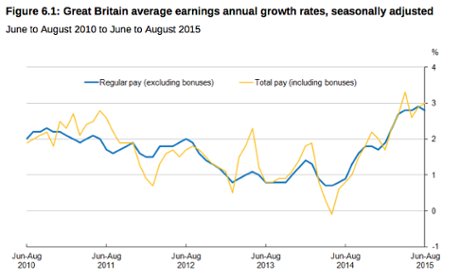
UK inflation actually fell by -0.1% last month, so this means real wages are rising by around 3%.
Updated
Britain’s employment rate has risen to 73.6%, the highest since comparable records began in 1971.
5.4% #unemployment rate in Jun-Aug 2015, down from 6.0% a year earlier and lowest since 2008 http://t.co/0FrwGDPpQ2 pic.twitter.com/CaGHcPunwx
— ONS (@ONS) October 14, 2015
UK jobless rate falls to 5.4%
Here we go! Britain’s jobless rate has hit a new seven year low, falling to 5.4% in the three month to August.
The Office for National Statistics reports that the number of people out of work fell by 79,000 in the last quarter, taking the jobless total down to 1.774 million.
UK unemployment rate falls to 5.4% in the 3 months to August, just 0.3 percentage points above its noughties average. pic.twitter.com/xdtdQiLKSt
— RBS Economics (@RBS_Economics) October 14, 2015
But the claimant count – the number of people claiming unemployment benefit – has risen by 4,600 in September. That takes the total to 796,000. That has dashed predictions of a small fall in the claimant count.
More to follow....
Updated
10 minutes to UK employment data. Jobless claims change exp. at -2.15k. #fx #forex #GBPUSD
— RANsquawk (@RANsquawk) October 14, 2015
UK labour market stats are due at 9:30am as we await news on what wages have been doing and unemployment numbers reflect a mature boom #GBP
— Shaun Richards (@notayesmansecon) October 14, 2015
Updated
UK government urged to reintroduce compulsory work experience

Ahead of today’s unemployment report (at 9.30am BST), the British Chambers of Commerce has urged the government to reintroduce compulsory work experience for school children.
BCC director general John Longworth believes it was a mistake to stop forcing schools to offer work experience for under 16-year-olds three years ago. It would help bring down Britain’s ‘stubbornly high’ youth unemployment rate, and help young people make the jump to the workplace.
Longworth says:
“Business and school leaders are clear - we won’t bridge the gap between the world of education and the world of work unless young people spend time in workplaces while still at school.
“It was careless of Government to end compulsory work experience in 2012, but it is not too late to correct the mistake and work with companies and schools to ensure that every school pupil has the chance to feel the energy, dynamism, buzz and challenge of the workplace for themselves.
Work experience is a touchy subject in the UK; those with good contacts typically get a head start at bagging the best placements. Still, even a week painting fences at a duck sanctuary can lead (eventually) to a desk in the newsroom....
Updated
#Lowflation hits #China! Inflation (+1.6%) falls more than expected. #CPI not above 2% since Jul '14. pic.twitter.com/vAni3nzBma
— jeroen blokland (@jsblokland) October 14, 2015
Chinese annual producer price inflation has been negative for 43 months in a row. And counting. pic.twitter.com/bkd4THZPEd
— Jamie McGeever (@ReutersJamie) October 14, 2015
Tony Cross of Trustnet Direct agrees that today’s weak China inflation figures, and fresh deflation at the factory gate, are a worry for traders:
Downbeat data from China – this time in the shape of weaker than expected inflation – is adding another layer of concern as to how the world’s second largest economy is managing the slowdown, and as a result the base metal mining stocks once again are wearing more than their fair share of the losses.
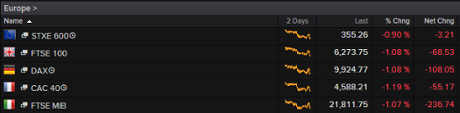
Here’s the picture across Europe:

Pizza chain Domino’s is bucking this morning’s selloff.
Domino’s shares have jumped by 13% to a record high of £10.14, after it raised its profit forecasts and revealed that UK like-for-like sales are up by a remarkable 14.9% in the 13 weeks to September 27.
CEO David Wild credited “the success of our strategic and marketing initiatives”; the company is strong on social media, has a successful smartphone app, and has sponsored several popular TV shows from The Simpsons to Hollyoaks.
Updated
Germany’s DAX and France’s CAC are both down around 1%, adding to losses earlier this week.
Bloomberg TV’s Carolyn Hyde flags up that more than 100 billion euros has been knocked off Europe’s largest companies value this week already:
Futures signal a 3rd day of declines in #stocks...Eu113b already wiped off Stoxx600 market cap this week pic.twitter.com/LUMKszPpF2
— Caroline Hyde (@CarolineHydeTV) October 14, 2015

Stock markets across Europe are in the red at the start of trading, and China is getting the blame.
The FTSE 100 has dropped by 55 points, or 0.85%, in early trading to 6288.
Mining stocks are all down, with Glencore dropping 2.5% and Anglo American shedding 2.3%.
Burberry is also leading the fallers, down 2%. The fashion firm is expected to report slowing sales on Thursday, due to sliding demand for its trench coats and natty checks in China.
Mike van Dulken, head of research at Accendo Markets, says today’s Chinese inflation figures are a worry for investors:
While Chinese consumer inflation (CPI) slowed further, Producer Prices made it a record 43rd straight month of deflation.
While inflation gives the People’s Bank of China room to ease monetary policy further to support the slowing economy, hopes of more stimulus are clearing failing to appease market concerns especially with Q3 GDP data only days away
Chinese policymakers may get another nudge to stimulate their economy next Monday, when GDP figures for the third quarter are released.
Growth is expected to slow to an annual rate of 6.8%, from 7.0% in the second quarter of this year. That would be the first sub-7% reading since the financial crisis.
August and September were turbulent times for China, with wild swings in the stock market. That could also hit the growth rate, if worried firms started cutting investment.
European markets are expected to fall this morning, following the weak Chinese inflation data overnight:
FTSE100 being forecast to open down around 45 points, at 6297.
— David Jones (@JonesTheMarkets) October 14, 2015
Chinese deflation fears as producer prices slide again
New fears over China’s economy are rippling through the markets this morning, after two piece of economic data showed that demand is weakening.
The producer prices index - which measures what Chinese firms charge for their goods - slumped by 5.9% year-on-year in September. That matches August’s decline, which was the biggest drop since the financial crisis in 2009.
It’s also the 43th month running in which producer prices have fallen.
It suggests that companies are being forced to slash prices in an attempt to stimulate sales, as Beijing tries to rebalance its economy without a ‘hard landing’.
#China remains biggest exporter of deflation. Sep producer prices extend slump for 43rd month http://t.co/SVBCMcbsA8 pic.twitter.com/rih2FpV8tt
— Holger Zschaepitz (@Schuldensuehner) October 14, 2015
Consumer price inflation also fell, with the CPI index dropping from 2% in August to 1.6% in September, partly due to slowing food prices
And that hit markets in Asia, with traders worrying that the Chinese economy is in urgent need of fresh stimulus.
As Chris Green, an Auckland-based strategist at First NZ Capital Ltd, told Bloomberg:
“In terms of global growth, the risk is skewed towards the downside.”
Angus Nicholson of IG reckons Beijing will act soon, saying:
Today’s Chinese CPI essentially guaranteed further cuts to the interest rate and the reserve requirement ratio (RRR) before the year is out.
But right now, all the Asian markets are in the red - with Japan’s Nikkei closing down almost 2%.
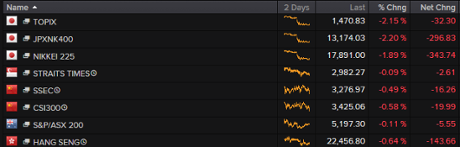
Updated
Introduction: UK unemployment report in focus
Good morning, and welcome to our rolling coverage of the world economy, the financial markets, the eurozone and business.
Coming up this morning...
The latest UK unemployment report, due at 9.30am BST, will show whether or not Britain’s labour market recovery lost pace over the summer.
The jobless rate is expected to remain at 5.5%, while the number of people claiming unemployment benefit is tipped to fall by around two thousand.
The latest UK earnings figures will also be closely scrutinised. Last month, we saw that wages were rising at their fastest rate in six years, at 2.9% year-on-year. Some in the City predict they will have risen again to around 3.1%.
Michael Hewson of CMC Markets explains:
Today’s average earnings data could present Bank of England policymakers with a problem in the short term if they continue to trend higher as they have been doing for the past few months.
Expectations for the three months to August are for an increase in wages to 3.1% from 2.9%, giving a further boost to hard pressed consumers who up until a year ago had undergone a five year fiscal squeeze in the other direction. The main concern would be if wages start to push higher in a wage/price spiral but that doesn’t seem likely at this point in time
We also get a healthcheck on the eurozone at 10am BST, when the eurozone industrial production figures for August are released. Economists expect a fall in output, as we’ve already seen weak data from Germany for that month.
And over in Greece, European commissioner Pierre Moscovici is visiting prime minister Alexis Tsipras to discuss the Greek bailout programme this afternoon.
.@pierremoscovici in Athens today & tomorrow. Due to meet Greek PM Tsipras at 17.00 today #Greece
— Nick Malkoutzis (@NickMalkoutzis) October 14, 2015
We’ll be tracking all the main events through the day....
Updated