Three Chinese Coast Guard ships entered the waters near a chain of disputed Japanese islands, further raising tensions in the East China Sea.
Though Japan controls the uninhabited island chain, which they refer to as the Senkaku Islands, China also calls the islands their own, referring to them as the Diaoyu Islands.
The Chinese vessels spent two hours in Japanese territorial waters, the Japanese Coast Guard said in a statement.
They said it is the fourth time this year Chinese ships have entered Japan's waters. There were 36 similar incursions last year, they added.
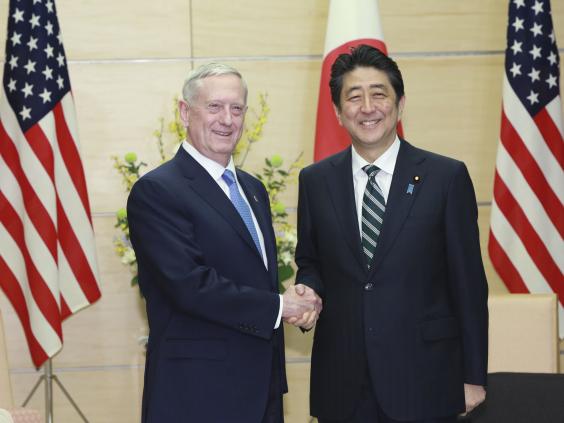
The incursion comes days after US secretary of defence James "Mad Dog" Mattis pledged to defend Japan and its disputed islands.
"I made clear that our long-standing policy on the Senkaku Islands stands — the US will continue to recognise Japanese administration of the islands and as such Article Five of the US-Japan Security Treaty applies," Mr Mattis said, as he appeared alongside Japanese Defense Minister Tomomi Inada.
China accused the US of compromising the stability of the region after Mr Mattis's statement, calling on Washington to stop issuing “wrong information” and risk further complicating the delicate issue by bringing “instability to the regional situation”.
Experts say the incursion could be seen as a provocation on behalf of the Chinese in an attempt to "push the limits" of Japanese and US territorial defence.
"There's been a big ramping up of maritime and air-based incursions," John Nilsson-Wright, senior research fellow in the Asia Programme at Chatham House told The Independent.
"The Chinese are testing the envelope in terms of their ability to challenge Japan's de facto control.
"They've done that by extending the ADIZ (air defence identification zone) into the East China Sea in a way that threatens Japan's control of the territories and they've also done it at sea by extending visits by naval vessels."
Mr Nilsson-Wright said the incursion could be seen as "an attempt to push back against that reported confirmation by the Americans. It's both a test of the US administration and it's also an attempt to consistently maintain China's policy of pushing at the limits of Japanese territorial defence."
He added: "So long as China continues to test these limits, we ought to take this very seriously. It's not that either country wants to go to war over the territory, but the fear is this crisis could escalate through miscalculation rather than intentionally.
"And it's linked to the wider concern about the broader deterioration of relations with China as the result of Trump's election and the live nature of the conflict in the South China Sea."


.png?w=600)