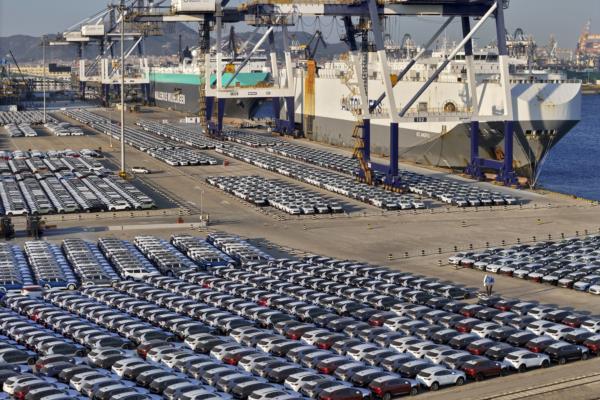
Chinese auto sales experienced a decline in June, with a 7.4% drop compared to the previous year, totaling 1.8 million cars. However, this decrease was offset by a 29% increase in exports, reaching 400,000 units, according to the China Association of Automobile Manufacturers.
During the first half of the year, exports surged by 31.5%, while domestic sales saw a modest 1.6% increase. Notably, the growth in exports has raised concerns in Europe and the United States about the potential impact of competitively priced Chinese vehicles on established Western automakers.
Despite the focus on China's affordable electric cars, the rise in exports was primarily driven by gasoline-powered vehicles, which saw a 36% increase and constituted 78% of total vehicle exports. In contrast, Chinese electric vehicle exports declined by 2.3%, while hybrid vehicles experienced a significant 180% jump from a smaller base.
Russia emerged as the largest export market for Chinese automakers, with substantial growth. Other key markets include Brazil, Mexico, the United Arab Emirates, Saudi Arabia, Belgium, and the U.K. The European Union recently imposed provisional duties on Chinese electric vehicles, citing unfair advantages due to government subsidies.
In response, Chinese manufacturers are expanding their production footprint globally. For instance, BYD, a leading EV maker, inaugurated a plant in Thailand and has plans to establish factories in Brazil, Hungary, and Turkey.
The decline in Chinese auto sales marks the second consecutive monthly drop, with data from the China Passenger Car Association indicating three consecutive months of decreasing sales. The sluggish performance is attributed to a real estate downturn impacting economic growth and consumer sentiment negatively.