
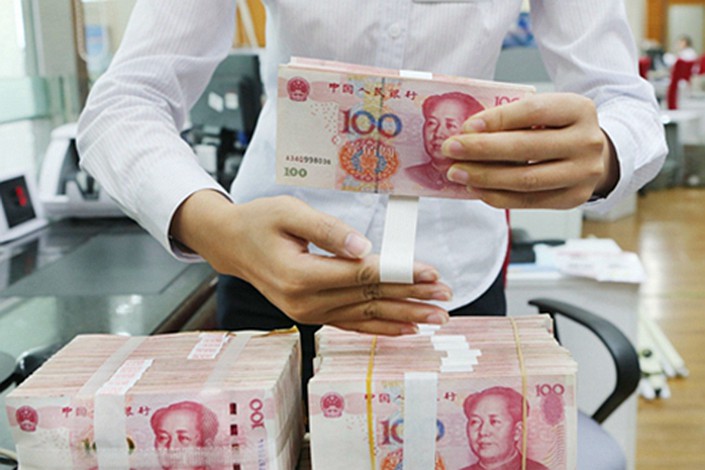
China will use a variety of monetary tools to accelerate growth of its M2 money supply and aggregate financing this year to “notably higher” rates than in 2019 as the country looks to offset the economic damage from the coronavirus outbreak.
Premier Li Keqiang announced the pledge in his annual government work report to the National People’s Congress, the country’s top legislature, during its annual session in Beijing on Friday.
The country’s monetary policy will be carried out in a “more flexible and appropriate way,” the report said.
At the end of last year, the country’s broad M2 money supply grew 8.7% year-on-year, while the outstanding aggregate financing expanded 10.7%, central bank data showed.
“We doubt credit growth will accelerate as sharply as in 2009 given a greater awareness among Chinese officials of the costs of excessive leverage,” Julian Evans-Pritchard, a senior China economist at research firm Capital Economics Ltd., said Friday in a note. “That said, it’s clear that concerns about debt levels are taking a back seat for now given that they were barely mentioned in this year’s work report.”
Li also pledged in the work report to increase financial support to try to keep businesses running without disruptions. “Large commercial banks should increase inclusive finance lending to micro and small businesses by more than 40%,” Li said. Previously, the government’s requirement for this growth rate was 30%.
The government is also extending repayment deadlines for loans to micro, small and midsize businesses to the end of March next year, according to the work report.
In addition, small and midsize banks are encouraged to replenish capital and improve governance to better serve micro, small and midsize businesses, Li said.
Contact reporter Timmy Shen (hongmingshen@caixin.com) and editor Michael Bellart (michaelbellart@caixin.com)
Caixin Global has launched Caixin CEIC Mobile, the mobile-only version of its world-class macroeconomic data platform.





.png?w=600)