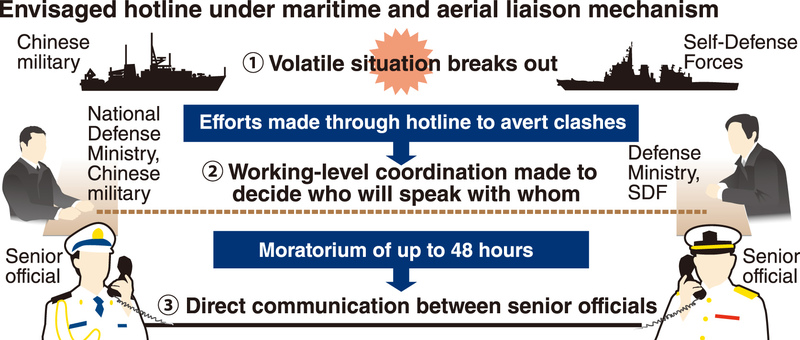
An agreement on a Japan-China hotline aimed at averting military clashes between the Self-Defense Forces and the Chinese military in the East China Sea and other areas includes a provision that allows for a moratorium of up to 48 hours from the breakout of a volatile situation to the start of communications, The Yomiuri Shimbun has learned. This provision was requested by the Chinese government, raising questions over the effectiveness of the hotline for avoiding clashes.
The hotline is the core of a maritime and aerial liaison mechanism agreed to between the Japanese and Chinese leaders to avert collisions. The Japanese and Chinese governments have not revealed the details of the agreement, but besides the hotline, they have agreed to set rules for direct communications between their vessels and aircraft in the field. Other agreements include having Japanese and Chinese defense authorities hold regular meetings.
The mechanism was launched on June 8 with the start of direct communications and other functions. However, the launch of the hotline has been delayed due to China taking its time coordinating the place to install the hotline. The Japanese side plans to set up the hotline at the Joint Staff, which is in charge of managing relevant units.
The hotline is intended to avoid military clashes by allowing senior defense officials of the two countries to communicate. However, the mechanism does not specify who will talk with whom in advance. The two countries will decide how to respond through working-level coordination, depending on the situation. The Defense Ministry envisages communication would be between generals or other senior officers of its Joint Staff and the Chinese military's commander-level officers of theater commands that are set up regionally in China.
In the course of reaching the agreement, the Chinese side called for a maximum waiting period of 48 hours, saying it would take time to adjust the selection of senior officials who would agree to communicate with their Japanese counterparts, according to the sources. The Japanese side then accepted the request, they said.
The use of the hotline is envisaged for a scenario in which tensions rise in the field with vessels or aircraft of the SDF and Chinese military approaching abnormally or vessels intimidating each other in the East China Sea and other such areas.
A senior SDF official expressed concern, saying, "If we wait 48 hours, the situation in the field could develop significantly."
Some people familiar with the Chinese military say that the 48 hours are intended to secure sufficient time to determine responses as the military is a more bureaucratic organization than the SDF. A source close to the Japanese government said, "That makes us wonder whether China has the intention of seriously trying to avoid clashes."
China has already set up hotlines that allow its senior military officials to communicate with their U.S. and South Korean counterparts. It is believed that these hotlines also involve provisions on the waiting period similar to the one with Japan. Both the United States and South Korea are said to have experienced cases in which the Chinese side had not responded to their hotline calls.
However, many Defense Ministry officials regard the hotline positively, with one saying, "It is significant that senior officials of the Japanese and Chinese defense authorities bear direct responsibility" for the hotline.
Read more from The Japan News at https://japannews.yomiuri.co.jp/