Here’s Reuters’s report on Wall Street’s surprise rebound:
Wall Street’s three major indexes staged a comeback to close around 1 percent higher on Wednesday as investors turned their focus to earnings and away from a trade conflict between the United States and China that wreaked havoc in earlier trading.
After investors fled equities in the morning due to proposed retaliatory tariffs from China, their concerns about a potential trade war eased by the afternoon after Trump’s top economic adviser Larry Kudlow said the administration was in a “negotiation” with China rather than a trade war.
Investors said they were comforted by the fact that any tariffs would not take effect immediately, if at all. Strategists also cited the S&P’s bounce above a key technical support level and said they expect equities to rise further around the first quarter earnings season, due to start in mid-April.
“We’re starting to feel that while markets hate uncertainty, Trump’s bark is worse than his bite when it comes to trade,” said Robert Phipps, a director at Per Stirling Capital Management in Austin, Texas.
Watch the Dow today go from negative to positive territory in this time-lapse. pic.twitter.com/FkGAFrSDrn
— CNBC (@CNBC) April 4, 2018
Wall Street rallies

In a surprise twist, shares have surged back in New York.
The Dow has closed up 230 points, bouncing back from its early slump.
Stocks make huge comeback, Dow rallies more than 700 points from lows of the day https://t.co/JtRnC7z2P9 pic.twitter.com/Lcv5w5TYbd
— CNBC Now (@CNBCnow) April 4, 2018
Why? Well, markets are mysterious and sometimes random things, but Larry Kudlow can take some credit after his efforts telling investors not to panic.
Trump can thank @larry_kudlow for calming the markets.
— Heather Long (@byHeatherLong) April 4, 2018
Dow: +232 (+1%)
S&P 500 +1.2%
Nasdaq +1.45%
A real turnaround after Kudlow went on air to say: "There’s no trade war here. What you’ve got is the early stages of a process....There’s already back channel talks going on. "
Paul Krugman, the Nobel-prize wining economist (and trade expert) has written an article for the New York Times, outlining why a trade war would be highly disruptive.
Here’s a flavour:
Since about 1990 corporate America has bet heavily on hyperglobalization – on the continuance of an open-market regime that has encouraged complex value chains that sprawl across borders. The notebook on which I’m writing this was designed in California, but probably assembled in China, with many of the components coming from South Korea and Japan. Apple could produce it entirely in North America, and probably would in the face of 30 percent tariffs. But the factories it would take to do that don’t (yet) exist.
Meanwhile, the factories that do exist were built to serve globalized production – and many of them would be marginalized, maybe even made worthless, by tariffs that broke up those global value chains. That is, they would become stranded assets. Call it the anti-China shock.
Of course, it wouldn’t just be factories left stranded by a trade war. A lot of people would be stranded too. The point of the famous “China shock” paper by Autor et al wasn’t that rapid trade growth made America as a whole poorer, it was that rapid changes in the location of production displaced a significant number of workers, creating personal hardship and hurting their communities. The irony is that an anti-China shock would do exactly the same thing. And I, at least, care more about the impact on workers than the impact on capital.
Some thoughts on trade wars and the stock market that doesn't like them https://t.co/4PoalWlx7a
— Paul Krugman (@paulkrugman) April 4, 2018
Analysts at Capital Economics have warned that President Donald Trump could raise the stakes further, possibly by labelling China a currency manipulator later this month.
In a note to clients, they say:
The next flashpoint may be the US Treasury’s semi-annual currency report, due out this month. As a candidate, Trump promised to label China a currency manipulator “on day one” but so far has resisted. In and of itself, that would not trigger any action, but it would be a signal that the trade spat is escalating.
Full story: China retaliates with new levies on US products
Here’s our latest news story on the US/China trade spat, for anyone just tuning in:
China has raised the stakes in the escalating trade showdown with the United States by unveiling tariffs on a wide-ranging list of American imports in response to levies on Chinese goods put forward by Donald Trump.
Beijing will impose additional tariffs of 25% on 106 American products from 14 separate categories, including soybean, cars and chemical products, covering imports to China worth up to $50bn (£36bn), Chinese state news agencies said on Wednesday.
The measures come after the US announced details of new 25% tariffs on $50bn worth of imports from China drawn up by the Trump administration. The list of more than 1,300 products targets China’s industrial base, covering everything from industrial robots and electronics to metal alloys and aircraft parts.
Washington said the levies were in response to China’s “unfair trade practices related to the forced transfer of US technology and intellectual property,” adding that the list of products had been designed to target China’s industrial plans while minimising the impact on the US economy.
The array of Chinese products that would be affected is lengthy and varied, covering everything from aircraft jets and tyres, to uranium and nuclear reactor parts, poultry incubators, haymaking machines and guns and ammunition. Technology products are also hit, including TV cameras, jukeboxes and cassette players.
The proposed list will undergo a public review process before trade officials ultimately decide which products should be hit by tariffs.
The Chinese state news agency Xinhua said the country would only implement its tariffs on American goods once the US government imposed levies on imports from China. Some types of aircraft, lubricants, tobacco and orange juice are on the list of products targeted by Beijing, along with some trucks and SUVs.
The inclusion of agricultural and food and drink products such as soybeans, whisky, beef, corn and wheat is likely to raise eyebrows for targeting southern American states where Trump drew much of his support while running for the presidency.
We’ve also pulled together a full list of the products which could be landed with new tariffs:
Wall Street is looking calmer now, but I’ll be back with any major developments....
Other countries could benefit if China hits US exporters with new tariffs.
As Dutch financial group bank Rabobank puts it:
There aren’t enough soybeans in the world to meet China’s demands without US supplies.
They suspect that farmers in Australia and Brazil might benefit, at the expense of US farmers, if American agricultural products become uncompetitively priced in China.

European stock markets have closed for the night, with trade jitters weighing on shares.
The Stoxx 600 index, which tracks the biggest companies across Europe, has lost 0.5% today, with losses in Germany, France, Italy and Spain.
Britain’s market did a little better, though, with the FTSE 100 finishing 3 points higher (up a meagre 0.05%).
Kudlow: Markets shouldn't overreact
Here’s a transcript of Larry Kudlow, the US National Economic Council Director, telling Fox Business why a trade war won’t break out between the US and China.
“Absolutely not. Absolutely not. And let me just say right at the top, number one, blame China, not President Trump. Because they’ve been going on for many years.
Trump is really the first president to fight back and to put a shot across the bow, stealing intellectual property rights, technology transfers, high barriers, investment limitations, high tariffs – this stuff really is not just unfair, it’s unlawful. It’s outside the boundaries of the WTO. Every country in the world knows this.
Every analyst knows this is the case. Somebody’s got to deal with it. President Trump is going to deal with it. There’s no trade war here. What you’ve got is the early stages of a process which will include tariffs, comments on the tariffs, then ultimate decisions and negotiations. There’s already backchannel talks going on. So look, I understand the stock market’s anxiety. I get that. But on the other hand, don’t over react. We’ll see how this works out.
My view Stu, look, you know I’m a growth guy, I’m a Reagan supply side growth guy. I think that at the end of this whole process, that at the end of the rainbow, there’s a pot of gold. And if you open up that pot, you will see better economic growth, more trading going on, improved wages for both sides.
Anytime you lower barriers, anytime you lower barriers, and that’s the key, the president will say this, lower barriers is the key, don’t raise the barriers. Anytime you do that, it’s good for growth. It’s good for American growth and American workers, it’s good for China’s growth, it’s good for the rest of the world’s growth.”
It’s been a volatile morning on the New York stock exchange, as traders saw shares slide sharply at the open before recovering some ground...


Jonathan Butcher, principal economist at consultancy firm Wood Mackenzie, reckons a full-blown trade clash between America and China would hurt global growth badly.
He says the mere risk of trade disputes will make people reluctant to spend, and discourage firms from investing in new equipment and factories.
“The risk of a trade war developing is a threat to the global economy. We are currently enjoying a period of robust global growth, but sentiment plays a big part in maintaining economic momentum. The threat of a trade war could dampen sentiment, slowing consumer spending and business investment. Should a trade war escalate between the US and China, Wood Mackenzie estimates that global economic growth could slow from 2.9% to 2.2% over the next 4 years.”
Wall Street is clawing its way back from its early slump.
The Dow is still in the red, but only by 150 points (-0.6%) while the Nasdaq is only 0.5% lower lower.
Traders may be heeding the soothing words of economics advisor Larry Kudlow, and reassessing the risks of a trade war.
They’ve also received some decent economic news today. US companies created 241,000 private sector jobs last month, more than expected. That indicates the labor market is still strong, and could mean a strong Non-Farm Payroll jobs report on Friday.
ADP Jobs Report comes in at 241,000 jobs added. Well above the 5 year average. Lower chart highlights this... $STUDY pic.twitter.com/i57VrKF3rr
— Sean D. Emory (@_SeanDavid) April 4, 2018
Commodity prices are still suffering, though; the soybean future contract is down almost 3%.
Kudlow: There's a pot of gold out there
Larry Kudlow, the president’s new top economic advisor, has embarked on a mission to calm the markets.
Speaking to reporters on the White House driveway, Kudlow insisted that America wasn’t about to lose a trade war with China.
“No. I don’t see it that way. This is a negotiation, using all the tools”
Kudlow, asked by reporters if US could lose a trade war, says, "No. I don't see it that way. This is a negotiation, using all the tools."
— Carl Quintanilla (@carlquintanilla) April 4, 2018
(via @reuters)
Kudlow has also popped up on Fox Business, to tell the markets not to panic.
He claims that the Trump administration’s goal is to get rid of trade barriers, and create a genuine level-playing field of free and fair trade.
As Kudlow puts it:
I think that at the end of this whole process, the end of the rainbow, there is a pot of gold.
If you open up that pot, you will see better economic growth, more trading going on, improved wages for both sides.
Any time you lower barriers....it’s good for growth. It’s good for American growth and American workers. It’s good for China’s growth. It’s good for the rest of the world’s growth.
.@larry_kudlow on market reaction to China's tariff announcement: "Don't overreact, we'll see how this works out... At the end of this whole process, the end of the rainbow, there's a pot of gold." pic.twitter.com/ZPeYpYq2Kw
— FOX Business (@FoxBusiness) April 4, 2018
Updated
The US president has tweeted again:
When you’re already $500 Billion DOWN, you can’t lose!
— Donald J. Trump (@realDonaldTrump) April 4, 2018
$500bn is a nice round number, but officially the US only ran a trade in goods deficit of $375.2bn with China last year.
Any farmer planning to sell his soybean crop may not agree either......
Today’s selloff means the Dow is now 11% off its record high, leaving it in correction territory.
That record high, of 26,616 points, was set on Friday 26th January - the day Donald Trump addressed the World Economic Forum, and boasted that the US stock market was up 50% since he won the election.
It’s never been higher since....

Updated

This is turning into a broad-based rout.
Each of the 30 blue-chip companies which makes up the Dow has fallen into the red.
Chemicals maker DowDuPont has lost 2.8%, Intel has lost 2.5%, General Electric and Goldman Sachs is down 2%.
Every sector of the S&P 500 has also fallen.
Boeing is also being hit hard. Its shares are down over 4% in early trading.
Bloomberg explains why China’s new 25% tariffs could be bad news for the airline maker:
In a tit-for-tat response to tariffs from Trump, China announced the planned levy on aircraft weighing between 15,000 kilograms (33,000 pounds) and 45,000 kilograms, which would include some variants of Boeing’s 737 family of passenger jets.
Single-aisle jets, dominated by the 737 and Airbus’s A320 family, both with sticker prices of about $100 million, are likely to account for three quarters of the global market over the next two decades, according to Boeing’s estimates.
Boeing could suffer as China plans 25% tariff on U.S. aircraft https://t.co/a2Fq0Du3o0 via @technology
— Brooke Sutherland (@blsuth) April 4, 2018
Shares in automobile manufacturers are falling in New York, following the news that China is proposing a 25% tariff on imports of some US cars.
Fiat Chrysler is down 2.6%, electric carmaker Tesla has lost 3.7%, and Ford has dipped by 1.5%.
Updated
WALL STREET FALLS
The opening bell of the New York stock market is ringing, and shares are taking a bath.
The Dow Jones industrial average has fallen by 480 points at the start of trading, as 2% was swiftly wiped off the benchmark index.
The S&P 500 index (which includes more companies than the Dow) and the tech-heavy Nasdaq index are also sliding, as investors express their anxiety over the tit-for-tat trade clashes between China and the US.

Details to follow....
Just time for a quick peek at the European markets...and they’re all in the red, as trade war fears bite.

Connor Campbell of SpreadEx says investors have been “deeply disturbed by the speed and extent of China’s response” to America’s tariffs.
Tin hats on...
10 minutes til the market open. Dow futures off 500 points.
— Joe Weisenthal (@TheStalwart) April 4, 2018
Traders in New York are getting ready for a rough open to the trading session, in just over 10 minutes.
The Dow Jones is currently on track to fall by almost 550 points, according to the futures markets, as Wall Street gives its verdict on the latest US-China tariffs.
Dow futures indicate drop of more than 500 points with less than 30 minutes until the opening bell https://t.co/gpHP8xAh37 pic.twitter.com/Yj6wCXR3gu
— CNBC (@CNBC) April 4, 2018
Fawad Razaqzada, market analyst at Forex.com, says trade war fears are gripping the financial markets today.
Investors are diving out of shares, and putting money into safe-haven assets like gold, he says:
Dow futures have collapsed 500 points and other global indices were sharply lower at the time of writing after China retaliated overnight to a slate of trade measures launched by the US government hours earlier aimed at narrowing China’s vast trade surplus with America.
China said it will apply tariffs on 106 US-produced goods, ranging from aeroplanes to soya beans.
While the escalation of trade wars have weighed heavily on commodity prices such as corn, soya beans, crude oil and copper, gold on the other hand has been able to climb higher thanks to its safe haven status.
Gold is up 1% today, at $1,325 per ounce.
Updated
Jared Bernstein, former economic advisor to vice-president Joe Biden, argues that America and China might not actually impose these tariffs for months, or indeed ever:
Re escalating trade conflict w/China: timing of when tariffs on either side go into effect is not nailed down. US could do so by June, but could also negotiate for 6 months after that. For now, these are tactical threats that may or may not come to fruition.
— Jared Bernstein (@econjared) April 4, 2018
Expert: Trade war could be defused
Economist George Magnus, of Oxford University’s China Centre, believes these new tariffs are only a ‘foothill’ in the history of trade wars.
But the situation could become a lot worse, he told Bloomberg TV, if the two sides announce further tariffs. Potentially, almost all US exports to China could face new tariffs, which would hurt both country’s economies.
He’s tweeted about this fear:
Trade war thinking 1/4: Chinese trade tariff response was more aggressive than ppl had expected. Heavily focused on soybeans, planes, cars and chemicals, the matching $50bn of products is already 38% of US exports to China (compared with 10% the other way).
— George Magnus (@georgemagnus1) April 4, 2018
Trade war 2/4: So what happens if US goes for another $50bn of tariffs? Where do the Chinese go next? If all new products, almost ALL US exp to China affected. That's going to hurt, push up import and food prices, and does Chinese rebalancing, such as it is, no good whatsoever
— George Magnus (@georgemagnus1) April 4, 2018
Trade war 3/4: 3 + consequences for China from all of this. Less US investment coming in, and can't imagine others would be keener. Inadvertently, trade war underpins MadeInChina2025 emphasis on 'do it ourselves'. But also cuts China off from tech it needs. China has more to lose
— George Magnus (@georgemagnus1) April 4, 2018
Trade war 4/4: The edge in this could yet be blunted. America has decreed 60days consultation period, and longer still for implementation. China has set no date. Got to imagine talks going on to defuse this. But, its an hors' d'oeuvre of Cold War 2.0, whichever way you look at it
— George Magnus (@georgemagnus1) April 4, 2018
Guy Foster, head of research at wealth manager Brewin Dolphin, points out there is time for America and China to step back from their new tariffs:
“The important thing to note about the current spat between China and the US is that the US has built a timescale for negotiation into their plans.
Seven weeks of consultation with the public will follow before US tariffs bite. The Chinese announcement today was to make sure agricultural and aeronautic businesses and workers have the longest time possible to lobby for a climbdown from this confrontation while they engage to find mutually beneficial ways of reducing the bilateral trade deficit”.
Updated
With an hour to go until the open, the Dow is expected to fall by around 2% - a fairly chunky decline.
Stock futures plunge, with the Dow set for a 460+ point drop, after China announces tariffs https://t.co/c7npzbnMup pic.twitter.com/DsIb0wy0dV
— CNBC (@CNBC) April 4, 2018
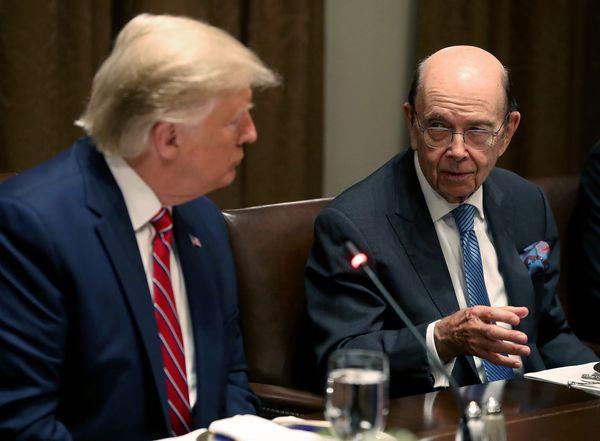
Here’s more details of the Wilbur Ross interview:
China’s tariffs “amount to about three-tenths of a percent of our GDP. So, it’s hardly a life-threatening activity,” Ross said in an interview with CNBC’s “Squawk Box.”
“It’s relatively proportionate to the tariffs we put on based on the intellectual property.”
Wilbur Ross, the US Commerce secretary, says we shouldn’t be surprised that China has hit back today.
He told CNBC it would have been “extremely embarrassing” for Beijing if it hadn’t retaliated, and that markets shouldn’t be too alarmed.
Ross said:
They are very good at arithmetic. They know we’re talking about fractions of 1% of the respective economies.
So, this is not World War 3.
joellawsondc: Wilbur Ross this morning: blithe about China #tariff retaliation, split screen with warning signals in red. If you’re a mid-sized company dependent upon soybean or any of these exports, you’re not shru… CNBC Squawk Box https://t.co/4jFvuR3A1D pic.twitter.com/aHKi1dBv0H
— FanNewsClips (@FanNewsClips) April 4, 2018
A quick recap: Trade war fears grip markets
America is waking up to the news that China and the US have taken another step closer to a trade war that could hurt the global economy badly.
A few hours ago, China announced plans to impose 25% tariffs on a swathe of US goods, worth $50bn last year. The list includes soybeans, cars and aircraft -- three key export areas. Beef, cigars and whiskey are all on the list too.
Economists say the tariffs are tougher than expected. They would hit American exporters, such as farmers, hard, as Beijing puts the US agricultural sector in the firing line.
China’s deputy finance minister has insisted that China doesn’t want a trade war, as it would be a ‘lose-lose’ situation. But Beijing has also made it clear that it won’t back down. As its eEmbassy in Washington, put it:
“As the Chinese saying goes, it is only polite to reciprocate.
The retaliation came hours after America announced tariffs on over 1,300 Chinese products. The wide-ranging list covered machinery, electronics - even uranium and flamethrowers.
The office of the US trade representative said the measures would target products that benefitted from China’s theft of US intellectual property.
President Trump has responded to Beijing’s move - he tweeted that America lost its trade war with China many years ago, so must take new measures to close its trade deficit.
Angel Gurria, Secretary General of the Organisation for Economic Co-Operation and Development, has called the latest developments ‘very worrysome’.
He told an audience in London:
You are talking about the number one and number two traders in the world,”
“It’s not good for anyone, it’s bad... It’s a lose-lose situation.”
US Soybean Export Council has said it ‘regrets’ China’s decision, warning that companies in the US and China will both suffer.
Financial markets have reacted badly, with the price of soybeans tumbling by 5%.
European stock markets have fallen into the red, and Wall Street is bracing for a sharp selloff in 90 minutes time.
In the futures market, aircraft-maker Boeing are down 4%, and machinery giant Caterpillar has lost 3.3%.
The Dow Jones industrial average is expected to fall by over 500 points, or around 2%.
Dow Jones futures are down more than 500 after fears of a trade war return to haunt markets https://t.co/fw4jityuKj pic.twitter.com/O9KlVduIq9
— Bloomberg (@business) April 4, 2018
Mihir Kapadia, CEO of Sun Global Investments, says investors fear that relations between Washington and Beijing could deteriorate further:
Despite hopes of success in negotiations between the US and China last week, today’s retaliation from China is likely to cement fears amongst analysts of a trade war. The tariffs represent the U.S.’s most powerful challenge in decades to China’s economic practices, with 25% tariffs unless Beijing makes major trade and investment concessions. China has announced retaliatory measures today, with 25% tariffs on US goods, leading the markets in Europe to slump this morning.
The uncertainty in the markets over the heightening trade tensions also weighed on the oil markets. Traders will be bracing themselves for further volatility in the coming days.”
Updated
Trump: We lost the trade war many years ago
Newsflash: President Trump has declared that America has already lost the trade war with China:
We are not in a trade war with China, that war was lost many years ago by the foolish, or incompetent, people who represented the U.S. Now we have a Trade Deficit of $500 Billion a year, with Intellectual Property Theft of another $300 Billion. We cannot let this continue!
— Donald J. Trump (@realDonaldTrump) April 4, 2018
That’s quite a change of position from Trump. Last month, he tweeted that trade wars were ‘good, and easy to win’ - for a country in America’s position.
When a country (USA) is losing many billions of dollars on trade with virtually every country it does business with, trade wars are good, and easy to win. Example, when we are down $100 billion with a certain country and they get cute, don’t trade anymore-we win big. It’s easy!
— Donald J. Trump (@realDonaldTrump) March 2, 2018
Christopher Balding, associate professor of business and economics at the HSBC Business School in Shenzhen, reckons China has a clear warning to America -- back down over trade, or else:
Quick hot take on the the US and Chinese lists of tariffs today. 1. US list appears to be chosen to diffuse the tariffs across a wide variety of products. I saw one number that the largest individual import on the list was a little over a billion USD. Conversely Chinese list 1/n
— Eternal Emperor Balding (@BaldingsWorld) April 4, 2018
seems relatively concentrated with a little over 100 items. That's strikingly different approach and intent. US seems to try and limit pain to US and China economically while China seems to try and inflict higher pain. This gets to point #2 2/n
— Eternal Emperor Balding (@BaldingsWorld) April 4, 2018
3. My guess is that Beijing is effectively trying draw a line in the sand or warn Trump that they will fight hard, dirty, or twist the knife. It also seems to telegraph the intent, they plan on giving up nothing. US and China list seem drawn up with very different intent. 4/n
— Eternal Emperor Balding (@BaldingsWorld) April 4, 2018
Last year, the US-China Business Council issued a report explaining why exports to China were “vital to US economic growth”.
They pointed out that China is America’s third-largest goods export market (behind Canada and Mexico), while service exports swelled over 400% between 2006 and 2015.

The report argued that trade with China supports a lot of US jobs:
US goods exports to China come from a wide range of industries including transportation equipment, agriculture, computers and electronics, and chemicals. These exports also sustain logistics jobs in America’s ports and throughout the country. US services exports to China included travel and education, royalties, transportation, business and professional services, and financial services.
The Council also explains how States across America have a stake - and could thus suffer from a trade war:
Most states have seen significant increases in exports of goods and services to China since 2006. Thirty states experienced at least triple-digit goods export growth to China since 2006, and four states saw growth of more than 500 percent over the same period: Alabama, Montana, North Dakota, and South Carolina. Every US state had triple-digit services export growth to China since 2006, 16 states had export growth of more than 400 percent.
China is among the top five goods and services export markets for most states. China was a top three goods export market for 39 states in 2016, and among the top five for another eight states. That includes states that are not usually associated with strong China trade ties, including Alabama, Arizona, Minnesota, Michigan, New Jersey, New York, Pennsylvania, Ohio, South Carolina, and Tennessee

Wendy Chen, an economist at Nomura, has told my colleague Lily Kuo that America and China can still avoid a trade war:
“We think there is still room for negotiation between the two economies, although the risk of a full-blown trade war is rising,”
Updated
It’s clear that the Chinese government isn’t messing about with its new tariffs.
By including aircraft, soybeans and cars, Beijing is targeting the three largest exports from America to China last year (according to the US Census Bureau).
US top exports to China in 2017, under threat of Beijing tariff retaliation to Trump’s tariffs:
— Chad P. Bown (@ChadBown) April 4, 2018
• Civilian aircraft, engines, equipment, and parts: $16.3b
• Soybeans: $12.3b
• Passenger cars, new and used: $10.5b
—
Source of US exports to China —> https://t.co/W4PyVkpIK3
New Chinese tariffs: The list in full
China has released a list of the 106 US products which will incur a new 25% tariff (unless Donald Trump backs down and abandons America’s proposed tariffs on Chinese goods).
The list includes:
- Yellow soybeans
- black soybeans
- other corn
- corn flour
- uncombed cotton
- durum wheat
- fresh and cold beef (whole head or half)
- fresh and cold beef with bones
- frozen boneless beef
- unstemmed tobacco
- tobacco cigars
- tobacco cigarettes
- cigar and cigarettes with tobacco substitute
- hookah materials
- frozen orange juice
- whiskey
- various types of cars and trucks
- aircrafts of more than 15000kg but less than 45000 kg weight
Here’s the full list
Updated

China’s deputy commerce minister, Wang Shouwen, has blamed the US government for triggering the latest tit-for-tat tariffs.
Shouwen told reporters in Beijing:
“It must be said, we have been forced into taking this action.
“Our action is restrained.”
Wang was speaking alongside deputy finance minister Zhu Guangyao, as he insisted that China didn’t want a trade war.
The future market is now indicating that the Dow Jones industrial average will tumble by 600 points, or more than 2%.
Such a sharp selloff would confirm that Beijing’s retaliation is firmer than many investors expected (or hoped).
Dow futures now down 600! https://t.co/2xE8dCHekJ pic.twitter.com/BMbnbOQjd0
— Joe Weisenthal (@TheStalwart) April 4, 2018
Julian Evans-Pritchard, Senior China Economist at Capital Economics, says the strength and scale of China’s retaliation is somewhat unexpected:
“The assumption was China would not respond too aggressively and avoid escalating tensions. China’s response is a surprise for some people.
Evans-Pritchard adds that the two sides could still avert a trade war:
“It’s more of a game of brinkmanship, making it clear what the cost would be, in the hopes that both sides can come to agreement and none of these tariffs will come into force.”
It’s worth noting that China hasn’t said when these new tariffs on $50bn of US imports will come into effect.
The Ministry of Finance says it depends when the $50bn of tariffs outlined by Donald Trump’s administration last night are implemented.
So, unless both sides back down, there will soon be 25% tariffs on $100bn of trade between the two countries:
So net net no-one has gained but there will be 25% more tax on USD 100bn of trade. Ball now in your court Mr President. China announces wide-ranging retaliation for US tariffs via @FT
— Paul Mortimer-Lee (@MortimerleePaul) April 4, 2018
https://t.co/WwbvZ0b1JI
Updated
Shares in major American industry giants are expected to take a tumble when Wall Street opens at 2.30pm BST:

The soybean selloff is deepening, as traders anticipate weaker demand for this crucial product.
Corn and wheat are also being hit by worries of a trade war between China and the US:
Any commods bears looking for an excuse to sell just got one after China tariff announcement: #OOTT #OATT pic.twitter.com/4WbeK562hp
— Amanda Cooper (@a_coops1) April 4, 2018
#TradeWar China tariffs on US exports of Soyabean. Biggest US state producers of Soya? 1st Illinois, 2nd Iowa and 3rd Minnesota. Worth noting Illinois voted heavily for Clinton in election
— Joshua Raymond (@Josh_RaymondUK) April 4, 2018
Back in Beijing, deputy finance minister Zhu Guangyao says China will not give in to pressure for America over intellectual property rights.
Reuters has more details:
External pressure will instead promote China’s development and innovation, Zhu told reporters in Beijing.
Friction is hard to avoid in fast-growing China-U.S. trade, and huge challenges face the two sides, but Zhu said he still hoped relations could return to a healthy track, since a trade war could hurt all sides.
China’s retaliation is more forceful than the financial markets had expected, says Gao Qi, Singapore-based strategist at Scotiabank.
That explains why shares fell immediately in Europe, with Wall Street on track for losses too.
He told Bloomberg:
“China’s response was tougher than what the market was expecting -- investors didn’t foresee the country levying additional tariffs on sensitive and important products such as soybeans and airplanes.
“Investors believe a trade war will hurt both countries and their economies eventually.”
Why soybean tariffs really matter
China’s decision to slap a 25% tariff on soybean imports from America looks like a real shot over the bows of the Trump administration.
Soybeans are a crucial part of the global food chain, used as a source of oil and also to feed livestock such as pigs and chicken.
The World Wildlife Fund calls it the ‘king of beans’, saying:
It contains 38% protein — 2x as much as pork, 3x more than eggs, and 12x more than milk. Also the protein in soybean has a more complete range of essential amino acids than most other foods.
It’s also used in vegetarian food products like tofu (which comes from soy milk).
China is the world’s largest import of soybeans; American farms sold around $14bn of soybeans to China companies last year.
So farmers in America’s agricultural belt - which is typically Republican-supporting - may have deep concerns about the tit-for-tat tariffs.
NBC’s Janis Mackey Frayer says China had this in mind when it drew up today’s tariffs...
Why did #Beijing target US soybeans?Because #China bought $14bn worth in 2016, and 8 of 9 biggest producing states voted for Trump. @NBCNews
— Janis Mackey Frayer (@janisfrayer) April 4, 2018
Soybean tariffs could also hurt Chinese farmers - pushing up their import prices and making pork more expensive.
Updated
China’s foreign ministry has urged the US to abandon its plan to impose tariffs on 1,300 Chinese products.
At a daily press briefing, the ministry said the two countries should resolve trade differences through dialogue.
Geng Shuang, a foreign ministry spokesperson, says:
“Those who attempt to make China surrender through pressure or intimidation have never succeeded before, and will not succeed now.
China: Trade war would be a lose-lose
China’s deputy finance minister, Zhu Guangyao, is holding a press conference now.
Zhu tells reporters in Beijing that the Chinese government doesn’t want a trade war -- despite having just announced retaliatory tariffs on $50bn of American goods.
A trade war would be a ‘lose-lose’ for China and America, he says.
Co-operation is the only right choice for both countries, Zhu insists. He says China wants to resolve the issues with America in a constructive way.

Updated
Analyst John Kemp fears that Beijing and Washington won’t be able to stop the situation escalating into a full-blown trade war:
TRADE WAR is on ... China announces tariffs on $50 billion of imported items from the United States in retaliation for Section 301 action: pic.twitter.com/8zaBP54yr1
— John Kemp (@JKempEnergy) April 4, 2018
TRADE WARS are easy to start but hard to stop. Like the First World War, once the GO code is given and the trains start moving they are hard to stop. Who is going to help the United States and China come up with a face-saving solution?
— John Kemp (@JKempEnergy) April 4, 2018
Most analysts and investors still assume a last-minute deal can avert tariffs actually being imposed. Maybe. But by then damage may already have been done. And neither Trump nor Xi can afford to appear to back down and look weak in front of a domestic audience.
— John Kemp (@JKempEnergy) April 4, 2018
Updated
China’s new tariffs are aimed firmly at America’s agricultural industry, says John Ross, senior fellow at Renmin University of China:
Trump Launches Attack on China... and US Workers & Farmers
— John Ross (@JohnRoss43) April 4, 2018
In drawing up its list of tariffs on $50 billion of Chinese products the Trump administration has tried to... https://t.co/MwDunaHWCG
China’s swift retaliation against the US has hit the financial markets.
The Chinese yuan has fallen 0.4% against the US dollar, its biggest fall in two weeks, according to Reuters data.
European stock markets have also slumped into the red; Britain’s FTSE 100 is down 0.5%, while Germany’s DAX has shed 1.4%.
US stock market is expected to fall sharply when trading begins in around five hours. The Dow is down 1.3% in the futures market.
Updated
The Chinese finance ministry has released more details of the new 25% tariffs which it will impose on US imports, in retaliation to Donald Trump’s new tariffs on its exports.
It confirms that the reciprocal measures cover 106 different US products.
The list includes soybeans, chemicals, whisky, cigars, some types of beef, corn and wheat.
Some types of aircraft, lubricants, tobacco and orange juice are also targeted, along with some trucks and SUVs.
Crucially, these imports were worth $50bn in 2017 -- that’s the same value as the 1,300 Chinese goods which America is targetting with its new tariffs.
China will retaliate against $50 billion worth of US goods including soybeans, cars and chemicals. pic.twitter.com/16LP3I8Wzp
— Bryce Baschuk (@bbaschuk) April 4, 2018
Updated
CHINA HITS BACK WITH NEW TARIFFS
Newsflash: China has just announced a fresh wave of tariffs on American goods, in retaliation to the US tariffs released last night.
Chinese state TV is reporting that 106 US products are affected, including a 25% tariff on soybeans, automomobiles and chemicals. In total, the goods affected are worth $50bn per year.
#BREAKING China to levy reciprocal tariffs on 106 U.S. products
— Peter Hoskins (@PeterHoskinsTV) April 4, 2018
So, Beijing hasn’t wasted any time in delivering on its pledge to hit back against the new proposed US tariffs on 1,300 of its products.
Many US farmers rely on sales of soybeans to China, so this could have a significant impact on America’s agriculture sector.
The soybean price has taken an immediate hit.

From uranium to rocketlaunchers - the new US tariffs on Chinese goods
The array of Chinese products that would be affected by America’s new 25% tariffs is lengthy, and varied.
It includes “compounds of depleted uranium”, nuclear reactor parts, a wide range of vaccines and medical products, aircraft tyres, stainless steel and aluminium in various sizes, and aircraft jets and tyres, domestic and commercial dishwashers, storage water heaters, and sewing machines.
On the agricultural side, poultry incubators, haymaking machines and milking devices are all hit -- suggesting US farmers could suffer from these tariffs.
Cranes, snowploughs and locomotive parts are all on the list too.
Technology products are also hit, including TV cameras, a range of televisions, and even fuses.
Even weapons are covered - including rocket launchers, flame-throwers, rifles, shotguns, pistols and military weapons.
The US will now hold a consultation on whether to impose these tariffs. The full list is online here.
Trump's 25% import tariffs on China's unfair trade apply to these 1,333 products
— Chad P. Bown (@ChadBown) April 4, 2018
...a Section 301 word cloud... pic.twitter.com/E0Pil4t6vc
Introduction: China vows to retaliate against latest US tariffs
Good morning, and welcome to our rolling coverage of the world economy, the financial markets, the eurozone and business.
Fears of a trade war between China and America are swirling this morning as both sides ratchet up the pressure.
Last night, the US government announced details of new 25% tariffs on $50bn worth of imports from China. The list of over 1,300 products targets China’s industrial base, covering everything from industrial robots and electronics to metal alloys and aircraft parts.
Public comment on the proposed list of goods from #China subject to 25% #tariffs by the U.S. is now open...and here's the 1,300 item list.https://t.co/4CPITm23jQ
— Heidi Learner (@heidilearner) April 4, 2018
Phonographs and uranium compounds? Nuclear reactors? Artificial teeth? Oh, and 156 types of #steel.
America claims these new 25% tariffs is prompted by Beijing’s long-running ‘intellectual property theft’ of valuable technology and ideas developed by US companies. It says:
The proposed list of products is based on extensive interagency economic analysis and would target products that benefit from China’s industrial plans while minimizing the impact on the US economy.
The move comes two days after China hit back against America’s tariffs on steel and aluminium by imposing new trade hurdles on 120 US products - including fresh food and steel.
And there are already signs that America’s latest move could trigger fresh retaliations.
China’s ambassador to the World Trade Organisation, Zhang Xiangchen, has declared this morning that his country will retaliate “immediately”, claiming that the Trump administration is breaking WTO rules.
In a punchy statement, Zhang says:
“The findings of the U.S. Section 301 investigation are a willful distortion of facts and full of selective assertions and allegations, turning a blind eye to the actual progress that China has achieved in the market-oriented reforms, further opening-up and enhanced intellectual property protection.”
The Chinese Embassy in Washington was also quick to condemn this latest move - saying:
“As the Chinese saying goes, it is only polite to reciprocate. The Chinese side will resort to the WTO dispute settlement mechanism and take corresponding measures of equal scale and strength against US products in accordance with Chinese law.”
That raises the danger that China imposes its own tariffs on a wider range of US goods, taking the global economy a little bit closer to protectionism.
Also coming up today:
We get a new healthcheck on Britain’s building sector this morning, which may show the impact of last month’s wintery weather. Plus, new jobs data from the Eurozone and America.
Markets are expected to be subdued, given the trade tensions swirling around:
Early trade in #European #markets mixed with London down 14 points -https://t.co/RUZNmoz8SA - losses can exceed deposits pic.twitter.com/JgwZpmewRv
— Jeremy Naylor (@JeremyNaylor_IG) April 4, 2018
Advertising giant WPP is also in the spotlight, after launching an investigation into an allegation of personal misconduct against its chief executive Sir Martin Sorrell. He denies the allegations “unreservedly”, but investors may be concerned.
The agenda:
- 9.30am BST: UK construction PMI for March
- 10am BST: Eurozone unemployment figures for February
- 10am BST: Eurozone inflation figures for March
- 1.15pm BST: The ADP survey of US private sector job creation in March
Updated