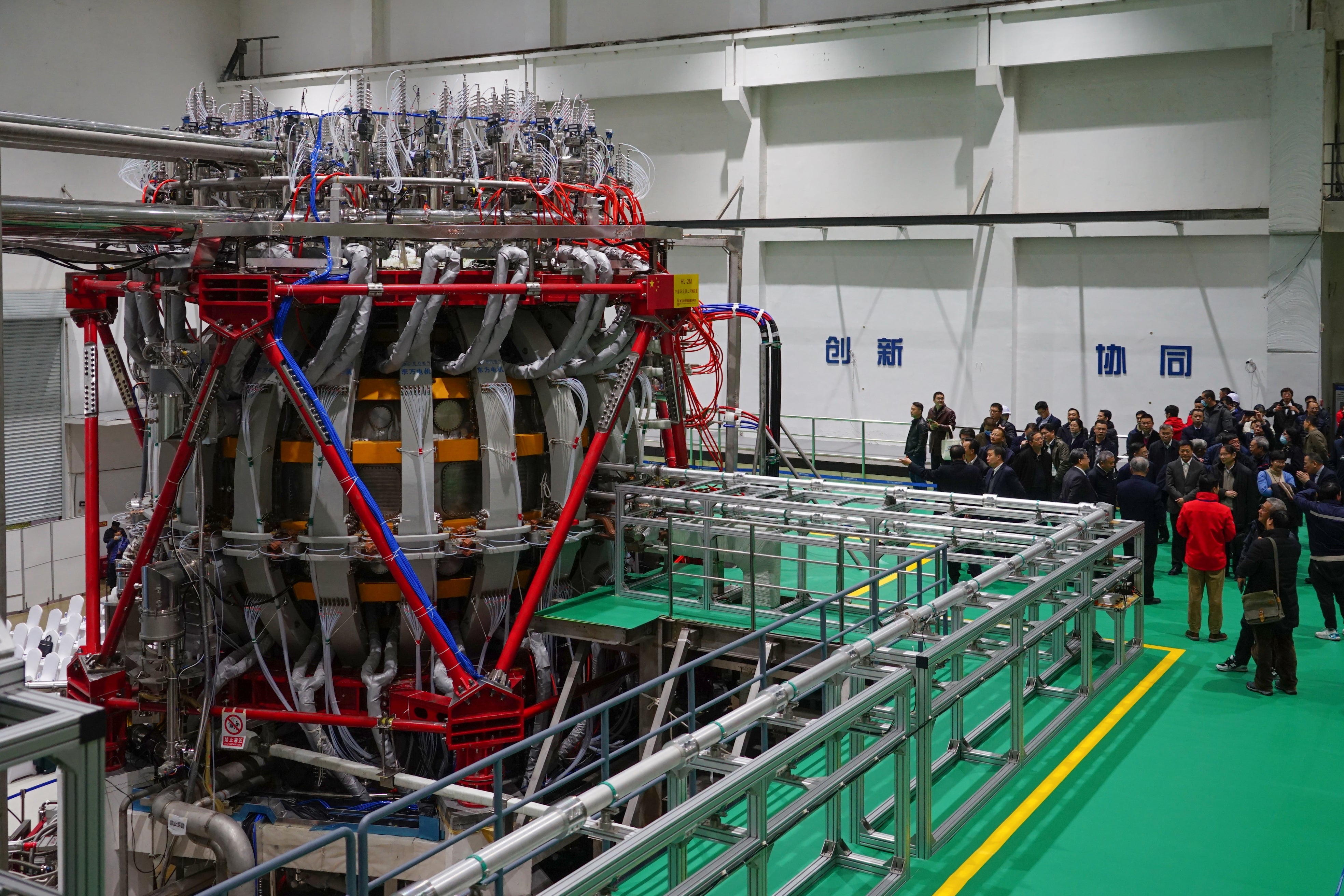
China has powered up its nuclear fusion reactor for the first time, in a step forward for technology which would ultimately provide a powerful and limitless source of clean energy.
The HL-2M Tokamak reactor in Chengdu, Sichuan province, is designed to use a powerful magnetic field to fuse hot plasma at temperatures of 150 million celsius – more than 10 times hotter than the sun’s core.
The reactor, referred to as an “artificial sun” because of the enormous heat and power it produces, was completed last year.
Chinese scientists have been working on smaller version of the technology since 2006 in experiments designed to lay the groundwork for future large-scale power generation.
According to state media, the new reactor will also provide technical support to the International Thermonuclear Experimental Reactor (ITER), the world’s largest reactor, which is being constructed in Marseille, France. China is one of six countries, as well as the European Union, participating in the project.
Scientists have been working on nuclear fusion, seen by some as the holy grail of energy production, for decades. The reactors are intended to mimic the physics of stars by merging atomic nuclei, releasing massive amounts of energy which can be controlled and ultimately turned into electricity.
Unlike nuclear fission, the process used in nuclear power plants, it creates little radioactive waste and carries less risk of environmental disaster.
But achieving fusion is extremely difficult and expensive. Estimates of the total costs of constructing and operating the ITER range between £17bn and £49bn, making it one of the world’s most expensive scientific projects, and it is likely to be decades before it provides a viable means of electricity generation.
Last week the UK announced its own step towards a nuclear fusion power station, launching a search for a site for the plant.
The government hopes construction of Spherical Tokamak for Energy Production (STEP), which would be plugged into the electricity grid, will be completed by 2040.
Professor Ian Chapman, chief executive of the UK Atomic Energy Authority, said the “plans will prove that fusion is not a far-off dream, but a dawning reality”.
“STEP is about moving from research and development to delivery,” he added.