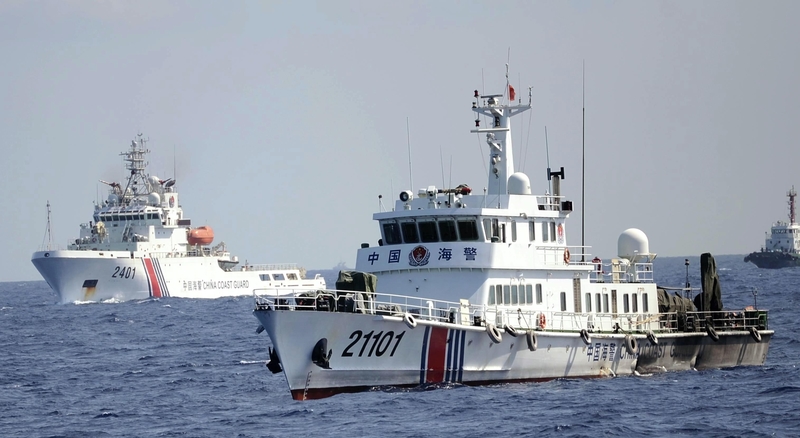
BEIJING -- The administration of Chinese President Xi Jinping has released a bill in which it sets out the powers and other aspects of the China Coast Guard, making it more clear that it is a paramilitary group.
Under the bill, which was released Wednesday, China's coast guard is authorized to forcibly remove structures built by foreign entities in the waters and on the islands under China's jurisdiction. This means that if Japan were to build facilities on the Senkaku Islands in Okinawa Prefecture, over which Beijing claims sovereignty, China's coast guard could use the envisaged law as a legal basis to make a forced landing on the islets.
The full text of the bill has been posted on the website of the National People's Congress, at which hearings on the bill are being held. The law will be enacted as early as the end of this year.
The coast guard was established in 2013 to secure maritime rights and interests. It is under the umbrella of the Chinese People's Armed Police Force, which directly belongs to the Central Military Commission.
The legislation clearly stipulates that the coast guard will "execute the duties of defensive operations" by order of the Central Military Commission, reaffirming its position as a paramilitary organization.
Included in the bill is the coast guard's authority to forcibly remove and seize foreign vessels that illegally enter China's territorial waters. It says the coast guard can also use weapons when China's sovereignty is violated.
Japanese fishing and patrol vessels sailing in the waters around the Senkaku Islands therefore could be targeted.
The bill further stipulates that the airspace over the waters under its jurisdiction are subject to the proposed law. Beijing appears to be considering the use of small unmanned drones to monitor foreign vessels. As China has been expanding its military footholds in the South China Sea, the bill states that artificial islands will also be subject to protection by the coast guard.
With the proposed law giving the coast guard legal grounds to exercise its authority, a diplomatic source in Beijing said it will "use the new law to increase its presence" and further sharpen its activities in the East China Sea and the South China Sea.
Read more from The Japan News at https://japannews.yomiuri.co.jp/