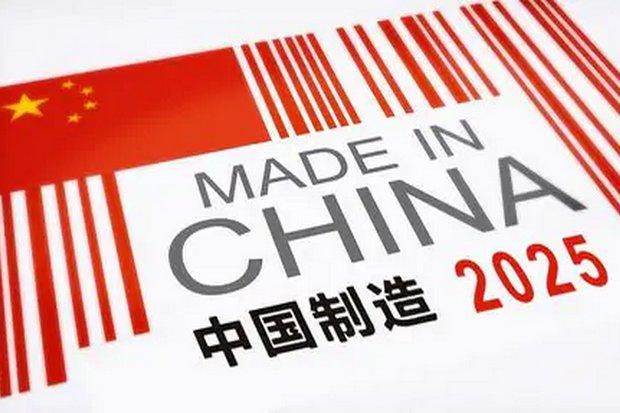
Beijing is considering delaying targets in its "Made in China 2025" programme, Bloomberg News reported last week. The roadmap, which seeks to advance domestic production of critical technology, has been a key bone of contention in President Donald Trump's trade war. Other reports said China may replace the programme altogether and give foreign companies more access to its market.
On the same day, though, the State Council said it had decided to boost "mechanised farming" and upgrade agricultural machinery. And the Ministry of Industry and Information Technology said it would roll out policies to upgrade manufacturing with "cutting-edge technologies".
The reports make one thing clear: China isn't going to rein in its industrial objectives any time soon. At the same time, it's a long way from achieving those targets.
By the numbers, China increasingly doesn't need the world's factories. The foreign content of its exports has been dropping for the last 20 years. But that's also true for foreign companies. Consider ABB Ltd. The Swiss industrial giant sources locally almost 90% of the parts it uses to manufacture transformers, robots and electrical equipment in China, and sells most of its output there, according to Morgan Stanley.
Made in China 2025, published in 2015, laid out how and why China would need to move up the technology ladder and close the gap with developed countries in higher-end or intelligent manufacturing.
The plan identified 10 key sectors and set out targets to raise domestic content in core components and materials. The global community has balked at the proposal, and its financial scale has sent shudders, with hundreds of billions of dollars in funds backed by state banks and other pools of government capital.
However, China's research and development expenditure, while growing, remains well below the likes of the US and Japan. R&D intensity, a proxy for how effectively the country has spent its money, has barely budged in the past two years.
At a recent business forum, a senior official with the financial and economic affairs committee of the National People's Congress said China was likely to miss its targets for R&D spending as a portion of GDP in the five-year plan ending 2020. The nation will effectively end up spending US$100 billion less than it had budgeted.
Speak to CEOs of German machinery makers, and they will tell you China's expertise may have reached the second or third level, but it is nowhere close to the highest tier. Chemical companies in southern China say every local entrepreneur wants to make the compounds but when it comes to the high-end they can't quite cut it, producing formulations that are often unstable.
In 2017, high-tech manufacturing accounted for just under 13% of total industrial value-added. More than half of China's technology standards for smart manufacturing don't match internationally accepted ones. That might hinder foreign players, but it also impedes the nation's own companies on the global stage.
A look at the state of the new energy vehicle, or NEV, industry suggests China is unlikely to race ahead. Domestic production is supposed to have an 80% share of the NEV market by 2025. Yet for all the millions of NEVs China now churns out, it has yet to produce a global or even a domestic champion. Instead, subsidies have led to swaths of low-quality electric cars. Ultimately, China brought in Tesla itself to manufacture locally.
Despite trade tensions and barriers, foreign investment in China has continued to pour in. In the first 11 months, it rose 1.1% to more than $120 billion and the number of newly approved foreign-invested enterprises increased by almost 78%.
Clearly, foreign investors aren't overly concerned by Made in China 2025. After all, other countries have industrial policies. The US-Mexico-Canada trade agreement has local content rules. India has exorbitant import tariffs. And the Committee on Foreign Investment in the US now targets all of the industries China has listed in its 2025 plan.
China's openness to foreign investment has served it well -- and overseas companies such as BMW AG and Apple Inc that have profited there. The country has a better chance of climbing the technology ladder by exposing its companies to the rigors of world-class competitors than by seeking to shut them out with rhetoric-heavy strategy documents. - BLOOMBERG OPINION
Anjani Trivedi is a Bloomberg Opinion columnist.


.png?w=600)