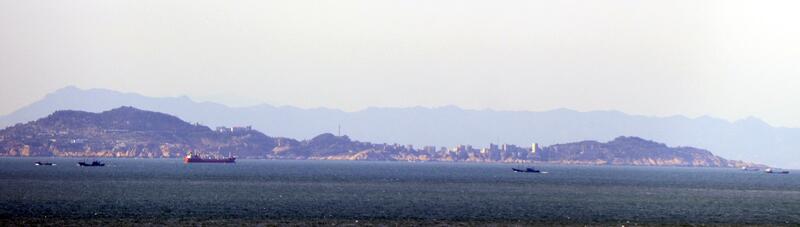
MATSU, Taiwan -- China's civilian vessels, mainly sand dredging ships, swarmed the sea around Taiwan's Matsu Islands near mainland China last year, causing environmental destruction. There still appeared the damage in the archipelago's Nangan and Beigan islands in early April.
Looking west over the glimmering sea, skyscrapers and wind turbines in China's southeastern province of Fujian were seen about 10 kilometers away from the shores of the Matsu Islands, which is dotted with Taiwan military defense posts.
About 7,600 people out of the archipelago's population of 13,300 live on Nangan Island. Running a guesthouse there is Lin Jian-Zhong, 53, who recalled a nightmarish situation he witnessed last summer.
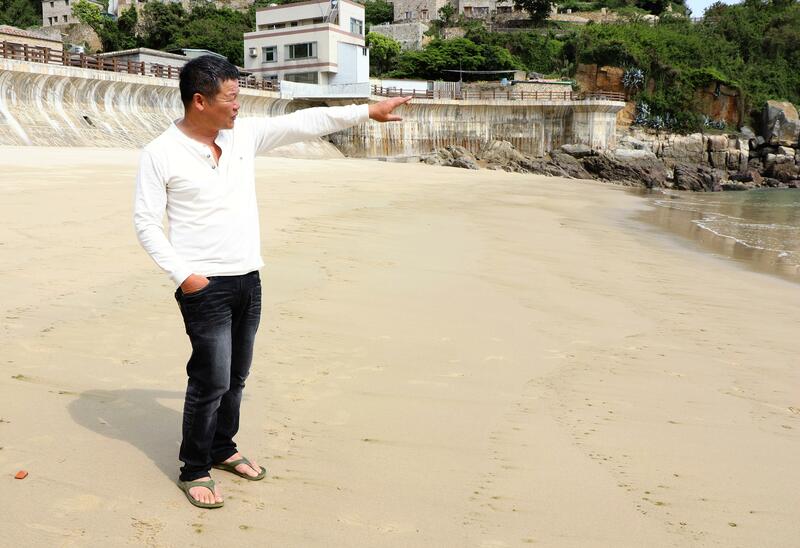
"The sandy beach here in front of us disappeared in just two days," Lin said.
In a normal summer, it takes about a month for the sand to disappear due to monsoon winds and ocean currents, before the sand returns in the autumn. But this unusual disappearance of sand was occurring at other beaches as well.
The cause could be determined with one's own eyes. Many sand dredging ships from China were operating offshore. The situation worsened in October when a huge fleet of a few hundred vessels from China arrived at waters around the Matsu Islands.
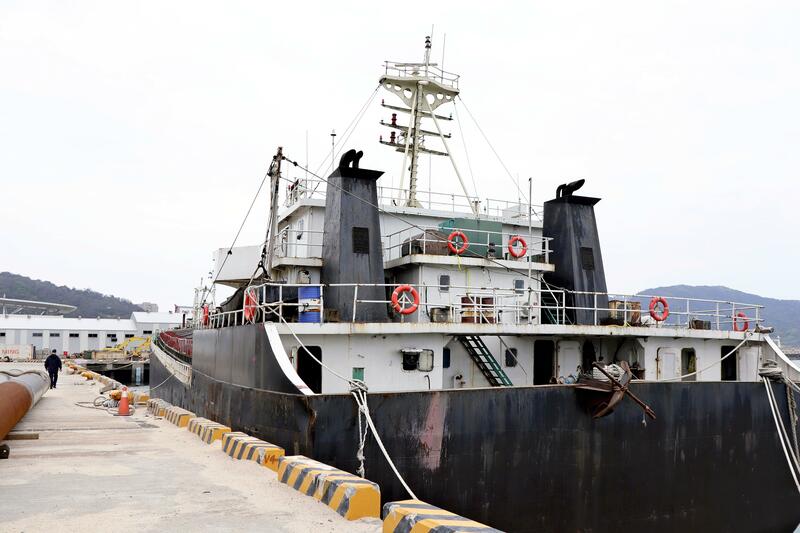
"The sea was filled with ships from China as far as the eye can see," a resident of the islands said. "It was scary."
Fishing vessels were mixed among the fleet of ships used to dredge and carry sand.
Explained Lii Wen, director of the Matsu Islands County Chapter of Taiwan's Democratic Progressive Party: "Sand is taken from waters deeper than 20 meters, and creatures in the sand such as shrimp, crabs, shellfish and fish are swept up, which attract larger fish that eat them. That's why fishing vessels go where the sand dredging ships are."
The entire ecosystem of the sea has been damaged.
"Last year, I couldn't catch a single shrimp on these shores," guesthouse proprietor Lin said. "No hope for fishing anymore."
The sand dredging ships disappeared around the Chinese New Year in February. Sand gradually returned to the beach, but the thickness was reduced by over a meter, compared to the same time in previous years.
-- Lifelines disrupted
There are two small islands, located about 20 kilometers south of Nangan Island, that together have about 1,500 inhabitants. These islands are connected to Nangan by two submarine cables laid by Taiwan's major telecommunications company Chunghwa Telecom.
Vessels from China are particularly common in these waters. Since last June, one of the cables was severed five times by the vessels' activities, according to the company's Matsu office head Lin Yi-Sheng.
The cable was buried about two meters below the seafloor. Pumps used by China's sand dredgers to extract sand altered the shape of the seafloor, exposing the cable. When it was severed, the small islands were left without their cable TV connection.
Chunghwa Telecom repaired the cable on Sept. 22, but it was cut again on Oct. 10. It was repaired again on Dec. 11 only to be cut another time two days later. The restoration cost tens of millions of Taiwan dollars (1 Taiwan dollar is about 3.85 yen).
"Communications is the lifeline of the remote islands," said Lin Rong-Shy, a senior executive vice president and chief technology officer at Taipei-based Chunghwa Telecom. "We can't abandon them."
The company has decided not to repair the cable for the time being, but is hurrying to strengthen satellite communications and other services.
Noise is another issue. Last year, low ringing sounds from machinery echoed throughout the night from the sea, distracting many islanders' sleep.
-- Complicated feelings
The waters around Matsu within six kilometers of the coastline are under Taiwan's jurisdiction. Taiwan patrol vessels can seize sand dredging ships from China that enter the waters, but they are unable to do anything to vessels outside its jurisdiction. In the end, the solution lies in the response from China.
"We call the relevant people in Fujian and urge them to take action" when there is an issue, said Chen Chen-Kuo, mayor of Nangan township. "We have a pipeline between our people."
The islands have strong ties with the mainland. Before the spread of the novel coronavirus, the islanders used to enjoy shopping over the weekends in Fujian, which is a 25-minute boat ride from Beigan Island.
Like Chen, who is a fifth generation Matsu resident whose ancestors migrated from the mainland, many islanders feel close to the people in mainland China who share the same ancestry, speak the same dialect and worship the same gods.
The sea sand dredging trampled on these feelings of the Matsu islanders. It is believed that the Communist Party of China's regime is behind this, using civilian vessels in an attempt to pressure Taipei, which does not agree on the unification of China and Taiwan.
"The people in China are not to blame," a male office worker said. "It's the Communist Party of China that is in the wrong."
In April, sightings of sand dredging ships started to be reported again. Anxiety once again envelops Matsu.
Read more from The Japan News at https://japannews.yomiuri.co.jp/