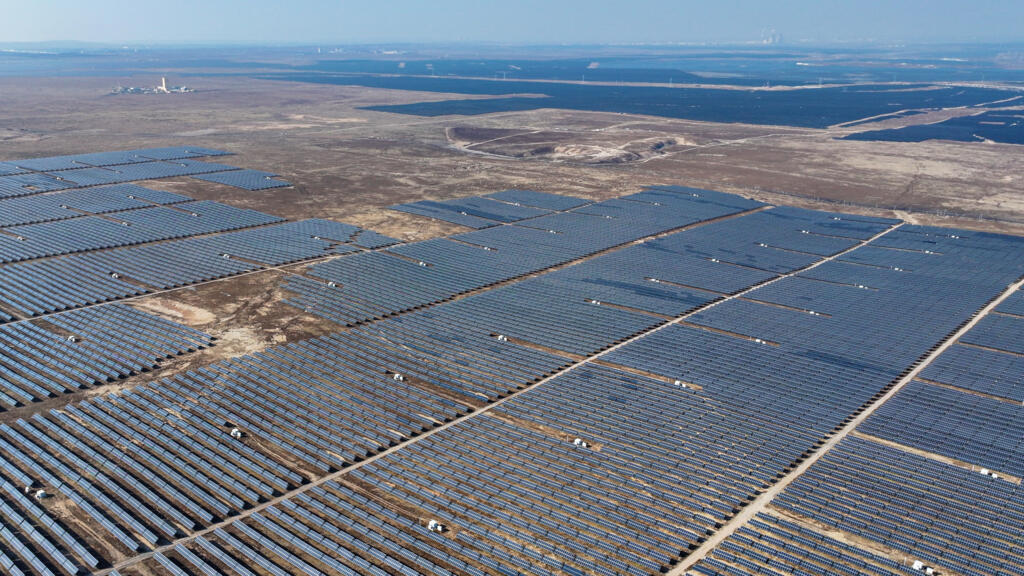
Ten years on from the Paris climate agreement, China sits at the heart of the global energy transition – as both the world’s biggest emitter of carbon dioxide and its biggest driver of renewable power.
China produced around 60 percent of the world’s new solar power in 2025, making it the world's largest manufacturer and deployer of renewable energy. It is installing more solar and wind capacity than the rest of the world combined.
However, a decade after the Cop21 talks in Paris – which led to the Paris Agreement, ratified by China in 2016 – China also remains heavily dependent on coal.
With Beijing now painting itself as central to global efforts to tackle climate change, the question is whether Chinese technology can help put the world on a viable climate path.
“We’re studying China’s technological progress, not only in photovoltaics, but also in wind power, solar thermal energy, onshore wind, offshore wind and nuclear energy,” Jiang Kejun, from the Energy Research Institute of China’s National Development and Reform Commission, told RFI.
If the world stays on track, he adds, it may still be possible to limit global warming to 1.5C using Chinese technology alone. That view reflects a broader shift in China’s message, with the transition framed not just as a national effort but a global one.
China’s energy transition differs from Europe’s. It is not built on reducing demand, but on meeting rising energy needs driven by urbanisation, industry and the electrification of the economy.
“Almost all the growth in energy demand comes from electricity, and almost all the growth in electricity this year has come from solar and wind,” says Dave Jones, chief analyst at Ember, a global energy think tank. China’s oil consumption is no longer rising, he adds, while gas use is rising but remains low.
China is not yet replacing fossil fuels outright. Instead, it is largely avoiding new fossil demand by steering growth towards low-carbon electricity. As a result, emissions are stagnating rather than notably falling, even as renewable energy expands.
While Beijing is aiming for its CO2 emissions to peak before 2030, energy stability remains the priority in a country with one of the world’s largest power systems.
Paris Agreement turns 10 as heat rises faster than global action
Race to cut costs
China’s strategy rests on producing electricity at very low cost. Vast solar and wind projects are being built in the Gobi Desert, a huge arid region in northern China, as well as in the Taklamakan in the far west, one of the world’s largest sandy deserts, and across the open grasslands and desert areas of Inner Mongolia.
These installations have been engineered to generate cheap electricity that is then sent east through ultra high voltage transmission lines, a field in which China is a global leader.
“China has made this product very affordable,” Jiang explains. “There is no overcapacity and no unfair price competition. Even with the existing supply of about 0.6 yuan per watt for photovoltaic modules, companies can still remain profitable.”
Western arguments about overcapacity no longer make sense in a world facing a climate emergency, he argues – adding that Chinese solar power has become cheap enough to outcompete fossil fuels even without subsidies.
“Even in a baseline scenario, investing in photovoltaics or carbon-free energy supply is already much cheaper than relying on fossil fuels,” Jiang says.
In his view, falling renewable costs mean fossil fuels no longer need to play a central role in future energy systems. That shift is already visible in the price of solar equipment.
“A solar panel today costs between $50 and $60 in countries that do not impose high tariffs on Chinese imports,” says Ember's Dave Jones. “That panel can produce electricity for 20 or 30 years.”
Falling costs help explain why Chinese solar is spreading rapidly, including in poorer countries where access to electricity remains limited.
Coal as a safety net
But despite the expansion of renewables, coal remains central to China’s power system. Beijing continues to approve new coal plants – not to drive growth, but to secure supply in a country where power shortages are politically sensitive.
“Coal-fired electricity generation in China may not be rising, but it is not falling either,” Jones explains. “The system absorbs huge amounts of solar and wind, but coal is still there to guarantee stability.”
Coal now acts as a buffer when solar output drops or demand spikes, and China is investing heavily in making its coal plants more flexible.
“This is so plants can shut down during the day and let cheap solar feed the grid,” Jones says. “It is not happening fast enough, but it is happening at scale.”
The next challenge is closing coal plants rather than simply building fewer of them. But for now, political and economic stability come before a rapid exit from coal, as electricity demand continues to rise.
Clean energy surpasses coal but policy headwinds threaten 2030 goals, IEA warns
Making solar work
Producing large amounts of solar power is only part of the task. The bigger challenge is integrating it into the grid without causing instability.
Jones points to two key tools: flexible coal generation and energy storage, where China has built a strong technological lead.
“Battery technology developed by Chinese manufacturers has advanced significantly,” he says. “Prices have fallen to the point where storage is becoming profitable, allowing solar power to become dispatchable electricity.”
China already dominates close to 80 percent of the global battery supply chain, from lithium processing to recycling. Storage itself is not seen as a major barrier, with Chinese researchers saying existing technologies are already capable of supporting large-scale solar power.
“Whether in the Gobi Desert or even in the Sahara, new storage technologies are already good enough,” Jiang says. “The problems are manageable. All of this can work.”
Beyond electricity generation is a broader industrial shift. The goal is no longer just green power, but fully integrated industrial ecosystems supplied by cheap renewables.
“In the future, within a single industrial park, investment will cover photovoltaics, wind, power generation, hydrogen purification, synthetic ammonia or olefins, right through to the final product,” Jiang says. “The system is fully integrated, and such a design can be supported 100 percent by photovoltaics.”
African leaders urge fair funding with $50bn climate call
Power struggles
However, China’s expansion in clean energy has fuelled concern in Europe and the United States, where Chinese technologies are often viewed as a source of strategic dependence.
Climate urgency is used to push back against those concerns. “My main concern is whether the world can still maintain the 1.5C warming target,” Jiang says. “The pace of warming is extremely fast. We do not have time. We must act.”
He also warns against turning the energy transition into a geopolitical dispute, saying climate discussions lose substance once international power struggles take over.
At the same time, the rise of Chinese clean technologies is not being driven solely by state planning. Much of the expansion reflects market forces and growing demand.
“Manufacturers introduce panels into new markets, they appear on shelves for the first time and demand grows organically,” Jones explains.
Both experts agree that the future of the transition now largely depends on the Global South.
“Solar power offers a real opportunity to catch up,” Jones says. “Countries do not need to follow the historic path of building dependence on oil and gas. They can electrify directly with clean energy.”
Unlocking finance and technology transfers is now critical, Jiang argues: “The key issue today is to release Chinese technology and capital flows to developing countries as quickly as possible.”
Control over renewable technologies is increasingly tied to control over future energy systems, a point energy experts say will shape the coming decade.
This article was adapted from the original version in French by RFI's Clea Broadhurst.