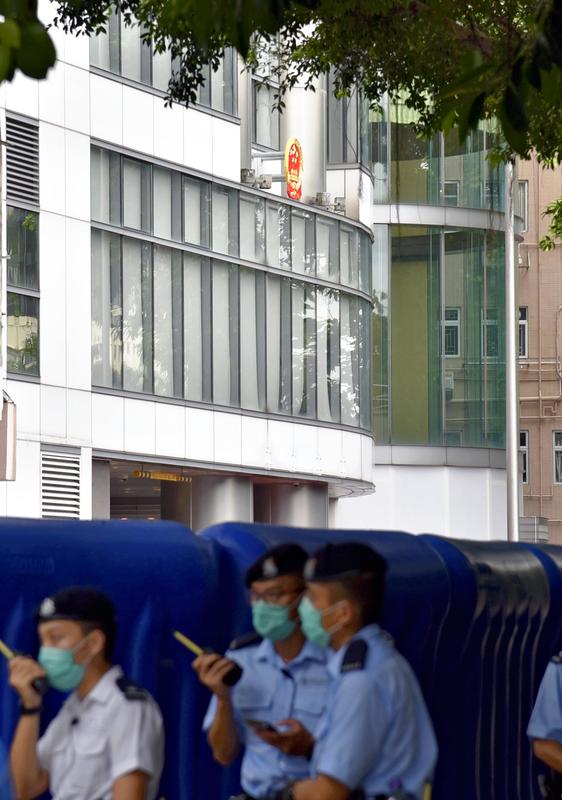
BEIJING/HONG KONG -- Five years ago Thursday, the administration of Chinese President Xi Jinping launched a sweeping crackdown on domestic human rights lawyers. Pressure continues to be piled on lawyers as secretive detentions and court cases remain widespread. Adding to the unease over the judicial system, the Chinese government's new Office for Safeguarding National Security was opened in Hong Kong on Wednesday, barely a week after Beijing passed a new national security law for Hong Kong.
A Beijing-based human rights lawyer described a recent trial conducted at the Intermediate People's Court in Suzhou, Jiangsu Province, as a "classic example" of the current murky application of the law in China. On June 24, the court in eastern China sentenced human rights activist Ge Jueping to 4-1/2 years in prison on a charge of "inciting subversion of state power." Observers have raised concerns over the length of Ge's detention and the evidence used in court.
Ge, 61, rose to prominence for supporting residents who opposed a local government's expropriation of land. In November 2016, Ge was placed under "residential surveillance in a designated location," which effectively put him under house arrest, and he was indicted in April 2018.
Chinese law stipulates a ruling should be made within a maximum of three months of indictment. However, the trial was interrupted and the ruling was delayed, resulting in Ge being detained for an extended period. It appears this was intended to place psychological pressure on Ge.
In its ruling, the court used "testimony" provided by human rights lawyer Wang Yu as evidence. After the ruling was handed down, Wang denied giving testimony to the authorities and issued a statement criticizing the "illegal ruling." It is possible evidence was arbitrarily used during the trial.
According to a lawyer representing Ge, the activist was exhausted from his long detention and could barely stand up on the day the ruling was handed down, but after the ruling was announced, Ge blasted the judicial authorities as a "criminal organization." Ge indicated he would appeal.
This lawyer also criticized the ruling, telling The Yomiuri Shimbun, "In China, human rights are nothing more than words on paper."
Judicial authorities in China suspended or revoked the licenses of at least 30 lawyers in the two years to September 2019, according to a Hong Kong-based organization that supports human rights lawyers.
"Five years ago, there were at least 200 human rights lawyers in China, but now that number is 100 or fewer," a lawyer in Beijing pointed out.
Lawyers continue to be hounded. Wang Quanzhang, 44, who was detained as part of the crackdown in 2015, was released in April this year but remains under surveillance.
In late June, authorities allegedly warned a Beijing-based human rights lawyer "not to express an opinion or give interviews" about the new security law that came into force for Hong Kong. Expressing critical views of this law and working closely with pro-democracy groups in Hong Kong also have drawn the attention of authorities.
During the crackdown that began on July 9, 2015, at least 300 human rights lawyers and activists across China, including officials of a Beijing law office that supported the socially vulnerable, have reportedly been taken away by authorities, summoned to their office and investigated. In some cases, prison sentences have been handed down for charges such as "subversion of state power."
A Beijing lawyer detained during the crackdown told The Yomiuri Shimbun about the pressure tactics authorities have adopted. Since last year, according to the lawyer, Chinese police authorities urged the lawyer's son, who lives overseas, to temporarily return to China by offering to pay for a round-trip flight.
"I think the authorities intend to hold my son hostage and force me to stop saying and doing things the government doesn't like," the lawyer said. "I told my son, 'Don't come back to China, even if I die.'"
--China opens security office in H.K.
An opening ceremony was held Wednesday for China's new Office for Safeguarding National Security in Hong Kong.
"We will fulfill our duties to safeguard national security based on the provisions of the law and exercise the relevant powers," said Zheng Yanxiong, the head of the office.
According to sources, including Hong Kong's Chinese-language Sing Tao Daily newspaper, about 300 personnel dispatched from China's Public Security Ministry and State Security Ministry will staff the office. A provision of the new security law allows the office to bypass the Hong Kong government when a serious crisis occurs and directly carry out the law. It is possible suspects could be sent to mainland China to be prosecuted and face trial. There have been concerns raised in Hong Kong's legal circles over whether a defendant's right to a fair trial could be guaranteed in such a case.
The office has been established in a hotel on Hong Kong island overlooking Victoria Park, the venue for antigovernment gatherings and other events.
"From up there, they can monitor the number of participants [in such gatherings] and the flow of people," said a man in the food and beverage industry. "I think they want to intimidate residents and completely clamp down on any protest movements."
Read more from The Japan News at https://japannews.yomiuri.co.jp/