
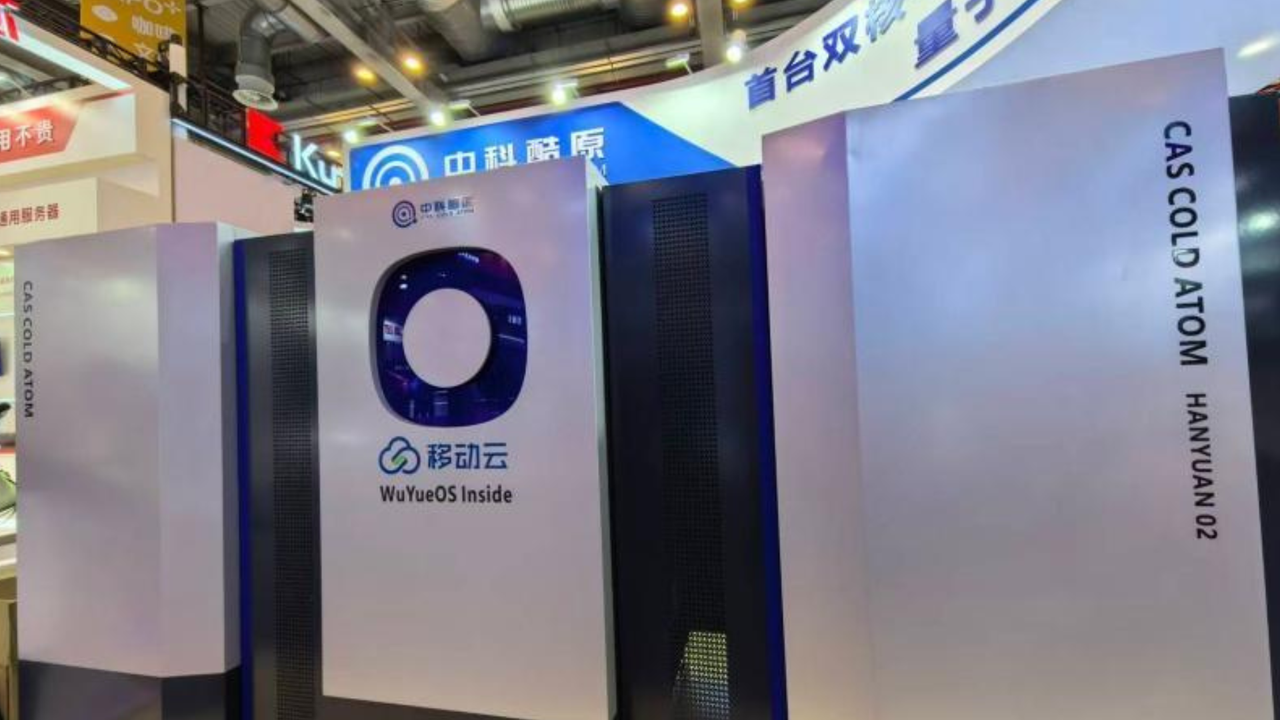
CAS Cold Atom Technology, a Wuhan-based firm affiliated with the Chinese Academy of Sciences (CAS), unveiled what it claims is the world's first dual-core quantum computer, according to a report from state-owned publication Science and Technology Daily. The system, called Hanyuan-2, pairs two independent neutral atom arrays inside a single cabinet-sized machine, totaling 200 qubits built from 100 rubidium-85 and 100 rubidium-87 atoms.
The company said the twin cores can either run in parallel to split workloads or operate in a "one main and one auxiliary" configuration, where the second array handles real-time error correction while the first executes computations. Ge Guiguo, a senior expert at CAS Cold Atom Technology, told Science and Technology Daily that the system represents the first time a quantum processor has moved from single-core to dual-core architecture.
Hanyuan-2 is built on neutral atom technology, which traps uncharged atoms using laser arrays to cool and manipulate individual neutral atoms as qubits. CAS Cold Atom Technology's general manager, Tang Biao, said the machine uses a compact, cabinet-style integrated design with a small laser cooling system, with total power consumption sitting below 7 kilowatts.
200 qubits places Hanyaun-2 well behind the West’s leading neutral atom systems. Atom Computing, for example, demonstrated a 1,180-qubit neutral atom array back in 2023 and has since partnered with Microsoft to deliver error-corrected logical qubits on commercial hardware, while QuEra has delivered error-correction-ready machines to Japan's National Institute of Information and Communications Technology and secured over $230 million in new capital through 2025.
Metrics and peer-reviewed papers lacking
Crucially, both these Western firms have published metrics like gate fidelity, coherence time, and error rate data for their systems, while CAS Cold Atom Technology has disclosed none of these metrics for Hanyuan-2. No peer-reviewed paper accompanied the announcement either, and, as is usually the case with similar announcements coming out of China, all reporting traces back to Chinese state-affiliated outlets.
The use of "dual-core" nomenclature also draws a deliberate parallel to classical multi-core CPUs, but the underlying concept is closer to modular quantum computing, an approach Western companies are already pursuing at larger scales. IBM has focused on linking superconducting processors through classical and quantum interconnect, and QuEra and Pasqal are scaling single arrays while developing inter-module connectivity. Atom Computing and Microsoft are building integrated systems designed around networked quantum processors.
CAS Cold Atom Technology's approach is more tightly integrated than a networked architecture, placing both arrays inside one machine. Whether that confers a practical advantage over scaling a single, larger array remains an open question, and one that published benchmarks would help answer.
Hanyuan-2 follows the delivery of the company's first-generation system, Hanyuan-1, though technical specifications for that machine are also limited.