Closing summary: China sends world market into a spin
China has been a major contributor to economic growth and low global inflation for more than two decades.
But tonight, investors around the globe are catching their breath after one of the worst day’s trading in many years. They’re now pondering whether today marks the start of a new and alarming phase of the crisis which began some eight years ago.
Mohamed El-Erian, former CEO of Pimco, believes today’s rout has sunk any prospect of US interest rates being raised next month. But he doesn’t believe we’re heading into a major crisis.
El-Erian told Bloomberg TV tonight:
“I’m not a buyer that this is the crisis of all crises.
Yes, this is a very unpleasant repricing, very unpleasant. And it’s going to go quite deep, but it’s not going to derail the economy in a major way.”

And while today’s losses are sizeable, they’re not among the worst losses in market history. For all the talk of Black Monday in China, and gloomy photos to match, this was more of a correction in Western markets. One to remember for years to come, though.
In a few hours, Asian markets will reopen; investors could drive a recovery, or send markets deeper into the red. We’ll have a new liveblog up and running to cover the action.
In the meantime, here’s a short summary:
-
The US stock market has suffered its biggest sell-off in four years. The Dow Jones ended the day down 588 points, having shed more than 1,000 points in early trading.
- The S&P 500 and Nasdaq are both in correction territory tonight, down 10% on their recent peaks.
- In London, almost £74bn was wiped off the value of the FTSE 100 index, in a rout led by mining giants.
- European stock markets suffered their worst days trading since 2011.
-
The selloff began in Asia 19 hours ago, where Australia’s market suffered its biggest fall since 2009 and Japan’s Nikkei slumped over 4%.
- But China was the worst hit, with the Shanghai composite index dropping 8,5% in the biggest selloff since 2007.
- These photos show how the mayhem unfolded
Thanks for reading, and for all the comments. Goodnight! GW
Updated
China market crash dominates the front pages
Today’s drama dominates the front pages of Tuesday’s UK newspapers:
Tuesday's Guardian front page: China urged to end market turmoil #tomorrowspaperstoday #bbcpapers pic.twitter.com/GzcEOjRjkm
— Nick Sutton (@suttonnick) August 24, 2015
Tuesday's Daily Telegraph: Black Monday risks a new financial crisis #tomorrowspaperstoday #bbcpapers pic.twitter.com/LIXWGeGoUI
— Nick Sutton (@suttonnick) August 24, 2015
Good work by the @Independent : combination of unrelated pic and market plunge story on front page: pic.twitter.com/ZP1sQpn7R4
— David Jones (@JonesTheMarkets) August 24, 2015
Our economics editor, Larry Elliott, argues that today’s crash isn’t just about China; it’s about fears that central banks are preparing to reduce their stimulus measures:
Financial markets in the west have been booming for the past six years at a time when the real economy has been struggling
Recovery from the last recession has been patchy and weak by historical standards, but that has not prevented a bull market in equities.
The reason for this is simple: the markets have been pumped full of stimulants in the form of quantitative easing, the money creation programmes adopted by central banks as a response to the last crisis....
More here:
Today’s selloff isn’t just about share prices.
Commodity prices have also been hit by worries over China; oil tumbled 6%, platinum is down 3.5%, and palladium suffered a 6.5% slide.
In case you missed it: Bloomberg commodity index has hit fresh 16yr low mainly driven by oil, copper and other metals pic.twitter.com/cueFXvN9pp
— Holger Zschaepitz (@Schuldensuehner) August 24, 2015
There are many reasons why world stocks slumped today, but the underlying fear is that central bankers lack the ammunition to prevent a major crash.
Here’s the Guardian’s take:
Potential disruption to the iron ore trade; the sudden exposure of the South African rand; the incompatibility of Xi Jinping’s anti-corruption drive with that Wild East entrepreneurial spirit which has powered decades of Chinese growth. Watching panic spread from Shanghai and Shenzhen to London and New York, western analysts grabbed for straws of understanding in unfamiliar fields, reflecting not only a professional need to look as if they know what’s going on, but a psychological yearning to impose order on a wild, mercurial swing in the mood. There may be no single reason why August 2015 proved the moment for the world’s investors to take collective fright about the People’s Republic. What there is however, lurking under all the anxiety, is a single question for governments everywhere. Namely, what’s left in the locker?.....
More here: Chinese flu, and the west’s empty medicine cabinet
The VIX ‘fear index’ has closed for the night too, at its highest level since October 2011.
This graph of the Dow Jones industrial average since 2010 underlines the scale of the selloff tonight:
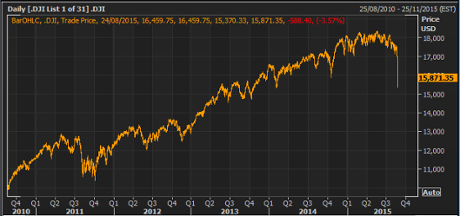
I believe the 588 point drop is the eighth-biggest one-day points decline in the Dow’s history (the 3.57% percentage decline is less dramatic, though)
Updated
US stocks suffer biggest one-day fall since 2011
It’s all over on Wall Street after a day in which stocks plunged, rallied, hovered, and then took a late dive deeper into the red.
The Dow Jones has ended the day down 588 points, or 3.5%, at 15,871. The 16,000 point mark proved a hurdle too far.
The S&P 500 lost around 3.9%, and the tech-heavy Nasdaq shed 3.8%.
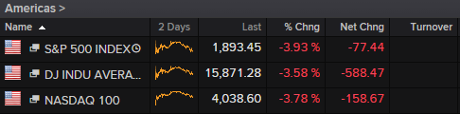
That’s the biggest one-day percentage falls for all three indices since 2011, Reuters reports.
It also means the S&P 500 and Nasdaq are both in correction territory, down more than 10% on their recent highs.
*S&P 500 DROPS 3.9%, ENTERS CORRECTION FOR FIRST TIME SINCE '11
— lemasabachthani (@lemasabachthani) August 24, 2015
Bloomberg’s Alix Steel is calling it “one of the craziest trading sessions” she’s seen in years. And we’re not arguing.
Brian Bolan, equity strategist for Zacks Investment Research, agrees too:
That was a hell of a day.
— Brian Bolan (@bbolan1) August 24, 2015
Updated
The Dow’s back below 16,000 points,a drop of around 540 points, as the final few trades flash across the markets. Can it claw its way back?.....
That awkward moment when you're invited to ring the closing bell on the worst day for stocks since 2007. pic.twitter.com/xvUwh4ZRK1
— Josh Barro (@jbarro) August 24, 2015
Updated
You could have made a lot of money by trading the Dow today. And you could also have lost a lot.
What a wild day: Panic selling and panic buying in constant rotation. pic.twitter.com/QXkzgfydQN
— Holger Zschaepitz (@Schuldensuehner) August 24, 2015
The US stock market is ending the day as it began, with some wild swings. The Dow is now down *just* 390 points (-2.2%), having been down 580 half an hour ago.
Huge volumes of US-listed shares have changed hands today, making it the busiest day of 2015.
FastFT has the details:
More than 11.6bn shares have traded hands on the New York Stock Exchange, Nasdaq and NYSE MKT by 3:30pm on Monday afternoon, the highest level of the year with roughly 30 minutes before markets close for the day.
More here:
US stock volumes set to eclipse October's 'flash crash' http://t.co/q3UoRVmyol
— fastFT (@fastFT) August 24, 2015
Dow has traveled more than 4,100 points today; nearly 5B shares have traded on NYSE with $161B trading hands in NYSE-listed securities.
— CNBC Now (@CNBCnow) August 24, 2015
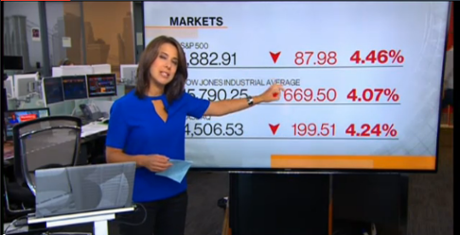
With 30 minutes to go until Wall Street closes, the Dow Jones is down 670 points or over 4%.
Better than its opening slump (1000 points down!), but rather worse than its early afternoon recovery.
Dow off 682 now
— Joseph Weisenthal (@TheStalwart) August 24, 2015
The words: "Dow Jones", "600 points" and "again" shouldn't all be used together to refer to one day's trading.
— Duncan Weldon (@DuncanWeldon) August 24, 2015
It’s been a pretty crazy day on Wall Street today, says Max Wollf, chief economist for Manhattan Venture Partners.
Despite the Dow’s wobbles, Wollf reckons this isn’t a rerun of 2008, but investors must stop treating risky assets as risk-free.
You can watch the interview here:
US market falling back in late trading
Wall Street has entered its final hour of trading, after a turbulent day. And markets appear to losing ground again.
The Dow Jones industrial average is currently down 3.6%, a drop of 580 points to 15,872, erasing some of its earlier recovery.
The Nasdaq is down by 3.7%, while the S&P 500 -- the broadest US index - has lost 4.2% at pixel time.
New York traders are feeling the jitters again; perhaps worrying about Tuesday’s Asian market open....
Apple boss sees 'strong growth' in China

It has been a topsy-turvy day on US markets and few companies have experienced the ups and downs as much as Apple.
The smartphone maker saw its share price slide by 13% on US stock markets, before springing back into positive territory.
Apple CEO Tim Cook took the unusual step of commenting on the help of Apple’s business halfway through a financial quarter, via CNBC.
I get updates on our performance in China every day, including this morning, and I can tell you that we have continued to experience strong growth for our business in China through July and August. Growth in iPhone activations has actually accelerated over the past few weeks, and we have had the best performance of the year for the App Store in China during the last 2 weeks.
Obviously I can’t predict the future, but our performance so far this quarter is reassuring. Additionally, I continue to believe that China represents an unprecedented opportunity over the long term.
Apple shares are now 0.7% down on market opening, while the Dow Jones has slipped 3.4%.
If everyone knew the Chinese economy was slowing down, why are markets falling so much.
It’s worth remembering that many traders are at the beach or the golf course, meaning that market moves are amplified at a time when fewer people are involved.
Demetrios Efstathiou at Standard Bank says the sell off has been been amplified by a number of factors, none of which relate to China.
We start with the August holiday season that finds many risk takers on holidays, followed by the breaching of technical support levels, then the strong presence of computer algorithms trading in such illiquid times.
Over on Wall St, market watchers are calling the sharp early decline on New York stock markets as “more shakeout” than cut and run by investors.
Jason Ware, chief investment officer at Albion Financial Group in Utah, blamed early losses on “indiscriminate selling” - automatic trading, rather than a considered decision to get out of the market.
We are unlikely to be going into a bear market .
There are a number of positive things happening under the surface of all this chaos and it is easy to forget those things when you see these types of moves.
Quotes via Reuters
Merkel puts faith in Chinese authorities
The German chancellor Angela Merkel has sought to offer reassurance to panicky investors, after the country’s main stock index crashed into bear-market territory.
Speaking at a press conference with French president François Hollande, she said:
China will do everything it can to stabilise the economic situation.
She also referred to the fact the International Monetary Fund sees the sell-off in China as an “adjustment”, not a crisis. A senior IMF officials said at the weekend “it was totally premature” to speak of a crisis in China.
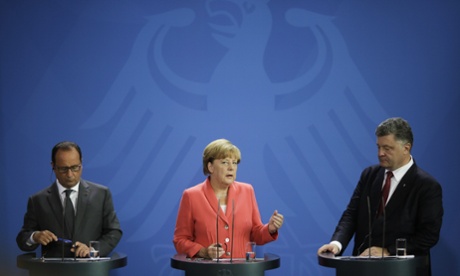
President Hollande also put in his words of reassurance.
[China] will find responses within itself and the world economy is sufficiently solid to have growth perspectives that are not solely linked to the situation in China
The third person in the picture is Ukraine’s president Petro Poroshenko, who was meeting the French and German leaders in Berlin. While the stock markets in Europe and Asia fall into panic mode, the ceasefire in Ukraine is falling apart.
I think US investors are recognising that all is not well in the world
A US analyst explains what is happening on US markets.
Updated
The White House has reason to be sounding confident.
The three major US stock indices are all down by less than 2%, not such a bad performance compared to the market panic in Europe and Asia.
- The Dow Jones is the biggest faller, down 1.93% at 16, 140 points
- The Nasdaq is down 1.8% at 4,621 points
- The S&P 500 index is off 1.49% at 1,941 points
Updated
US economy 'far stronger now' than 2008, says White House
The White House has played down fears that volatility in international stock markets, particularly in China, will have any significant knock-on impact on the US economy, writes the Guardian’s Washington correspondent Paul Lewis.
“There is no doubt the global economy is more interconnected that it ever has been,” Josh Earnest, the president’s chief spokesperson, told reporters on Monday.
What I would encourage people to evaluate is the ongoing strength and resilience of the US economy.
Earnest said the US was experiencing the longest period of sustained private sector job increases in American history, with unemployment is at the lowest level in seven years. “The US economy is far stronger now than it was in 2008,” he said.
Earnest added that Wall Street reforms ushered in since the financial crisis mean that major US financial institutions have added more than $600bn in capital since 2009.
That means banks are less reliant on unstable short-term funding, and that they are better able to withstand short-term volatility in the financial markets.
Updated
Market panic was too much to measure on US markets today.
The Chicago Board Options Exchange Volatility Index - a gauge of market turbulence - failed to update for 30 minutes after trading started, according to data seen by Blooomberg.
Here are more details, courtesy of Bloomberg:
The gauge reflects the cost of options on the Standard & Poor’s 500 Index that are used, among other things, to protect against losses in shares, so its level is viewed to gauge how cautious investors are toward equities.
Today, they started out very cautious. The Standard & Poor’s 500 Index plunged more than 5% in the first minutes of trading as a global rout in risk assets circled the globe for a third day...
More here
Worst day for European markets since 2008
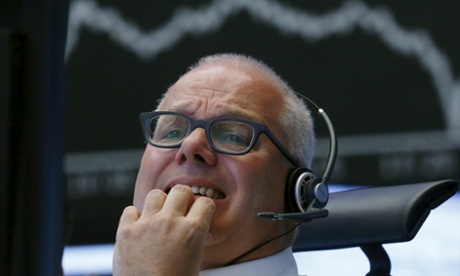
Market watchers have also been counting the cost of losses across Europe.
The pan-European FTSE Eurofirst 300 has lost €450bn (£286bn) today, its worst performance since November 2008, as it ended the day 5.4% lower.
This brings total losses since the start of the month to €1 trillion.
A painful, but perhaps necessary, return of common sense. This is the verdict of London-based market analysts Baker Tilly on the Chinese stock market rout.
Rob Donaldson, head of M&A and private equity at Baker Tilly Corporate Finance, said:
Over the last few years, tens of millions of individual investors in China - who vastly outweigh institutional investors (80/20 versus the other way around in the developed markets) - have been encouraged by the State apparatus to plough their money into shares. This has pushed prices up far beyond their fundamental value and what we are now seeing is a painful, but perhaps necessary, return of common sense.
What is perhaps more surprising is the degree of knock-on effects to share prices on the FTSE and across European markets, but we should perhaps be wary of undue panic. Fundamentally, the Chinese economy was always going to slow...
One likely outcome could be that Chinese investors are even more likely to be looking for tasty investments outside China. Chinese firms have already been snapping up western brands, from breakfast cereals to super yachts as well as splashing cash on big infrastructure projects.
Donaldson says:
As capital flight continues and hot money heads for the exit, a possible side effect is that investors will now be more likely than ever to look to make their money work for them elsewhere – including in the UK.

The FTSE Group has confirmed that £73.9bn was wiped off the FTSE 100 today, as the London stock market suffered its biggest tumble in over six years.
A further £13bn was wiped off the FTSE 250 index of smaller companies, showing the extend of the rout (my colleague Graham Ruddick reports)
Updated
FTSE 100 closed at 5,898, which is down 288.78 points on Friday’s close. In terms of GBP lost, this equates to £73.88 billion.
— Damian Clarkson (@JournoDamo) August 24, 2015
Biggest crash since 2009 "wipes £74bn off FTSE 100"
Around £74bn has been wiped off the value of the FTSE 100 by today’s selloff, according to Sky’s financial analyst, Guy Harding.
Nearly £74bn was wiped off the value of the FTSE 100 as the UK had its biggest one day fall since March '09. #FTSE100 pic.twitter.com/o9SfLhx6DC
— Guy Harding (@GuyHardingSky) August 24, 2015
The 4.6% slump on the blue-chip index today looks to be the biggest one-day fall since March 2009.
The FTSE 100 Index has closed down 4.67% suffering its biggest daily drop since March 2009
— Sky News Newsdesk (@SkyNewsBreak) August 24, 2015
And it means that the FTSE 100 has just posted its longest losing streak since 2003.
Laith Khalaf, Senior Analyst, Hargreaves Lansdown, explains:
“The summer slump continued into its third week as global stock markets sold off once again. Here in the UK the Footsie has been decimated in ten days, as fears over global growth have gripped international investors.
China and commodities are still dominating proceedings, with oil and mining companies once again bearing the brunt of poor sentiment, though the banks aren’t far behind.
It was just five months ago investors cheered as the Footsie broke through the 7,000 mark for the first time; it now looks like a very long climb back.”
FTSE 100 tumbles 4.67%
Britain’s FTSE 100 has plunged to its lowest level since the start of 2013, after the worst day’s trading in several years.
The FTSE 100 finished the day down 288 points, or 4.67%, at 5898, as China’s market crash rippled through the markets.
By my reckoning, that means more than £70bn has been wiped off the index -- we’re trying to get that confirmed now.
That’s 17% off its recent record high, meaning the Footsie is close to a bear market (a 20% decline).
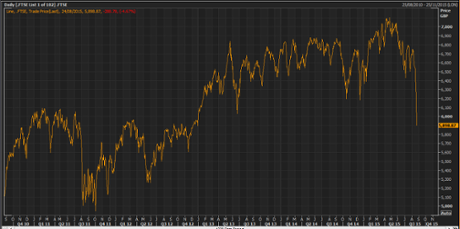
Mining shares plummeted through the day, as fears grew that China’s economy is in trouble.
Commodity trader Glencore slumped 13% to a new record low, while Anglo American and BHP Billiton lost over 9%.
Glencore finishes down 13%, worst performer in FTSE100. Anglo drops 9.9% and BHP 9.2%. FTSE miners index at 6-yr low pic.twitter.com/lJ3IiLEmBz
— Jesse Riseborough (@JP_Riseborough) August 24, 2015
It’s the 24th biggest percentage drop since the blue-chip index was created in the deregulation of the City in 1984, according to RBS:
Well that was quite a ride. FTSE 100 closes -4.67% down today. Puts it in the top 24 biggest daily falls since 1984. pic.twitter.com/a705VOSw9N
— RBS Economics (@RBS_Economics) August 24, 2015
Updated
This is the worst day’s trading for many of European stock markets since 2011.
And the pan-Europan Stoxx 600 had its worse day since the end of 2008, according to Marketwatch.
German and French stocks suffer worst day since 2011 http://t.co/NNKeSKFmI0
— MarketWatch (@MarketWatch) August 24, 2015
Updated
It was a day to forget for Frankfurt traders.
*GERMANY'S DAX CLOSES DOWN 22% FROM RECORD, ENTERS BEAR MARKET
— lemasabachthani (@lemasabachthani) August 24, 2015
That’s it! European stock market have closed, with heavy losses across the board.
The pan-European FTSeurofirst300 has provisionally closed down 5.4%, which is its lowest level this year.
That includes a 5% tumble on the German DAX, while France’s CAC shed 5.6% and Spain’s IBEX lost 5.7%.
The FTSE 100 index was down over 4.5% as trading ended, a very heavy selloff. More on that in a moment....
Updated
Here’s a reason to worry. The VIX index, commonly known as the Fear Index, hit its highest level since January 2009 earlier today.
VIX surged by 67% today to 53 - a level not seen since the aftermath of the Lehman Brothers’ collapse. It then dipped back to 37.4, below the level when the US lost its AAA credit rating in 2011 (updated).
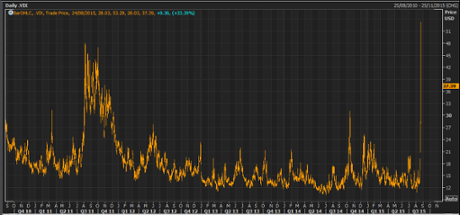
The VIX tracks the prices of options on the S&P 500, which are often used to hedge against potential losses. So a jump in the VIX shows that investors are getting scared.....
Updated
Cheer up, readers in the City. Europe’s stock markets close in just 20 minutes, and then you can have a well-earned rest (and perhaps a small sherry).
Savers shouldn’t be too alarmed by today’s market selloff, argues Nick Dixon, Investment Director at Aegon UK (the life insurance and pension firm).
His advice is to sit tight, and ride the volatility (even if you can’t actually enjoy the journey):
“If pension savers don’t need to access their fund for many years, they needn’t be alarmed by short term volatility. Stock markets are in for a bumpy ride over the coming weeks, but if savers can stomach the ups and downs, equities are likely to provide superior returns over the medium and long term.
With a FTSE-100 dividend yield of circa 4%, equities should deliver good value for savers with a five year plus investment horizon. Undoubtedly, there will be volatility along the way, but this shouldn’t faze individuals with a long term investment strategy.”
Larry Summers: This could be very serious
Markets may not pay much attention to Donald Trump’s views on the selloff, but Larry Summers is another matter entirely.
Summers, the former US Treasury secretary, has suggested that the Federal Reserve could be forced to ease monetary policy, rather than hiking interest rates in the next few months.
It is far from clear that the next Fed move will be a tightening.
— Lawrence H. Summers (@LHSummers) August 24, 2015
As in August 1997, 1998, 2007 and 2008 we could be in the early stage of a very serious situation.
— Lawrence H. Summers (@LHSummers) August 24, 2015
Summers has spent the last few years warning that developed economies are stuck in ‘secular stagnation’, requiring more vigorous government action (ie: spending) to lift us out of the mire.
Many policymakers have disagreed; we may soon find out who was right....
Photos: Global stock markets routed
Here’s the scene on the New York stock exchange today, as the Dow Jones industrial average plunged 1,000 points at the start of trading before rebounding (a little)


Across the globe, traders have been gripped by the selloff since Asian markets opened around 15 hours ago, as these photos show:


And here’s where it all began, in China, with the Shanghai stock market suffering its biggest fall since 2007.

Updated
Global markets deep in the red
World stock markets are not a pretty picture right now, even as the Dow Jones claws its way back from its worst losses.
The FTSE 100 is still down 5%, and on track to hit its lowest level since December 2012. That would wipe around £80bn off the value of the index, I reckon.
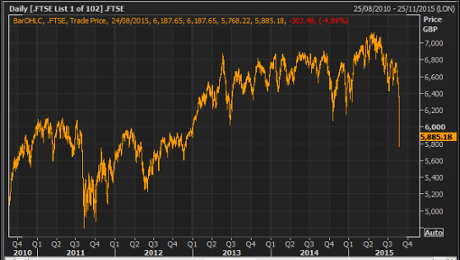
And across Europe, the main indices have been hit just as hard. More than €500bn has been wiped off the FTSeurofirst 300 index, with just over an hour’s trading to go.
Here’s the situation right now:
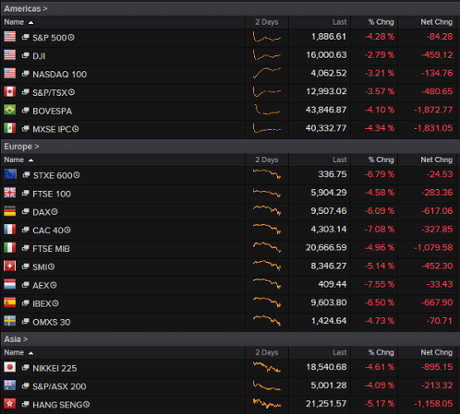

Our Wall Street correspondent, Rupert Neate, reports:
US stock markets collapsed on Monday continuing a global stock market rout that has wiped hundreds of billions of dollars off shares across the world.
The Dow Jones Industrial Average dropped by 6.4%, the S&P 500 dropped 4%, and the Nasdaq lost 8.5% raising fears that a fresh tech bubble has burst. The drops followed already-heavy falls last week.
Technology stocks were the hardest hit with Facebook losing 14% at one point and Apple off 11%.....
More here:
Mark Luschini, chief investment strategist at Janney Montgomery Scott in Philadelphia, fears that US stocks will keep falling until policymakers get a grip on the situation.
Luschini says (via Reuters):
“Until we have some sign that China and the emerging markets aren’t being sucked into some vortex from which they can’t recover ... it is unlikely this selloff will stem.”
US presidential hopeful Donald Trump claims he’s the man to get the financial markets into better shape:
Markets are crashing - all caused by poor planning and allowing China and Asia to dictate the agenda. This could get very messy! Vote Trump.
— Donald J. Trump (@realDonaldTrump) August 24, 2015
British journalist Paul Mason puts the blame elsewhere:
Markets slump as world realises main growth engine in hands of incompetent, secretive police state that thinks it can dictate equity prices
— Paul Mason (@paulmasonnews) August 24, 2015
Updated
European stock markets slumped by 7.8% as traders watched the Dow Jones index shed 1,000 points in early trading (and who can blame them?).
They’re now clawing back some losses, but are still on track for their biggest losses since the early days of the financial crisis.
In the last 15 mins, #FTSE +150pts, #DAX +200pts and #Dow +500pts #crazy
— Joshua Raymond (@Josh_RaymondUK) August 24, 2015
The Dow Jones index is now below 16,000 for the first time since February 2014.
It’s now 14% below its record peak, putting the Dow firmly into correction territory.
Updated
After plunging 1000 points (!) at the start of trading, America Dow Jones index appears to be stabilising. But it’s very early days.
Fifteen minutes into trading, the Dow is currently down 632 points at 15831. That’s a 3.8% slump, adding to the heavy losses we’ve already seen in Europe and Asia over the last 12 hours.
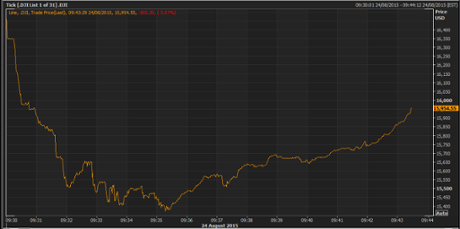
-> Another history making day Dow's largest drop in a day since 2008 Down as much as 6.5% , more than 1000 pts
— Fercan Yalinkilic (@FercanY) August 24, 2015
That is the biggest opening fall on Wall Street that I can remember since the dramatic days after Lehman Brothers, when the world’s financial market was really creaking.
Dow Jones falls 1,000 points
Amazing scenes in New York - the Dow Jones industrial average briefly fell by over 1000 points, or over 6%, in frenzied early trading.
More US stocks are being hit by the selloff triggered by China’s slump overnight.
1000 punten van Dow af. Dit is wat op de beurs een bloedbad wordt genoemd pic.twitter.com/InXiQrg5yD
— Gerben van der Marel (@VanderMarelNYC) August 24, 2015
The market may calm down a little in a few minutes.... But right now, it’s a serious rout and Europe is being hit by the backwash.
The S&P 500 index has fallen into correction territory -- down over 4%.
* S&P 500 down more than 10 pct from may 20 record high, confirming S&P 500 in correction territory - RTRS
— Fabrizio Goria (@FGoria) August 24, 2015
Dow Jones index tumbles as Wall Street opens
The Dow Jones index has fallen 485 points at the open of trading in New York.... make that 502 points....
....it’s still falling, now down over 900 points, or more than 5%.
Now it’s down 950 points!
Dow now down 950 points.
— M. Caruso-Cabrera (@MCaruso_Cabrera) August 24, 2015
And the Nasdaq index had plunged by 8.3%.....
It’s going to take a few minutes to get a clear picture....
DING DING DING. That’s the sound of the Wall Street opening bell being rung. Now for the selloff......
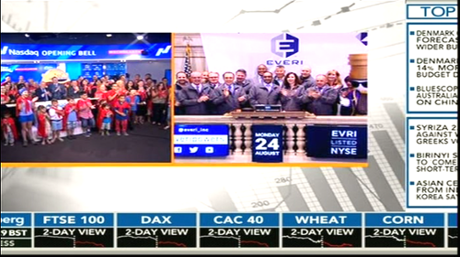
Brace yourselves. Here comes the opening of Wall Street, with shares expected to tumble sharply.....
Wall Street authorities have invoked a rarely-used regulation called Rule 48, in an effort to speed up and smooth trading when trading begins in a few minutes.
The rule allows NYSE to open stocks without indications. “It was set up for situations like this,” said Art Hogan, chief market strategist at Wunderich Securities. It was last used in the financial crisis.
Here’s a good explanation of why markets are tanking today, from Thomas Thygesen, SEB’s head of cross-asset strategy, (via Bloomberg)
“GDP growth in the U.S. and euro zone economies just isn’t strong enough to prevent a global disinflationary shock from accumulating.”
“People have realized there could be further weakness in the Chinese currency. They don’t seem in control of the situation and we could see feedback loops that haunt the U.S.”
Dow and S&P 500 futures both hit daily limit-down http://t.co/skNkUh3mYL pic.twitter.com/er4FSJpTQU
— Bloomberg Markets (@markets) August 24, 2015
European stocks hit new lows
European markets are wobbling as we approach the opening of Wall Street.
The FTSE 100 index of blue-chip shares is now down by 5.5%, or 343 points, at 5844.
And the FTSeurofirst 300 index has fallen by 6.2%, on track for its worst one-day decline since 2008.
All main European benchmarks down over 5%
— Michael Hewson (@mhewson_CMC) August 24, 2015
Why? Because the Dow Jones industrial average is expected to suffer a very serious selloff - around 800 points, or over 5%.
BREAKING: DOW FUTURES FALL MORE THAN 800 POINTS http://t.co/84bqqVtnd0
— CNBC Now (@CNBCnow) August 24, 2015
A former adviser to Gordon Brown, UK prime minister during the 2007-08 crisis, reckons the Chinese stock market crash means catastrophic times are ahead.
Damian McBride warned that the next financial crisis will be worse than seven years ago, and urged followers to take action now.
Here’s his alarming (alarmist?) tweets:
Advice on the looming crash, No.1: get hard cash in a safe place now; don't assume banks & cashpoints will be open, or bank cards will work.
— Damian McBride (@DPMcBride) August 24, 2015
Crash advice No.2: do you have enough bottled water, tinned goods & other essentials at home to live a month indoors? If not, get shopping.
— Damian McBride (@DPMcBride) August 24, 2015
Crash advice No.3: agree a rally point with your loved ones in case transport and communication gets cut off; somewhere you can all head to.
— Damian McBride (@DPMcBride) August 24, 2015
Simply this, @AndrewzCooper - we were close enough in 2008 (if the bank bailout hadn't worked), and what's coming is on 20 times that scale.
— Damian McBride (@DPMcBride) August 24, 2015
For the record, I don’t think the global market selloff means the economic system is about to totally seize up. It’s certainly serious, and we don’t know the ramifications for some time. But I suspect policymakers will avoid a complete meltdown.
Feel free to quote that back at me in a few months, though, if I find myself life-blogging the collapse of the banking sector.....
Dear @DPMcBride, I will exchange your electronic money for tinned food and hats. Very good price. DM me. https://t.co/2Ud10zibcQ
— James vS (@James_v_S) August 24, 2015
US stock market authorities have been forced to suspend the futures market on the Nasdaq index.
Panicking traders have driven it down 5% - the maximum allowed under Wall Street rules before a circuit-breaker is triggered.
Have you tried switching it off and on again. RT @IGSquawk: Nasdaq100 Futures hit limit down, -5%.
— David Jones (@JonesTheMarkets) August 24, 2015
Limit down on Nasdaq. Can someone just close the stock markets?
— Brenda Kelly (@Brenda_Kelly) August 24, 2015
Updated
Here’s our updated news story on today’s market mayhem:
George Osborne: Europe can ride out China volatility

George Osborne, the UK’s Chancellor of the Exchequer, has warned that China’s stock market volatility is a “real concern”.
Speaking during a trip to Sweden, Osborne also predicted that Europe would not suffer ‘immediate’ problems from China, despite the heavy losses across global markets today.
Over to Reuters for the story:
British finance minister George Osborne said on Monday he did not expect the slump in Chinese share prices, which has hit financial markets around the world, to pose a threat to Europe’s economy.
“I am reasonably confident, although I don’t think that we can be unaffected by what happens in China, I don’t think it’s going to cause immediate sharp problems in Europe,” Osborne said in response to a question from a reporter during a visit to Sweden.
While the volatility in China’s market was “a cause of real concern,” the main issue was the underlying growth of the country’s economy and officials in Beijing were focused on reforms to ensure consumption-led growth, he said. [end]
-----
Osborne is touring the Nordic area, discussing issues including Britain’s relationship with the rest of the EU. Yesterday he met with Finland’s finance minister Alex Stubb:

It’s a fast-moving situation, but the FTSE 100 currently is on track to lose roughly £70bn of value today, if it closes down around 4.5%.
#BlackMonday 1pm: FTSE 100 down 4.4%, £71bn wiped off it's value in 5 hrs #ftse #ChinaMeltdown pic.twitter.com/bHpGSHr11r
— Tara Cunningham (@TaraSCunningham) August 24, 2015
Wall Street is going to be, err, rather lively when trading begins, given the latest forecasts from the futures markets:
US INDEX prices pre-equities open: #DOW 15850 -3.75% #SPX 1908.5 -3.1% #NASDAQ 3993 -4.9%
— IGSquawk (@IGSquawk) August 24, 2015
Shangai Composite - 8.5% Nikkei - 4.6% Euro Stoxx -5% Dow Jones Futures - 667 points Welcome back from holidays!
— Maxime Sbaihi (@MxSba) August 24, 2015
European stocks face biggest fall since 2009
It gets worse and worse....
More than €400bn has been wiped off the value of Europe’s three hundred largest companies today, according to Reuters data, as the selloff continues.
The FTSeurofirst300 index has now plunged by 4.5%, as stock markets in London, Paris, Frankfurt and beyond suffer heavy selling.
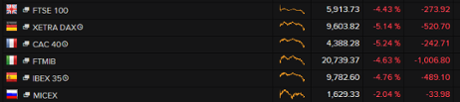
FTSeurofirst300 is now on track for its biggest one-day decline since March 2009, Reuters says.
The Stoxx 600 index, which includes smaller European firms, is taking even more of a pounding.
This selloff won't end - Stoxx 600 now down more than 5% and on track for worst day since 2008!
— Sara Sjölin (@sarasjolin) August 24, 2015
This is triggered by alarming signals from Wall Street, where the Dow Jones index is now forecast to plunge by 4% as fears over China’s crash ripple through global markets.
* U.S. Dow Jones futures down more than 4 percent - RTRS
— Fabrizio Goria (@FGoria) August 24, 2015
This is turning into a major selloff -- the FTSE 100 is now down a whopping 275 points, or almost 4.5%, at 5914 points.
FTSE 100 hits new lows, now down 3.5%
The rout is deepening.
The FTSE 100 just fell below the 6000 point-mark again, as traders react to predictions of a heavy selloff on Wall Street.
The blue-chip index is now down over 220 points or 3.5% at 5964 points, its lowest level since January 2013.
If it finishes there, then more than £50bn would have been wiped off the collective value of the 100 companies on the index (we’ll get the official verdict after 4.30pm BST, when the market closes).
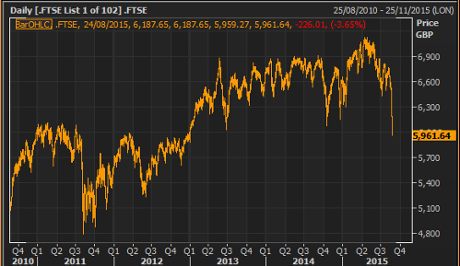
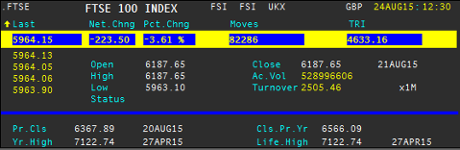
Anyone exposed to the resources sector has taken heavy losses. Commodity trader Glencore is down 6.7%, while mining giants Anglo American (-6.6%) and BHP Billiton (6.2%) are also leading the fallers.
Updated
Here we go, stock futures picking up losses as bleary-eyed New York wakes up. S&P 500 off 2.2%, DJIA down 2.5%, Nasdaq futures off 3.7%.
— Barbara Kollmeyer (@bkollmeyer) August 24, 2015
Update: Traders are now calling the Dow Jones index down more than 400 points - a very chunky selloff, after China’s market tumbled by 8.5% earlier today.
BREAKING: Dow Futures plunging 400+ points; S&P and Nasdaq Futures also steeply lower. http://t.co/84bqqVtnd0 pic.twitter.com/tmhVXcUh8J
— CNBC Now (@CNBCnow) August 24, 2015
At its heart, today’s market panic shows that investors are losing faith in central banks’ ability to keep the show on the road.
So argues Jasper Lawler of CMC Markets, who writes:
The People’s Bank of China has spectacularly failed to stimulate the Chinese economy, Europe’s whole recovery is based on a lower euro which was just undermined by the yuan devaluation and the US is experiencing its slowest post-recession recovery on record, despite huge stimulus.
Those stimulus measures involved ultra-low interest rates and massive bond-buying through quantitative easing.
That drove many world stock markets to record highs in recent years, but didn’t resolve the underlying problems in the global economy.
Updated
Summary: Europe follows Asia's lead, sharply downwards
Time for a recap, for anyone just tuning in on this dramatic day.
European stock markets have posted heavy falls this morning, after China’s stock market suffered its biggest plunge since the start of the financial crisis.
In London, the FTSE 100 fell as low as 5995 points this morning, the first time it’s been below 6000 since the first trading day of 2013.
The Footsie is currently down 2.7%, or 169 points, at 6018, wiping more than £40bn off its value. Mining companies are worst hit, with many losing more than 5%.
Other European stock markets are also in retreat, with Germany’s DAX entering a bear market this morning.

And Wall Street is expected to follow suit in three hours (at 9.30am local time, not 8.30am as I wrote earlier, sorry)
Earlier, China’s stock market plunged 8.5% in another wave of selling, as concern grows that the country’s economy is weakening. Local media swiftly dubbed it “Black Monday”.
One fund manager called it a “disaster”, which could drive many firms under.
The scale of the crash, though, is raising fears that Beijing is losing its grip on the crisis -- which Bloomberg says has wiped $5 trillion from global markets this month.
Asian markets were left reeling by the selloff in Shanghai, as they were dragged downwards in a wave of selling.
-
Japan’s Nikkei tumbled by 4.6%, it’s biggest one-day decline since June 2013
-
Australia was worse hit - suffering its biggest one-day fall in six years.
- and Hong Kong’s market tumbled over 5%.
China’s slowdown, the fall in commodity prices, and uncertainty over when the US Federal Reserve might raise US interest rates are all fuelling the selloff, according to Société Générale’s Kit Juckes.
The oil price was hit too, hitting its lowest level since early 2009. US crude is now changing hands at just $38.85 per barrel, down 4% today.
Brent crude is down 3.8%, at $43.70 per barrel.
Updated
It’s shaping up to be a rough day on Wall Street.
The Dow Jones index is predicted to shed 300 points, or 1.8%, when the New York stock market opens at 2.30pm BST ( 8.30am 9.30am on the east coast).
That follows a nasty selloff on Friday, in which the Dow tumbled by 530 points.
Wall Street prepped for another meltdown as Dow futures crash in excess of 300 points http://t.co/qw140Ecx8n pic.twitter.com/z2n4jXcYTc
— CNBCWorld (@CNBCWorld) August 24, 2015
Updated
August is often a cruel month for investors, but this year has been particularly grim.
According to Reuters, it’s on track to be the worst month since the height of the crisis.
Over $1 trillion wiped off top European shares in August. FTSEuroFirst -12%, eyes worst month since Oct 2008. HT @asmo17 @LLaurentReuters
— Jamie McGeever (@ReutersJamie) August 24, 2015
More than £40bn wiped off FTSE 100 so far today

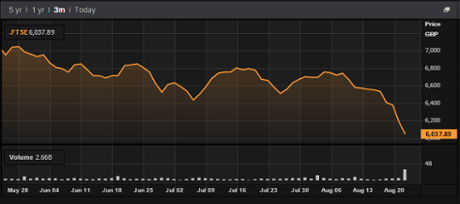
This morning’s selloff has wiped more than £40bn off the value of Britain’s blue-chip stock index since trading began less than three hours ago.
The FTSE 100 is currently down 145 points, a slump of 2.4%, with mining stocks continuing to be hit hardest. Glencore, Anglo American and BHP Billiton are all still down at least 5% [see earlier chart for more details].
That’s on top of the £46bn fall suffered on Friday, helping to send Europe’s stocks down €230bn today alone.
The 15% decline in the FTSE 100 since April is obviously a blow to pensions funds, asset managers and speculators. But this selloff is also hitting small investors, perhaps those with an ISA, or even a Child Trust Fund exposed to the stock market.
Chris Towner, director of FX advisory services at foreign currency firm HiFX, says China’s Black Monday is spreading alarm worldwide:
“Risk aversion is back in the financial markets.
A combination of threats of tightening monetary policy in the US and UK with China slowing has created nervousness and this nervousness is now spreading to panic.”
Updated
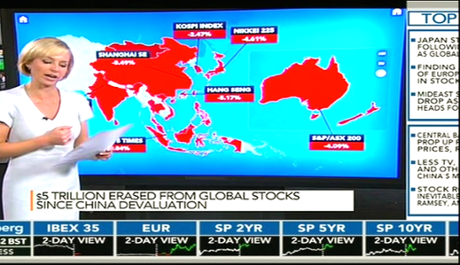
Here’s a remarkable fact - more than $5 trillion has been wiped off the value of global stock markets since Beijing devalued the yuan a fortnight ago.
The yuan devaluation was the trigger for the current market mayhem, as it fuelled fears that China’s economy was in worse shape than authorities admitted.
Updated
ING: Chinese central bank must act soon
Analysts at ING believe the Chinese central bank will soon be forced to take new steps to shore up confidence, after seeing the Shanghai stock market plunge 8.5% today.
While today’s market rout is obviously alarming, the big fear among policymakers is that capital is flowing out of China as its economy deteriorates. This would trigger a damaging liquidity shortage in the country’s financial sector.
The People’s Bank of China took action last week to address this issue, and ING predicts it will soon slash lending requirements.
They write:
We infer from last week’s double-barrel PBOC liquidity injection that capital outflows are big and may persist.
There is nothing on the horizon but another round of the PBOC easing that could stem capital outflows.
We believe a 50-100bp RRR cut is imminent.
China’s RRR, or reserve requirement ratio, limits how much money banks are forced to hold onto rather then lending it on. So lowering the RRR would effectively pump more money into the economy.

Around €230bn has been wiped off the value of Europe’s 300 largest companies this morning, calculates Tara Cunningham of the Daily Telegraph.
Mayhem in them European markets this morning, as €230bn has been wiped off the pan-European FTSEurofirst 300 pic.twitter.com/CNyh3IaZiv
— Tara Cunningham (@TaraSCunningham) August 24, 2015
The market turbulence is likely to make it impossible for the US Federal Reserve to raise interest rates this month, predicts Simon Smith, chief economist at FXPro.
He says:
The prospects of an increase in rates from the Fed in September look very slim indeed at this point in time.
Uncertainty over the Fed’s next move has been a contributing factor to the recent falls in global stock markets.
The FTSE 100 has now lost 15% since hitting a record high of 7104 points in April.
Another 5% and it will be a Bear Market:
Another 300pt+ fall in the #FTSE from today's low and we would be in a #BearMarket. #Greatfallofchina
— Joshua Raymond (@Josh_RaymondUK) August 24, 2015

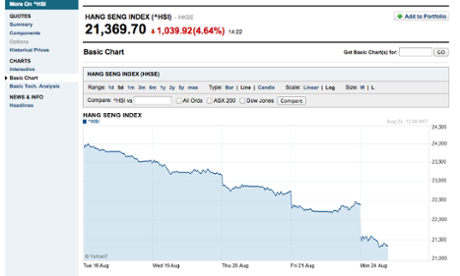
Over in Hong Kong, the Hang Seng Index has just closed down 5.2% at 21,251.57 points, its lowest point since March 2014.
That’s the Hang Seng’s seventh daily fall in a row, reflecting market worries over China’s slowing economy....and Beijing’s ability to handle it.

Alarm over the global economy has driven the oil price down to its lowest level since the global recession began.
A barrel of US crude oil now costs just $39.33 per barrel, the cheapest since early 2009.
Yann Quelenn, market analyst at Swissquote, reckons oil has further to fall:
We consider that the decline in the oil prices will continue. Fears of oversupply cause plunge of oil to continue.
Updated
Beijing's credibility hit by market mayhem

Fraser Howie, the co-author of Red Capitalism: The Fragile Financial Foundation of China’s Extraordinary Rise, said Beijing’s handling of the stock market calamity raised real questions about the leadership of president Xi Jinping and prime minister Li Keqiang.
Our colleague Tom Phillips reports:
“I think there is now growing realisation – domestically and offshore - that the Chinese leadership are not in control of the situation. Not only are they not in control of it, they don’t even seem to grasp the problems at times,” Howie said.
“The real casualty over the summer is the government’s credibility. When you look at the stock market intervention, when you look at the FX botch as I would call it a couple of weeks ago, and then you look at the Tianjin blasts, you see a government that is most certainly not in control. You look at this and it sends a very poor picture about China’s competency at the leadership level. Who else is responsible here? Xi Jinping seems invisible.”
“There are no short term fixes for what China is going through,” Howie added.
“This is ultimately a painful unwinding of imbalances and leverage in the system and those processes are always tough and sore. It’s a bit like saying what’s a quick solution to my hangover?
And that is exactly where China is at the moment. There are no quick solutions.”

The “fog of fear” over the state of the Chinese economy is thickening over European stock markets, warns Connor Campbell of City firm Spreadex.
Here’s a flavour of his morning research note.
The Shanghai Composite, the continual epicentre of the markets’ recent woes, fell by over 8.5% this morning, setting off a chain of losses that included the biggest one-day sell off in over 2 years for the Nikkei and over 6 years for the Australian Securities Exchange.
The People’s Bank of China remains in ‘see what sticks’ mode, and so far nothing has been able to provide an adequate tourniquet for the market-wide bloodshed that has only intensified this Monday. The latest move by the PBOC saw the central bank announce that local government-managed pension funds will be able to invest in the markets for the first time, in an attempt to pour billions of yuan into an equity market that is currently drowning in losses.
However this move only inspired panic not peace, and the fervent selling, with investors fleeing in droves, infected the Western indices from the moment the bell rang....
Morning Market Comment: The Shanghai Composite, the continual epicentre of the markets’ recent woes, fel... http://t.co/epHb6cpMF9
— Spreadex (@spreadexfins) August 24, 2015
Stock markets are gripped by a “deep funk”, says Kit Juckes of French bank Société Générale.
Kit identifies three key factors behind today’s rout:
- further economic weakness in China,
- further pain in global commodity markets
- Uncertainty over how the central banks - US Federal Reserve and the People’s Bank of China - will react.
Commodity prices have hit their lowest levels in 16 years, thanks to the Chinese slowdown. And that is making traders very worried, as Kit explains:
The divergence between global commodity prices and equities is not a new theme but the danger now is that they begin to re-correlate - as they did when the dotcom bubble burst in 2000 and what had previously been an emerging market crisis became a US recession.
And @kitjuckes defines markets today like no other: 'deep funk'
— Francine Lacqua (@flacqua) August 24, 2015
Mining companies hit by China panic

Shares in mining companies are being hammered this morning, taking the brunt of this morning’s selloff in the City.
Anglo America, which produces iron ore, copper, manganese, nickel and coal, has slumped by 6%.
Glencore, the commodity trading giant, is close behind, along with silver producer Fresnillo and then BHP Billiton.
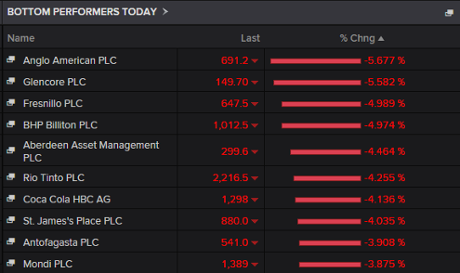
The mining sector is clearly exposed to China’s slowing economy. But today’s sell-off has spread much wider -- every company on the FTSE 100 has fallen this morning.
Tony Cross, market analyst of Trustnet, says:
Any hopes that the last week of August would pass off in unremarkable fashion for equity traders has been dashed as the London market opened for business....
Panic is genuinely gripping the mining stocks which collectively have dumped £5bn of value already this morning.
Chinese market suffers biggest fall since 2007
Investors in Beijing can finally take a breather after the worst day’s trading since the start of the global financial crisis eight years ago.
After a dramatic day’s trading, the Shanghai Composite index has just closed down a jaw-dropping 8.5%, at 3209 points.
That’s its biggest one-day slump since 2007, explaining why Chinese media were quick to dub today Black Monday.
The Shanghai stock market has now lost all its gains this year. Umpteen stocks were suspended today after falling 10% - the maximum allowed under Beijing’s rules.
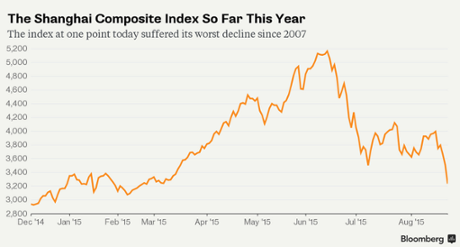
And there could be worse days ahead, analysts predict, as fears grow that the Chinese economy is heading for a hard landing.
“This is a real disaster and it seems nothing can stop it,” said Chen Gang, Shanghai-based chief investment officer at Heqitongyi Asset Management Co.
“If we don’t cut holdings ourselves, the fund faces risk of forced closure. Many newly started private funds suffered that recently. I hope we can survive.”
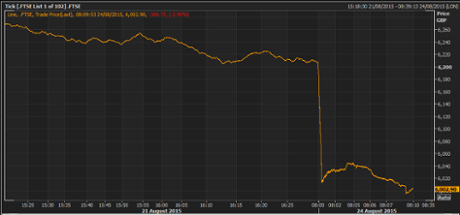
The FTSE 100 just slumped below the 6,000 point mark for the first time since the start of 2013, in rather choppy trading:
Germany’s stock market appears to have crashed into bear market territory, down more than 20% from its recent high.
Looks like a #bear market to me...-20% from April high on German stocks #DAX pic.twitter.com/7Ci4s2h45M
— Caroline Hyde (@CarolineHydeTV) August 24, 2015
Across Europe, stock markets are deep in the red.
Spain’s IBEX is down 3.3%, Italy’s FTSE MIB is down 3.%% and the Portuguese PSI 20 has shed 4.4%.
Germany’s DAX index has fallen by 3%, dropping below the 10,000 point mark for the first time since January.
FTSE 100 plunges 2.8% at the open
Trading is underway in the City, and shares are falling fast.
The FTSE 100 index tumbled 2.8%, shedding 175 points to hit a low of 6012 points.
It’s now settling around 6030 points as traders flood the market with sell orders.
I’m now handing over to Graeme Wearden in London. I’ll be back tomorrow. Thank you.
Just five minutes until the European stock markets open...
FTSE set to open 188 points lower, at 6000. Out of hours Dow around 400 points lower than Friday's close, at 16,057.
— David Jones (@JonesTheMarkets) August 24, 2015
Thailand’s stock exchange has been hit by the global selloff, dropping 3.84%, or 52.43 points, to 1,313.18.
The stock exchange in Thailand also suffered last week following a bomb attack at a Hindu shrine in the capital that killed 20, including tourists. The Thai economy is dependent on tourism revenues, accounting for up to 10% of GDP.
Here’s the official ASX 200 closing figure. Some $70bn has been lost from the market’s overall value, AAP reports, in the index’s worst one-day trading for six years. And it’s now at a two-year low.
Australian Stock Report head of research Chris Conway says the market could go lower if it drops below 5,000 points.
Right now, there is clearly some panic selling occurring and there is little in the way of technical support below the current market price.
Updated
More strong comments from Rajiv Biswas, chief Asia economist for IHS Global Insight, who has been speaking to our man in Beijing. He says that the problem for investors is that the authorities in Beijing aren’t making a very good fist of dealing with this market business. As our the Guardian’s economics guru Larry Elliott wrote last week, it’s as if everyone is realising that China might not have all the answers.
Anyway, here’s what Rajiv has said:
We have seen quite big corrections ever since the middle of June and it has created some policy responses from the Chinese government but up to they have been piecemeal. There hasn’t been any consolidated effort. It is almost as if they don’t really know what to do.
That is adding to the negative sentiment. That is playing out in the stock market and it is also playing out in the commodities markets because as people fear Chinese growth is slowing down more, we are seeing the commodities sector also taking a further [move] downwards.
Updated
Photos: Chinese investors watch 'Black Monday' unfold
There were dark faces across brokerage houses in Beijing today as small investors watched shares tumble, dragging the Shanghai Composite index down over 8% in late trading.


Updated
It’s closing time elsewhere.
The Philippines’ stock market has slumped over 7% today to a 14-month low, amid the global stock market rout.

Updated
Australian market closes down 4% – worst one-day fall for six years
The ASX 200 index was down 213.3 points, or 4.09% lower at 5,001.3. The broader All Ordinaries index was down 210.6 points, or 4.03%, at 5,014.2.
Updated

Money is surging into German government debt, or bunds, this morning, as nervous investors brace for trouble ahead.
Buying bunds is a classic safe-haven trade – they don’t offer a very good interest rate, but you’re pretty well certain to get your money back.
Brutal #stock opening lined up for Europe...futures show 3% slumps in Germany/France & money into havens of German debt #selloff
— Caroline Hyde (@CarolineHydeTV) August 24, 2015
Updated
The Aussie dollar has been sold heavily today. it’s currently buying US72.28c having dropped just over 1% since friday.
And it could get worse, some people think.
Japan's Nikkei posts biggest fall since June 2013
Japan’s Nikkei index has suffered its biggest one-day sell-off in over two years, after a day of hectic selling sparked by growing fears over China.
The Tokyo stock market just closed with the Nikkei down 4.61%, its biggest one-day fall since June 2013.
The Topix index, which includes more smaller Japanese companies, slumped by 5.8%. That puts the Topix into ‘correction territory’, down more than10% since its recent peak.
#Japan | *JAPAN'S TOPIX SLUMPS MOST SINCE MAY 2013 TO ENTER CORRECTION pic.twitter.com/I7g8yy7Ts1
— Ioan Smith (@moved_average) August 24, 2015
Updated
More reaction via our man Tom Phillips in Beijing.
Rajiv Biswas, the chief Asia economist for IHS Global Insight, said Black Monday was one of the strongest signals yet that Beijing was not doing enough to tackle the crisis.
The private money is all trying to get out of the market and what is holding up the market is only the government intervention.
It’s been piecemeal efforts through the course of the year with several small cuts in interest rates, some fiscal stimulus measures scattered around in recent months.
But you haven’t seen any decisive action and there is no sense of determination coming out of policy makers that they want to turn the economy around.
Updated
For you Simpsons fans.
Australia's A&P/ASX 200 is down 3.73% at 5,020
The Australian market has had a shocker. The ASX 200 has closed down nearly 4% for its worst day for four years. It’s now at a two-year low.
Updated
Traders in Europe are bracing for a heavy sell-off when the stock markets open, in one hour’s time.
The FTSE 100 is currently expected to tumble below the 6000-point mark for the first time since the start of January 2013.
Other European markets are heading for a bath – having already tumbled on Friday.
Our European opening calls: $FTSE 5981 down 206 $DAX 9711 down 413 $CAC 4472 down 159 $IBEX 9851 down 421 $MIB 20874 down 872
— IGSquawk (@IGSquawk) August 24, 2015
The slowdown in China, and the surprise devaluation of the Chinese yuan this month, has forced investors into a sharp rethink.
Ian Williams of Peel Hunt, the City stockbrokers, explains:
Earnings-based valuations have retreated dramatically from their previous extended levels; the issue now is the extent to which concerns over global growth hamper the corporate profits outlook.
Updated
Important again to remember that the Chinese market had more than doubled in value in the 18 months or so leading up to June. A 30% fall in recent weeks is not much when measured against a rise of 150% and you could argue it’s a natural correction.
The respected Australian economist Saul Eslake believes the concerns about China, which are reflected in the sell-off there and overseas, are slightly overdone.
He told Guardian Australia that the country’s growing service industry is gradually overtaking the manufacturing sector as a share of GDP. He also noted that the property market in the biggest cities is “stabilising” although the smaller cities were “still weak”.
And he believed that the recent devaluation of the yuan was not an attempt to stimulate flagging exports but was a genuine attempt to reform the forex regime and to try to get ahead of any possible rate cut by the US Fed.
It’s a move to be more flexible ahead of a Fed rate cut. The yuan is up 20% in trade-weighted terms so they wanted wriggle room if the Fed cuts rates and the US dollar rises.
Updated
He adds:
As investors see more selling they also want to get out.
He said the continued panic reflected a lack of faith in Beijing’s attempts to prop up the stock market.
I think the sell down is probably going to continue for the next few sessions.
Updated
More reaction from my colleague Tom Phillips in Beijing, who’s been talking to market experts.
Bernard Aw, a market analyst from IG in Singapore, has used the “P” word.
Risk sentiment is really on the verge of panic which is why we are seeing plenty of red screens.
Updated
Shanghai Composite now down 8.7%
Despite reasons for optimism, the authorities in Beijing are struggling to keep things under control.
The Shanghai Comp is now down 8.7% at 3202. If it closes anywhere below 3233 points, it will have lost all its gains for the year.
Angus Nicholson of IG again:
A disastrous result for China, after working so hard to breathe life back into domestic equities after the 2007 crash and having spent hundreds of billions of dollars propping up the market since June.
Updated
But as Angus Nicholson points out, you could argue that the world economic situation doesn’t really warrant this panic selling.
The current global economic environment does not seem to warrant such a dramatic sell-off. Volumes in global markets are famously thin in August, possibly leading to these outsized moves. Investors will be looking to major news announcements this week that may change sentiment in global markets and provide a floor to these downward moves. Thursday will see the release of US GDP and PCE inflation data, the beginning of the Jackson Hole symposium, and the release of Japanese CPI data. Although if markets continue to decline at this rate until then, we could be seeing an even more serious correction than in 2010 or 2011.
Updated
Angus Nicholson, of IG Markets, has an interesting take on the day’s turmoil. He says the recent annual meeting of the country’s top leadership must have seen some pretty heavy chat about the economy with the country facing a momentous fork in the road.
It is a key moment for China. The equity market in free fall, the banking system increasingly starved of liquidity, rising capital outflows, and a rapidly slowing economy. The annual meeting of the top leadership at Beidaihe has ended (one of the reasons Li Keqiang was delayed in visiting Tianjin), and no doubt there were very serious discussions over how the 7% growth target is going to be met. That target is now looking overly ambitious, and the most sensible way forward would seemingly involve further currency devaluation, further RRR cuts, and stepped up fiscal stimulus.
Updated
Summary
It’s been a torrid day so far on financial markets across the Asia- Pacific on what Chinese media are calling “Black Monday”, in an echo of the infamous global stock market meltdown of 1987.
But the main points are these:
- The Chinese market has plunged 8.45%
- Beijing poised to respond by “flooding the market with cash”
- Markets in Britain, Europe and US set for heavy losses again
- Australian share market suffering worst day in four years
- Taiwan market has had its worst day ever
- Nikkei in Japan down 4.25%
- Oil and copper also hit by sell-off to new six-year lows
Updated
US and European markets set for a hammering again
Stock futures for today’s trading in Europe and the US point to heavy losses again.
The FTSE is pointing to lose more than 200 points and the Dow Jones 400.
Updated
It’s Black Monday with good reason. The Shanghai Composite is down 8.45% today.
Takako Masai, the head of research at Shinsei Bank in Tokyo, said:
Markets are panicking. Things are starting look like the Asian financial crisis in the late 1990s. Speculators are selling assets that seem the most vulnerable.
They’re calling it Black Monday
Taiwan market having worst ever day
China to flood market with cash – report
This could be significant.
The Wall Street Journal is reporting that Chinese authorities have cracked and are about to flood the market with cash to halt the alarming fall in the country’s main stock markets and end jitters about its slowing economy.
This – if it happens – will be the cut in the reserve requirement ratio (RRR) that investors expected to come at the weekend.
The expected move to free up more funds for lending – by reducing the deposits banks must hold in reserve – is directly aimed at countering the effects of a weaker currency, which could send more funds away from Beijing’s shores.
Updated
Not surprisingly, the Hang Seng index in Hong Kong is also having a torrid day, down more than 4%.
In South Korea, another country very exposed to any slowdown in China, the benchmark Kospi index is down by nearly 3%.
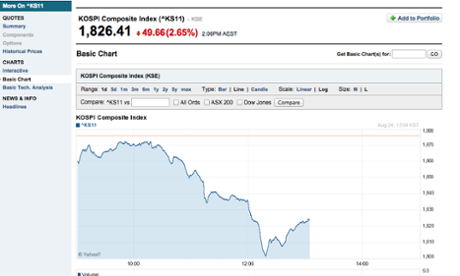
Last week South Korea said exports to China fell nearly 12% in the first 20 days of August from a year ago.
Updated
Gold is doing OK, though, as people seek some shelter from the storm.
It’s close to a seven-week high at $1160.80 an ounce but traders think it could rally to $1200 an ounce, a level last seen in June.
Updated
... and copper.
Updated
It’s not just shares and currencies that are struggling, of course. Commodities are taking a real pounding as expectations of less demand from China weigh on investors.
Oil ...
Updated
Australian dollar falls
More from the other markets around Asia in a minute, but just a quick one on the Australian dollar, which is trading at US72.55 cents, down from 73.02 cents on Friday.
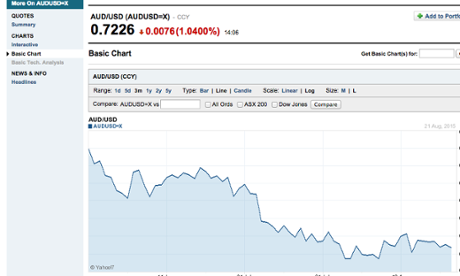
Stephen Innes, of Oanda Australia and Asia Pacific, said the Aussie was again being hit by concerns about a weaker Chinese economy having a knock-on effect on Australian exports.
Updated

Updated
Nikkei in Japan now down 4.25%
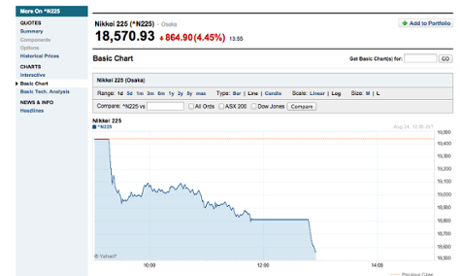
Updated
BlueScope may cut at least 500 steel jobs
Away from the markets – but still with China – and the Australian steel producer BlueScope says it might have to shed 500 jobs because weakening demand from the world’s second biggest economy had created massive oversupply.
The Port Kembla-based company said the future of the steel works was “on a knife-edge”.
The chief executive, Paul O’Malley, said demand in China had grown nearly six-fold in 15 years but had recently plateaued, moving the country’s producers to treble exports on 2010-14 levels. He said prices had fallen 46% in that time and a third of global capacity was sitting unused.
When there’s oversupply and a shortage of demand – and the equivalent of an extra 50 Port Kemblas on the market globally – you know you have to respond to international competitive pressures.
Updated
One of the biggest fallers has been Andrew Forrest’s Fortescue Metals Group.
Its shares have plunged 12.79% after the company announced a 88% fall in profits this morning on the back of plunging iron ore prices.
That’s an ugly figure and while the company expects things to look up in the current year when the benefits of hefty cost-cutting kicks in, FMG’s huge exposure to China does not help. Not long ago Forrest was talking gamely about how China’s demand for iron ore felt limitless.
Australian Mining reported him last year as saying:
A bet against China is the only guarantee of loss I’ve seen for a long time ... 400m people still have to be urbanised.
That view is obviously being quite strenuously tested now as assumptions about growth in China are reassessed.
Updated
Biggest one-day fall in Australia for four years
It’s the biggest one-day fall since September 2011 on the Australian market, according to AAP, and it’s taken a whopping $60bn off the overall market value.
Updated
For a good summary of where we’re at across the region today, my colleague Justin McCurry has sent this dispatch from Tokyo. Here’s how he starts:
Fears of a slowdown in the Chinese economy sent Asia-Pacific stocks plummeting on Monday, days after Wall Street suffered its biggest one-day loss in almost four years.
Updated
Worth remembering, though, that the Chinese stock market had risen a massive 150% in the past 18 months. In that context a drop of 30% in the past couple of months is nothing to be worried about.
After all, the optimists say, the country is still growing by as much as 7% (maybe 4% if you don’t believe the figures), the service sector is beginning to make up for an admittedly weakening manufacturing sector and there are still millions of people to bring out of poverty.
As the American economist Nicholas Lardy told the Australian:
The sceptics have taken insufficient notice of China’s progress in transitioning to its new model of economic growth, one less dependent on expanding industrial output, investment and exports and more dependent on expanding private consumption expenditure.
Updated
'There's no good news'
An analyst in Shanghai, Qi Yifeng, at consultancy CEBM, put it quite pithily to Reuters:
The market is in a downtrend. There’s no good news, stocks are still expensive, and there’s no fresh money coming in. With no RRR [reserve requirement] cut over the weekend, the market will directly head south.
Updated
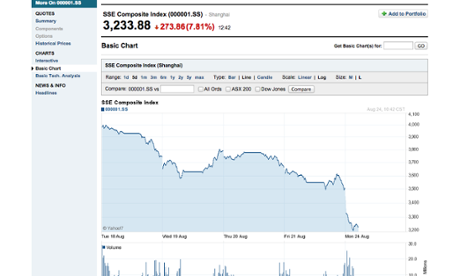
After starting to devalue the yuan two weeks ago caused further selling on its main stock exchanges, investors expected Beijing to introduce some more calming measures at the weekend.
But despite new rules allowing pension funds to invest in the stock market – quite a good idea on the face of it and another step towards reforming the financial system in China – the market has been sold heavily today and is down 7.92%.
Updated
Seems sensible to look first in more depth at what’s happening in China this morning given that most people agree that’s where the problems are stemming from.
For an expert analysis of the background I can point you to the Guardian’s economics brains trust of Larry Elliott and Philip Inman who wrote at the weekend about how concerns about China’s slowing economy will spread to other emerging markets. Here’s a snippet.
The problem is a relatively simple one. In the post-great recession world, the tendency has been for all countries to try to export their way out of trouble. But this model works only if the exports can find a home, as they did when China was growing at double-digit rates.
But in the past 18 months, the Chinese economy has slowed, causing problems for two distinct groups of emerging-market economies: the east Asian countries that sell components and finished goods to their big neighbour, and countries that supply China with the fuel and raw materials to keep its industrial machine going.
Updated
Summary
It’s pretty grim out there so I’ll set out the main points so far:
- The ASX200 in Australia fell 2.4% at the opening. It’s now down 2.89%.
- The Shanghai Composite is down 8.6%.
- The Nikkei in Japan is down more than 3%.
- In commodities, Brent and US crude are at new six-year lows.
- Copper and aluminium also at six-year lows.
- The yuan was weaker at the opening, despite a firmer setting for the day.
- The Malaysian ringgit down 0.9% at a 17-year low against the US dollar.
- Gold has continued its comeback though and is at a seven-week high.
Hold on to those hats.
Updated
Global rout intensifies
Good afternoon and welcome to the markets live blog. It’s been a very lively morning across the Asia-Pacific region following on from last week’s China-inspired heavy selling here and on Wall Street and in Europe on Friday.
Stock markets, commodities and currencies are being smashed.
Updated