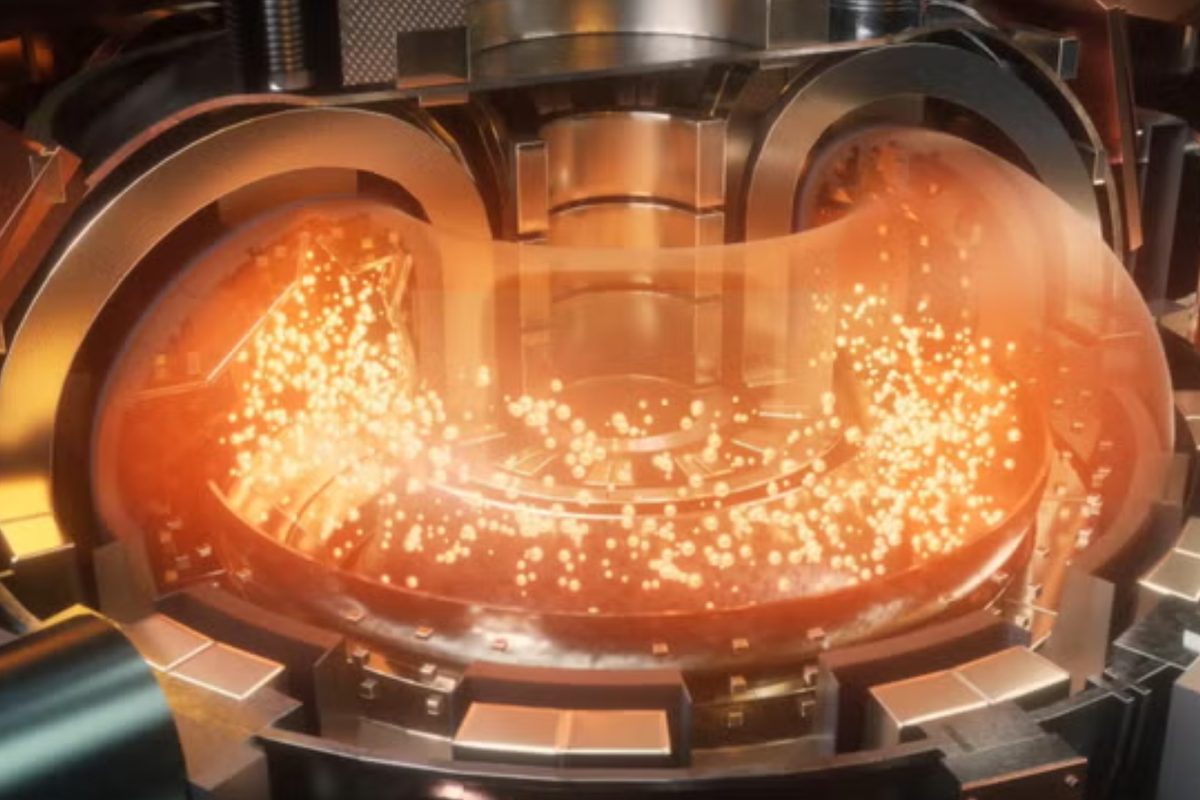
Scientists in China have made a breakthrough with fusion energy that could finally overcome one of the most stubborn barriers to realising the next-generation energy source.
A team from the Chinese Academy of Sciences (CAS) said its experimental nuclear reactor, dubbed the ‘artificial Sun’, achieved a plasma density that was previously thought impossible.
Nuclear fusion holds the potential to produce near-limitless energy without leaving behind hazardous waste, with some heralding it the “holy grail” of clean energy.
It mimics the same natural reactions that occur within the Sun, though it has proved immensely difficult to achieve it at scale.
There have been several major breakthroughs in recent years, including milestones achieved at CAS’s Experimental Advanced Superconducting Tokamak (EAST).
Last year, CAS successfully ran its artificial Sun reactor for more than 1,000 seconds for the first time –a record that was subsequently broken by France’s WEST machine.
Both experiments were limited by the theoretical ceiling on density, known as the Greenwald Limit, which causes fuel – or plasma – to become unstable at a certain level.
Through a new process called plasma-wall self organisation, the CAS researchers were able to keep the plasma stable at unprecedented density levels.
By pushing plasma density well past long-standing empirical limits, the researchers said fusion ignition can be achieved with far higher energy outputs.
“The findings suggest a practical and scalable pathway for extending density limits in tokamaks and next-generation burning plasma fusion devices,” said Professor Ping Zhu from Huazhong University of Science and Technology, who so-led the research.
Professor Zhu’s team now plan to apply this new method on the EAST reactor to confirm that it will work under high-performance plasma conditions.
The latest breakthrough was detailed in the journal Science Advances in a study titled ‘Accessing the density-free regime with ECRH-assisted ohmic start-up on EAST’.
Practical power production through nuclear fusion still requires significant developments for it to be realised at scale, though several startups are already planning to deliver it within the next few years.
US-based Helion Energy secured the world’s first purchase agreement for nuclear fusion energy in 2023, promising to provide 50MW of fusion power to Microsoft by 2028.
Lego launches ‘revolutionary’ new product
From an AI companion to a stair-climbing robot: The coolest technology from CES day 2
Spotify will let you see what friends are listening to while you talk to them
Should you leave chargers plugged in all the time? An expert explains
Elon Musk declares Grok to be ‘on the side of angels’ amid X undressing scandal